On this page
Gemini 4 Argon is Google's new frontier model. Announced on September 30, 2026, it opened on October 13 to developers through the Gemini API and to Google AI Pro and Ultra subscribers, in the Gemini app and in AI Mode, the conversational mode of Google Search. For a brand, the question is not whether it codes better than GPT-6 Astra. It is whether it talks about you the way the previous model did. A new model is a new engine: your citations can move without you touching your site. Gemini 4 Argon is already available in Citeme, so you can audit your brand on it today.
Key takeaway: Gemini 4 Argon now answers in the Gemini app and in AI Mode for paying subscribers, but Google says nothing about AI Overviews. Google's surfaces can therefore give different answers about your brand. The only way to know is to measure before and after, engine by engine. Gemini 4 Argon has been available in Citeme since launch.
Gemini 4 Argon at a glance
Here is what we know as of October 13, 2026, from Google's two announcements and the tech press.
| Item | What we know |
|---|---|
| Announcement | September 30, 2026, by Koray Kavukcuoglu (Google DeepMind), first for cybersecurity experts in the Fairwind Program |
| General release | October 13, 2026, rolling out "globally" according to Google |
| Positioning | Coding, enterprise knowledge work (finance, legal), cyber defense, long multi-step reasoning; Google also cites creative writing, chart analysis, long video and acting across multiple documents |
| Token limit | 1 million tokens through the API, a unified input and output limit; output was previously capped at 64,000 tokens |
| API pricing | $2 per million input tokens and $10 per million output tokens until November 30, 2026, then $4 and $20; cached input 95% off |
| API model ID | gemini-4-argon, on the paid tier of the Gemini API |
Google dropped the Gemini 3.5 Pro it had planned this year and went straight to the fourth generation. Its most recent launches had been Flash models, including Gemini 3.8 Flash.
In short: Gemini 4 Argon, announced on September 30, 2026 and released on October 13, 2026, targets coding, enterprise work and cyber defense. The API offers 1 million tokens at $2 per million input tokens and $10 per million output tokens until November 30, 2026.
Where to use Gemini 4 Argon, and who has access
Access depends on the surface. The free tier is not included for now: you need a Google AI subscription or a paid API account.
| Surface | Access as of October 13, 2026 |
|---|---|
| Gemini app | Google AI Pro and Ultra subscribers |
| AI Mode in Google Search | Google AI Pro and Ultra subscribers |
| AI Overviews | Not mentioned by Google |
| Gemini API, AI Studio | Paid tier, model gemini-4-argon |
| Enterprises | Gemini platform and Gemini for business |
| Antigravity, Android Studio | Google AI Ultra subscribers |
| Cyber defense | A version without cyber guardrails, reserved for Fairwind Program partners |
In the app, according to Josh Woodward, VP of Product for Gemini and Google Labs, as reported by Engadget, the model answers faster, with less hedging, repetition and cliché. It can also return a partial answer while it works on a long task.
In short: Gemini 4 Argon is available in the Gemini app and AI Mode for Google AI Pro and Ultra subscribers, and on the paid tier of the Gemini API. The free tier is excluded, and Google says nothing about AI Overviews.
What the benchmarks say
The most quoted numbers come from Google itself. Two independent sources partly back them up.
| Area | Benchmark | Result |
|---|---|---|
| Coding | DeepSWE v1.1, real software engineering tasks | 77.9%, versus 74.2% for Claude Opus 5.5 and 74.1% for GPT-6 Astra (Google's figures, reported by 9to5Google) |
| Agents | Zapier's AutomationBench, multi-step automations | 51.3%, first place |
| Video | LVBench, long video understanding | 91.7% |
| Cybersecurity | CWE-bench v1, vulnerability fixing | 68%, tied for first |
| Independent | Vals Index (finance, coding, legal, tax) | First |
| Independent | Artificial Analysis Intelligence Index | On par with GPT-6 Astra, at about 60% of the cost per task at introductory pricing |
A coding benchmark says nothing about how a model chooses the brands it recommends. For a company that wants to be cited, these numbers place the model without predicting what it will say about you.
On safety, Google says it applies its Frontier Safety Framework: refusals for risky cyber requests and for chemical, biological, radiological or nuclear ones, monitoring of the model's reasoning and actions with the ability to stop them, and a pause before any irreversible step when it acts as an agent. Google also takes part in the US government's voluntary pre-release model access process.
In short: On Google's figures, Gemini 4 Argon scores 77.9% on DeepSWE v1.1, ahead of Claude Opus 5.5 and GPT-6 Astra, and ranks first on the independent Vals Index. Coding benchmarks do not predict which brands the model will cite.
What Gemini 4 Argon changes for your brand's visibility
For generative engine optimization (GEO), the work of getting cited by AI engines, the same question asked to the same Google product can now get a different answer.
A new model means new citations
Engines do not cite the same brands, and the gap is measurable. Across roughly 2,000 queries run against the engines for the brands we monitor at Citeme, those brands are cited in 13% of answers. The rate ranges from 17% on Anthropic to 11% on Perplexity, and stands at 16% on Gemini, measured before Argon arrived.
Our own site shows how unpredictable these gaps are. Anthropic is our weakest engine there, at 2%, while it is the most favorable across the brands we monitor. Nothing guarantees that Gemini 4 Argon keeps its predecessor's ranking: the 16% measured so far on Gemini is a starting point.
Several Google surfaces, possibly several answers
Google is opening Argon in the Gemini app and in AI Mode, but says nothing about AI Overviews, the generated summaries at the top of classic results. As long as that holds, a Pro subscriber asking Gemini and a searcher reading the AI Overview for the same query may see different brands. You need to track both separately, which is what our GEO audit does by treating Gemini and AI Overviews as two distinct engines.
More direct answers, to be measured
Google promises less hedging and repetition. A more decisive answer could cite fewer brands, or put more weight on the first one. We do not yet have enough measurements on Argon to confirm it. All the more reason to look at position, not just presence: our audits record the rank at which each brand is named in the answer.
Hidden tricks in pages work even less
Google presents Argon as its most resistant model yet to indirect prompt injection, the instructions hidden in a web page to manipulate the AI that reads it. On the Gray Swan benchmark, the attack success rate drops to 0.7% across 15 adaptive attempts. The direct consequence: invisible text and hidden instructions aimed at bots are even less likely to work with this model.
In short: Gemini 4 Argon may cite different brands than its predecessor: Citeme measured a 16% citation rate on Gemini before Argon. Gemini and AI Overviews should be tracked separately, and hidden instructions in pages are even less likely to work.
Gemini 4 Argon in Citeme
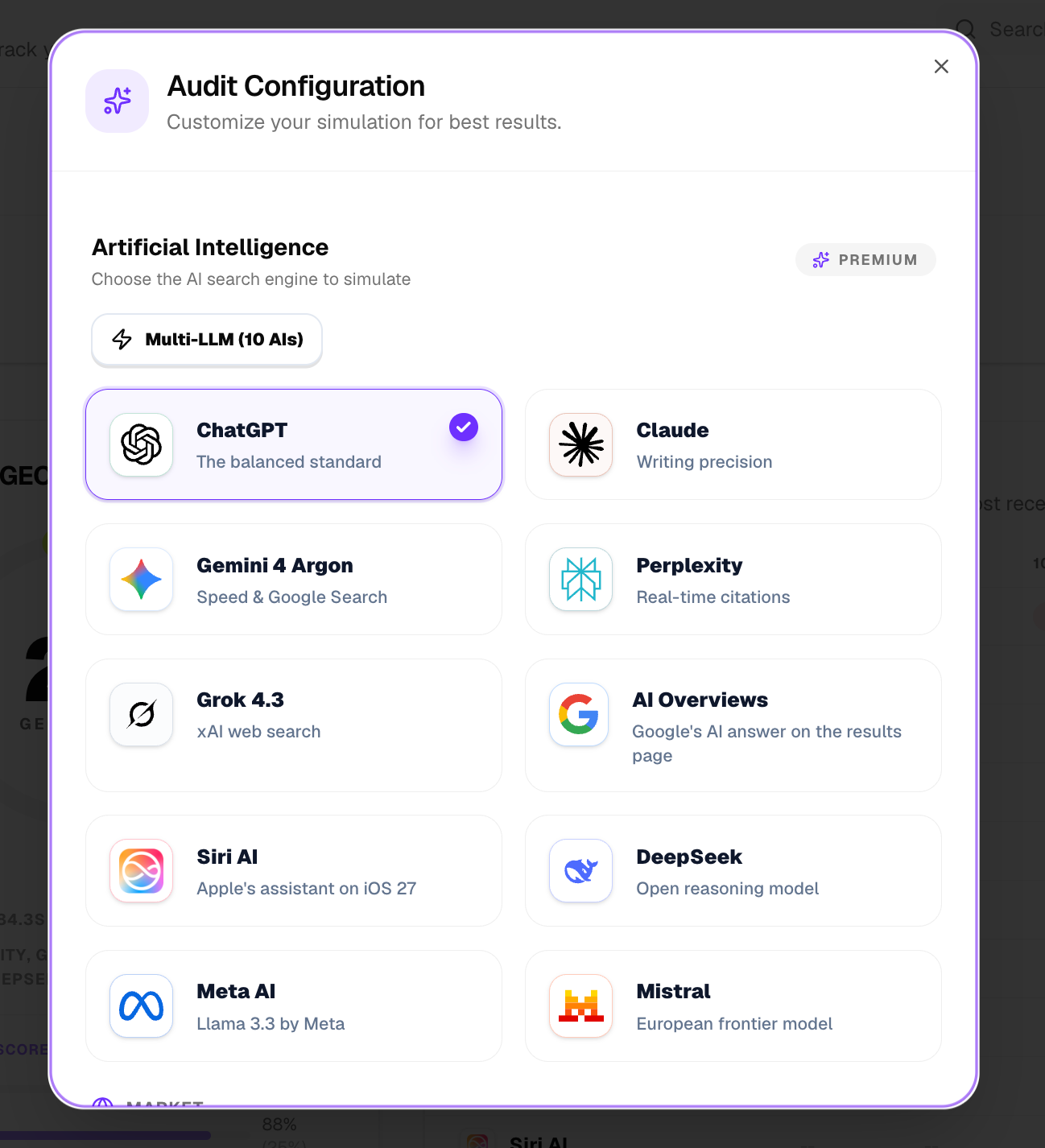
Gemini 4 Argon is available in Citeme. In the audit configuration, it is one of the ten engines: you can query it on its own, or alongside the nine others in Multi-LLM mode. Your usual prompts stay the same.
Since every audit is kept, you can then compare with your previous results on Gemini. A single audit tells you where you stand; the history tells you what the model change won or lost you.
The platform also tracks the nine other engines, including Google AI Overviews, so you can see whether Gemini and AI Overviews diverge on your queries. AI Mode is not tracked at this point. Competitive monitoring shows, alongside, which competitor is cited when you are not.
In short: Gemini 4 Argon is one of the ten engines in Citeme, our product, queried alone or in Multi-LLM mode. Saved audits show what the model change won or lost on Gemini, next to AI Overviews; AI Mode is not tracked yet.
What to do in the coming weeks
- Lock in your baseline. Record your current citation rate on Gemini and on AI Overviews, query by query, before Argon's answers blend into the history.
- Rerun your key prompts on Argon. Buying questions first: "best X for Y", comparisons, alternatives to a competitor.
- Compare Gemini and AI Overviews on the same queries, to spot where the two surfaces diverge.
- Look at who is cited instead of you. If a competitor gains citations on Argon, its cited pages tell you what content the model prefers.
- Measure again in two to three weeks. Answers vary from one run to the next: a single measurement is not enough to conclude.
To start with no commitment, use our AI visibility checker: the 3-day trial costs €1.
In short: After the Gemini 4 Argon release, record your current citation rate on Gemini and AI Overviews, rerun buying prompts on Argon, compare both surfaces, study who is cited instead of you, and measure again in two to three weeks.
FAQ
What is Gemini 4 Argon?
Gemini 4 Argon is Google's frontier model and the first of the Gemini 4 generation. Announced on September 30, 2026 by Google DeepMind, it is built for coding, enterprise knowledge work, cyber defense and long multi-step reasoning. It has been open since October 13, 2026 to developers and to Google AI Pro and Ultra subscribers.
Is Gemini 4 Argon free?
No, not for now. In the Gemini app and in AI Mode, it is reserved for Google AI Pro and Ultra subscribers. Through the API, it costs $2 per million input tokens and $10 per million output tokens until November 30, 2026, then $4 and $20.
Is Gemini 4 Argon available in Citeme?
Yes. Gemini 4 Argon is one of Citeme's ten engines, alongside ChatGPT, Claude, Perplexity, Grok, Google AI Overviews, Siri AI, DeepSeek, Meta AI and Mistral. You select it in the audit configuration, on its own or with the other engines, and compare its answers with your previous results on Gemini.
Does Gemini 4 Argon power AI Overviews?
Google does not say. Its announcements of September 30 and October 13, 2026 mention the Gemini app and AI Mode, not AI Overviews. Answers in AI Mode and in AI Overviews may therefore differ for the same query, and it is better to track them separately.
Will Gemini 4 Argon change my visibility in Google?
It can, in either direction. Each model has its own source preferences, and the gaps between engines are large: across the brands we monitor, the citation rate ranges from 11% to 17% depending on the engine. The only way to know what Argon does for your brand is to compare your citations before and after, on the same queries.
How do I know if Gemini 4 Argon cites my brand?
You can ask your key questions in the Gemini app with a Pro subscription, but the result will not be reproducible, since the answer changes from one time to the next. In Citeme, select Gemini 4 Argon in the audit configuration: your prompts are asked at every audit and the results are kept, which lets you tell a real change from simple variation.
Sources (6)
- 1Gemini 4 Argon: our next era of frontier intelligence
- 2Gemini 4 Argon: Built to solve your hardest problems
- 3Google's Gemini 4 Argon is now available in the Gemini app and AI Mode in Search
- 4Google announces Gemini 4 Argon as its new frontier model
- 5Google releases Gemini 4 Argon, called its most powerful model yet
- 6Gemini 4 Argon Benchmarks, Cost and Capabilities

Written by
Alexandre Teillet · CEO, CitemeCEO of Citeme, leading the brand's content and AI visibility strategy across answer engines.