On this page
To get your brand cited in Google AI Overviews, start with ordinary Google eligibility: your page has to be indexed and eligible to show a snippet in Google Search, because AI Overviews draw their sources from Google's index. Google says there are no extra requirements and no special markup. Past that baseline, citations go to pages that rank for the questions behind the overview, answer them in a short passage Google can quote, keep their structured data and dates consistent, and belong to a brand other sites talk about.
In short: there is no AI Overviews switch to flip. Be indexable, rank, write answers that can be lifted as they are, and build a presence beyond your own site, including on the platforms AI Overviews cite most.
Where do AI Overviews get their sources?
AI Overviews are built on Google Search. They do not crawl a separate web or read a special file. Google's guide to optimizing for generative AI features says these features rely on Google's core ranking and quality systems, and that retrieval targets relevant, up-to-date pages from the Search index.
One mechanism explains why the cited pages are not always the top ten results for the query you typed. Google's page on AI features and your website says AI Overviews and AI Mode may use query fan-out, "issuing multiple related searches across subtopics and data sources" to build an answer. A page that ranks well for one of those sub-queries can be cited even if it is not visible for the main query.
In short: AI Overviews cite pages from Google's index, picked through related sub-searches. Your SEO foundations decide whether you are even in the pool.
What does Google officially say about appearing in AI Overviews?
Google has written down more than most people realize. Here is what its Search Central documentation states, checked on 4 November 2026.
- No extra requirements. Google states "There are no additional requirements to appear in AI Overviews or AI Mode, nor other special optimizations necessary."
- No special schema. Google says there is no special schema.org structured data you need to add.
- Eligibility is the snippet. A page must be indexed and eligible to be shown in Google Search with a snippet.
- Structured data must match the page. Google asks site owners to make sure their structured data matches the visible text.
- No AI text files needed. The optimization guide says Google Search does not use llms.txt or similar files, and ignores them.
- Snippet controls apply. According to Google's robots meta tag documentation,
nosnippetprevents content from being used as a direct input for AI Overviews and AI Mode, andmax-snippetlimits how much of it can be used. - Reporting exists. Traffic from AI features is counted in the Search Console Performance report under the Web search type, and Google has a separate Generative AI performance report that shows impressions for AI Overviews and AI Mode.
Two points deserve a closer look. First, Google-Extended is not the AI Overviews switch. Google describes it as a control for AI training and grounding in some of its other systems. AI Overviews are part of Search, so the controls that matter are the Search ones: Googlebot access, noindex and the snippet directives.
Second, Google says there is no need to break content into tiny pieces for AI. We agree that you should not chop a good page into fragments. We still write a short, direct answer under each question heading, because it helps the reader first and makes the passage easy to quote. That is our editorial practice, not a Google rule.
In short: Google's line is simple. Same SEO, no special markup, snippet eligibility required, and snippet directives also govern AI Overviews.
Which levers actually get you cited?
Everything below sits on top of standard SEO. None of it guarantees a citation, and Google itself says indexing and serving are not guaranteed. These are the levers that follow from how AI Overviews pick their sources, once the foundations are in place.
1. Indexation and crawl access
Check the basics before anything else. Googlebot must be allowed in robots.txt and must not be blocked by a firewall or bot-protection rule. Use the URL Inspection tool in Search Console to confirm that the page is indexed and that the rendered HTML contains your main text. A page Google has not indexed cannot be cited, however good it is.
2. Rank for the sub-questions, not only the head query
Because of fan-out, list the questions that sit around your main topic: definitions, comparisons, prices, steps, pitfalls. Make sure you have a page, or a clearly labelled section, that ranks for each of them. A single long page can cover several sub-questions if each one has its own heading.
3. An answer passage under each question
Phrase your H2 headings as the question a searcher would ask. Directly under each one, give the answer in roughly 40 to 60 words, in a paragraph that still makes sense if it is read alone. Then expand with details, examples and numbers. The first sentence should contain the words of the question, so the match is obvious.
Compare two openings for "How long does a kitchen renovation take?". "Every kitchen is different, and many factors come into play" says nothing quotable. "A full kitchen renovation usually takes 6 to 12 weeks, from demolition to final inspection, with cabinet delivery as the most common delay" can be lifted as it stands (the numbers here are only an example of form).
4. Structured data that agrees with the text
Structured data is not required, but if you use it, it must say the same thing as the visible page. A price, a rating or an author in the JSON-LD that contradicts the text gives Google two versions of the same fact, which is exactly what its guidance asks you to avoid. Our AI schema checker flags mismatches and missing fields.
5. Freshness you can see
Google says retrieval targets up-to-date pages. Show a visible "updated" date, keep dateModified in your markup consistent with it, and only change the date when the content really changes. Revisit pages with prices, rankings or yearly figures on a fixed schedule.
6. Authority and third-party mentions
Pages from brands that other sites cite, review and compare tend to rank better, and ranking is the entry ticket. Google also warns that "seeking inauthentic 'mentions' across the web isn't as helpful as it might seem." Paid mention farms are a waste. Real coverage, real reviews, a place in industry comparisons and partner pages are what count.
7. Presence on the platforms AI Overviews cite
AI Overviews do not only cite websites. In our own tracking panel at Citeme (our project for citeme.io, last 30 days to 3 November 2026), 15% of the sources cited by Google AI Overviews were social platforms such as YouTube, Reddit and LinkedIn. For ChatGPT, Gemini, Claude and Perplexity, the same share was 2% or less.
That is one panel, not a census of Google. It still points to a practical consequence: for AI Overviews, a useful YouTube video, a well-answered Reddit thread or a substantial LinkedIn article on your topic can be a citation path in its own right. Post where your buyers already ask questions, under your real name and brand, with answers worth quoting.
In short: be crawlable and indexed, rank for the sub-questions, answer each one in a short self-contained passage, keep markup and dates honest, and earn mentions on other sites and platforms.
How do you measure whether AI Overviews cite you?
You measure it query by query. Start with two questions: which of your target queries trigger an AI Overview at all, and which sources does each overview cite?
The manual way is to search your list of queries in a clean browser session, in the country you sell to, and note for each one whether an overview appears, which domains it cites, in what order, and whether you are among them. Results vary with location, device and time, so repeat the check rather than trusting a single screenshot.
Search Console gives you the other side. The Generative AI performance report shows how many impressions your links got in AI Overviews and AI Mode, by page, country, date and device. It tells you that you were shown. It does not tell you who was cited instead of you.
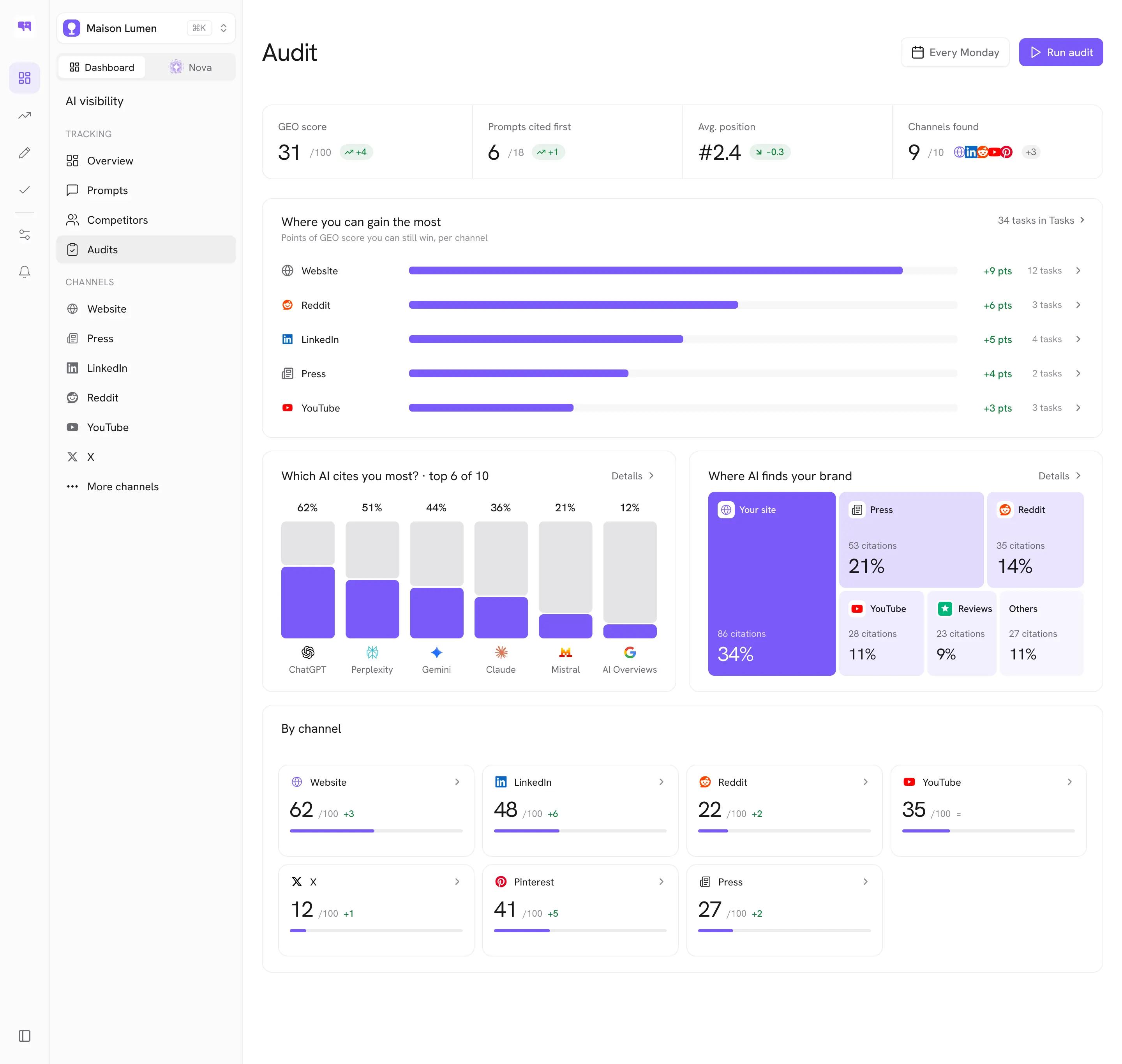
A Citeme audit shows which engines cite the brand, AI Overviews included at 12%, and where they find it: the site, press, Reddit, YouTube and reviews.
Our AI Overviews Tracker reports four metrics on your own queries:
| Metric | What it measures | Why it matters |
|---|---|---|
| Trigger rate | Share of your tracked queries that show an AI Overview | Queries without an overview are still decided by classic rankings |
| Citation rate | Share of those overviews that cite your domain | Says whether the surface works for you |
| Citation rank position | Where your link sits in the list of sources | The first sources are the most visible |
| Competitor share of voice | Share of all citations going to each brand | Moves when a rival publishes |
The tracker runs inside the Citeme app, which is our product. You can use it during the 3-day trial for $1, with a payment method required. Ongoing tracking starts at $69 per month (excl. tax) on the Starter plan, which covers 50 prompts tracked every day on 3 engines of your choice, Google AI Overviews included. Google AI Overviews has no public API, so Citeme captures it from the results page. For each citation won or lost, it shows the exact query where it happened. Details are on the pricing page.
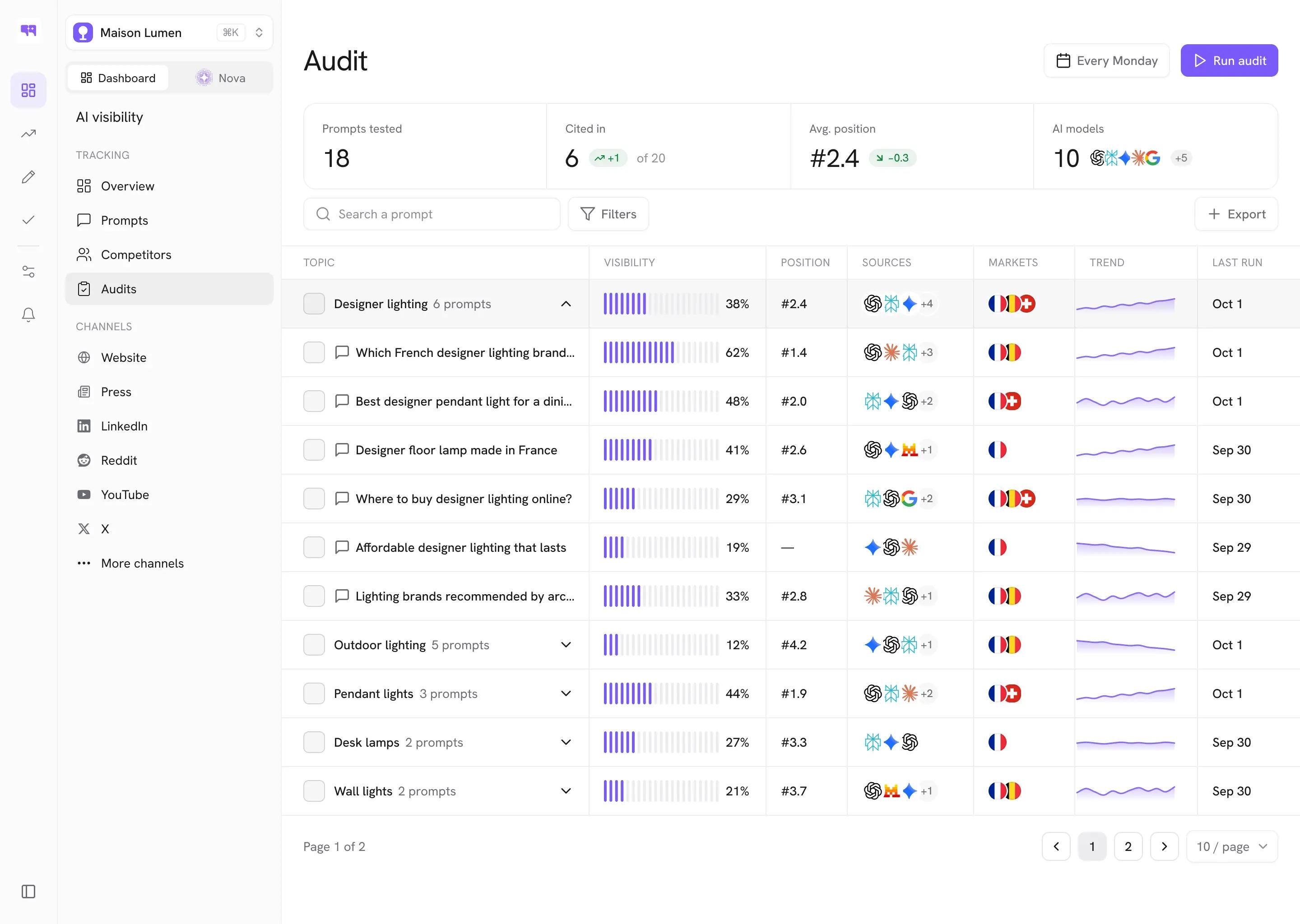
Tracked prompts in Citeme, grouped by topic, with visibility, average position, citing engines, markets and the date of the last run.
In short: check trigger rate and citations on your own queries, read Search Console's Generative AI report for impressions, and track competitors to see who takes the spot when you do not.
Which mistakes keep brands out of AI Overviews?
When a good page is never cited, the cause is often mundane rather than editorial.
- Blocking Googlebot by accident. A robots.txt rule meant for other bots, or a bot-protection setting on the CDN, can stop Googlebot too. Check both.
- Main content that only appears after JavaScript runs or after a click. Google says it can process JavaScript as long as it is not blocked, but content hidden behind tabs, accordions loaded on demand or a client-side app is easy to lose. Confirm in URL Inspection that the rendered HTML contains the text you want quoted.
- A leftover
nosnippetormax-snippet:0. These directives also apply to AI Overviews. They are often added by a plugin or a past legal request and forgotten. - A
data-nosnippetwrapper around the whole article body, which keeps that text out of snippets. - A
noindexcopied from a staging site to production. - Structured data that contradicts the page, such as an old price in the markup and a new one in the text.
- Answers buried under a long introduction, so no passage answers the question on its own.
- Expecting llms.txt or Google-Extended to change anything in AI Overviews. Google says Search does not use llms.txt, and Google-Extended does not govern Search features.
Our AI citability checker reviews how quotable your passages are, and our guide to generative engine optimization covers the same work across the other AI engines.
In short: before rewriting anything, rule out a blocked Googlebot, hidden content, stray snippet directives and markup that disagrees with the page.
FAQ
Do I need special markup to appear in Google AI Overviews?
No. Google states that there is no special schema.org structured data to add and no additional technical requirements for AI Overviews or AI Mode. The page must be indexed and eligible to show a snippet in Google Search. Structured data can still help with rich results, and if you use it, Google asks that it match the visible text on the page.
Does ranking first on Google guarantee an AI Overview citation?
No. AI Overviews can use query fan-out, running related searches across subtopics, so the cited pages are not always the top results for the query typed. A first-place page with no clear answer passage can be skipped, and a page ranking lower on a sub-question can be cited. Ranking well raises your chances, it does not settle the outcome.
Can I keep my pages in Google but out of AI Overviews?
Only partly, and at a cost. The nosnippet directive stops your content from being used as a direct input for AI Overviews and AI Mode, but it also removes the text snippet from your regular search results. max-snippet limits how much text is used in both. Google-Extended does not control AI Overviews. There is no setting that removes you from AI Overviews alone while leaving classic results untouched.
Where do I see AI Overviews traffic in Search Console?
Clicks and impressions from AI Overviews and AI Mode are included in the Performance report under the Web search type, mixed with regular results. Google also offers a Generative AI performance report that isolates impressions of your links in AI Overviews and AI Mode, broken down by page, country, date and device. It does not show which competitors were cited alongside you.
Is AI Mode different from AI Overviews?
They are two separate features, but Google applies the same guidance to both: no extra requirements, the same snippet eligibility and the same controls. AI Overviews appear above the classic results on a normal search. AI Mode is a conversational search experience where the user asks follow-up questions. Both can use query fan-out, so the work described in this guide serves both.
How long does it take to get cited in AI Overviews?
There is no fixed delay, and anyone quoting one is guessing. A page must first be crawled and indexed, then rank for the right queries, then be picked for a given overview. A technical fix such as removing a stray nosnippet can show results as soon as Google recrawls the page. Gaining authority on a competitive topic takes months. Track your queries before and after each change so you know which one moved the result.
Sources (5)

Written by
Alexandre Teillet · CEO, CitemeCEO of Citeme, leading the brand's content and AI visibility strategy across answer engines.