Answer engine optimization (AEO) is the practice of structuring content so that AI answer engines can extract a passage from it and quote it as a direct answer. Where search engine optimization works to place a page in a list of links, AEO works to have that page named inside the answer itself, on ChatGPT, Claude, Perplexity, Google AI Overviews and voice assistants.
One clarification before going further, because the acronym is shared. This guide covers AEO in marketing. AEO also designates the Authorised Economic Operator, a customs status with no connection to search, which has its own terminology.
For twenty years, being visible online meant one thing: ranking in the top results of a search engine. That era is not over, but it is no longer the only one that matters. A growing share of searches now ends without a single click, inside an answer generated by AI. If your content is not built for answer engines, it simply becomes invisible in this new search experience. AEO is the discipline that answers that shift.
What is Answer Engine Optimization (AEO)?
Answer engine optimization is the practice of structuring content so an AI answer engine can lift a passage from it and cite that passage as a direct answer. Answer engines do not return a list of pages: they analyze, synthesize and produce the answer themselves, naming a handful of sources along the way, so the goal shifts from earning the click to being the source the engine quotes.
In practice, effective AEO produces situations like these: a voice assistant reading a definition pulled from your article, a Google AI Overview synthesizing a response from several sources including yours, or Perplexity attributing a factual claim to your page by name. In each case your brand gains AI visibility and authority even when nobody visits your site.
Remember this sentence, because it explains everything: LLMs do not rank, they select. A traditional search engine orders links from most to least relevant. An answer engine instead hunts for the clearest, most trustworthy passages to build a single response. AEO is the work of becoming one of those passages.
Why does AEO matter in 2026?
AEO matters in 2026 because search behavior changed faster than content strategy did. Google rolled out AI Overviews at scale, which mechanically lowers the click-through rate on organic search results. In parallel, tools like Perplexity and ChatGPT now handle hundreds of millions to billions of queries every month: Perplexity reported 780 million in May 2025, and ChatGPT receives 2.5 billion prompts a day. People ask full questions and expect a direct answer.
This creates a paradox for many brands: their SEO traffic can look fine while their presence in AI answers is zero. They rank on Google but are absent from the conversation happening inside ChatGPT or Gemini. That blind spot is exactly what AEO fills. Being cited by an answer engine is becoming an authority signal at least as important as a position in the blue links.
There is also a leveling effect worth noting. A lesser-known but precise, reliable, well-structured brand can get cited by Perplexity ahead of a large but poorly structured site. The barrier to entry is not raw fame, it is the quality of your structure and information. For small teams and independents, that is a genuine window of opportunity.
AEO vs SEO vs GEO: what is the difference?
All three disciplines share one goal, making content visible, but they aim at different targets. SEO (search engine optimization) aims for a position in traditional organic search results, shown as clickable links. It relies on technical signals, backlinks, and the match between content and a keyword's search intent.
AEO shifts the target: the point is no longer to be listed but to be the answer produced by a conversational assistant or an AI Overview. GEO (generative engine optimization) is the newest and most specific term. It focuses only on generative engines and on how content is chunked, analyzed semantically, and weighted to build a generated answer. In everyday use, many practitioners treat AEO as the umbrella term that covers GEO.
| Criterion | SEO | AEO | GEO |
|---|---|---|---|
| Target | Traditional search engines | AI answer engines (voice and text) | Generative engines (LLMs) |
| Desired result | Position in a list of links | Citation in a direct answer | Inclusion in generated text |
| Priority signals | Backlinks, keywords, technical | Clarity, structure, authority, trust | Semantic coherence, segmentation |
| Maturity | Very established | Growing fast | Emerging |
The short answer: SEO targets a rank, AEO a citation inside an answer, GEO the text a generative model produces. They compound rather than compete, because content that is technically clean for SEO is a strong base for AEO, and the rigor GEO demands lifts overall quality. What changes between them is the definition of success. We break the three apart in detail, with measured citation data, in the difference between AEO, GEO and SEO.
How do answer engines actually work?
Answer engines work on fragments, not on pages: they retrieve a document, split it into chunks, score each chunk against the query, and quote the ones that answer it on their own. A clear paragraph that settles the question in its first sentence is a candidate; a block mixing three ideas behind a marketing intro is not, and a section that only makes sense after the section above it never becomes one.
An answer engine does not read your page like a human. It retrieves the page through a crawl or an API, then splits it into semantic fragments called chunks, usually a paragraph, a list, or a question-answer block. Each chunk is converted into a vector and compared to the query. The closer and more self-contained a fragment is, the likelier it gets selected. This is the logic of RAG, retrieval augmented generation.
This has a direct consequence for writing: the rule of one idea per paragraph is not a style tip, it is a technical signal. A paragraph that develops a single idea clearly can be extracted and cited as is. A catch-all paragraph gets ignored, even when the information inside it is excellent.
How do answer engines choose what to cite?
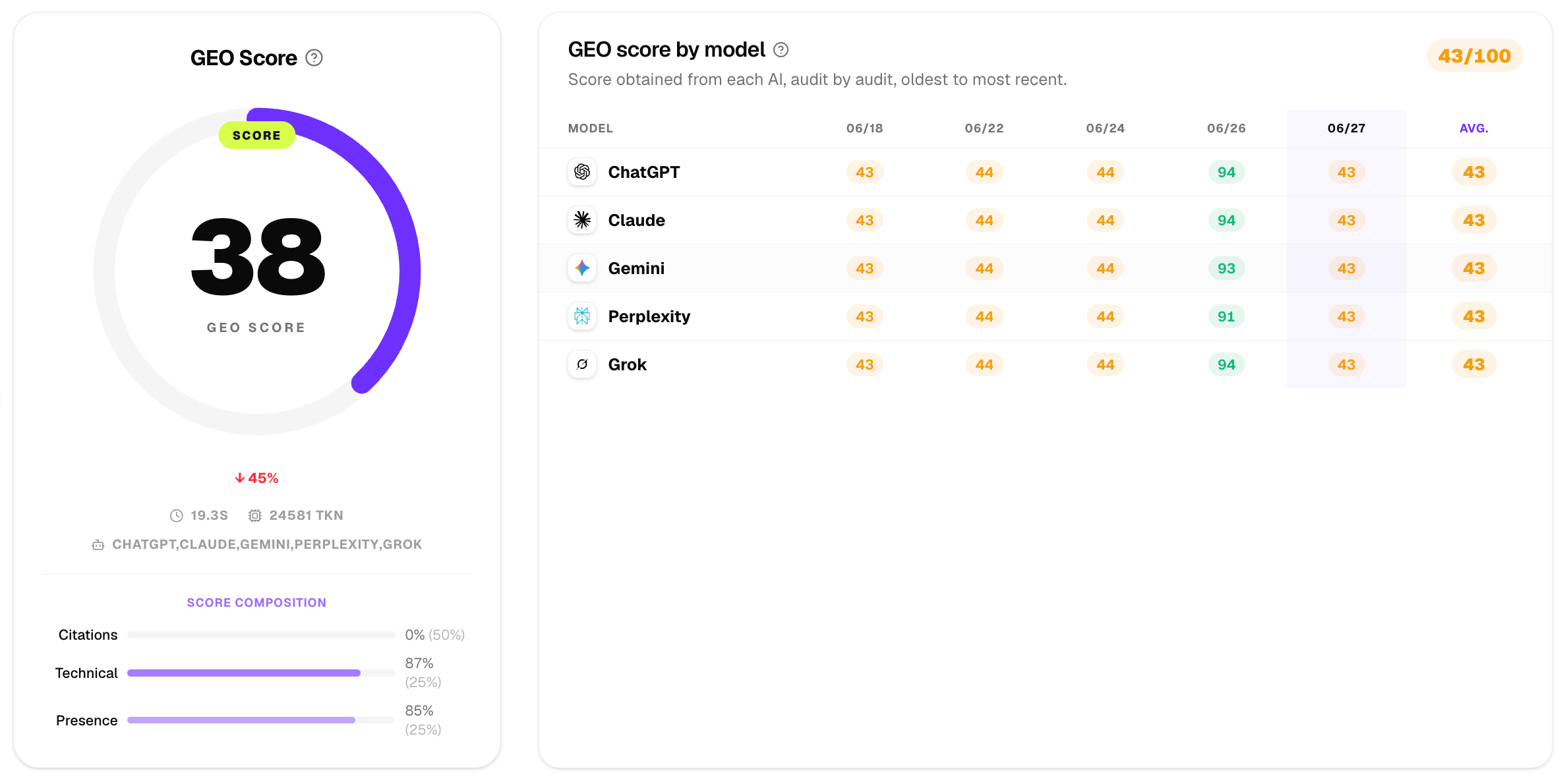
Answer engines score every fragment before it can make it into an answer, on five signals: semantic proximity to the query intent, factual precision (numbers, dates, verifiable definitions), the fragment's autonomy, syntactic simplicity, and the presence of structured data.
Two of those signals can be put in numbers. When we scored 767 pages from four competing platforms with a System One model, the archetype that scored highest on proof and originality was the case study, at 2.67 and 2.49 out of 3, while the page produced in series from a template scored 0.91 and 1.00. Both are equally crawlable, and only one gives an engine something worth lifting.
One criterion is rising across every platform: source credibility. Google formalizes it as E-E-A-T (Experience, Expertise, Authoritativeness, Trustworthiness), and that framework extends well beyond Google. For an AI system, E-E-A-T translates into detectable signals: an identified author page, cited sources, update dates, legal pages, and how often your content is itself cited elsewhere on the web.
Each platform then applies its own logic. Google AI Overviews leans on the existing index and rewards content that already ranks well. Perplexity crawls in real time and cites its sources explicitly, which rewards freshness and clean HTML structure. ChatGPT combines web browsing with training data, weighting source notoriety heavily. The common core stays the same: clarity, structure, and trust.
What are the pillars of an effective AEO strategy?
Five pillars carry an AEO strategy: content structure, chunk-friendly writing, topical authority, E-E-A-T signals, and crawlability with structured data. They work as a combination rather than a menu, which is why no single trick substitutes for them. They are listed below from the most accessible to the most structural.
- Content structure comes first: one clear H1, H2s and H3s that restate real questions, short paragraphs, lists and tables for comparisons. This is the fastest and highest-return lever to activate.
- Chunk-friendly writing means answering in the first sentence after each heading, one idea per paragraph, and avoid implicit references to earlier context. Every block should stand on its own.
- Topical authority follows. A site with one lonely article on AEO rarely gets cited. A site that covers prompts, citations, structured data and crawler access in depth, with identified authors and coherent internal linking, is seen as a reference.
- E-E-A-T signals matter too. An author page with verifiable expertise, update dates, reliable sources, complete legal pages. These are proof points that answer engines can read.
- Crawlability and structured data close the list. Content that is not accessible cannot be cited. Mark up your FAQs in JSON-LD, apply Article schema, make sure the main content is readable without JavaScript, and check your llms.txt file and how AI bots are handled in robots.txt.
On that last pillar the vendors document exactly what to allow, and the agents are not interchangeable. OpenAI lists four user agents in its bots documentation, OAI-SearchBot, OAI-AdsBot, GPTBot and ChatGPT-User, and states that only OAI-SearchBot decides whether your site can appear in ChatGPT search answers. Perplexity lists two in its crawlers guide, PerplexityBot and Perplexity-User, and notes that the second generally ignores robots.txt because a user requested the fetch. Both say a robots.txt change takes around 24 hours to be reflected.
These pillars do not work in isolation. It is their combination, clear structure, demonstrated authority, signaled credibility, and flawless technical access, that decides whether your content gets cited or ignored.
How to optimize your content for answer engines
Optimizing for answer engines starts with mapping the real questions your audience asks, not with writing. Answer engines respond to natural-language queries that are usually longer and more specific than the keywords typed into Google. Collect the actual phrasings from People Also Ask boxes, forums, and your support team's verbatims, then sort them by intent.
Next, structure each piece for extraction. Restate the question in the text before answering it, deliver the answer in the first sentence, then expand. Use crisp definitions in the form "AEO is...", numbered lists, and comparison tables. These are the formats answer engines reuse most readily because they are directly usable.
Finally, build presence beyond your own site. AI systems heavily weight sources they encounter elsewhere in their corpus: a mention on Wikipedia, a citation in a recognized publication, a consistent listing in your industry's directories. Our guide on winning visibility in AI search breaks this mechanism down, and if Perplexity is a priority for you, our Perplexity ranking guide goes deeper.
What citation rates actually look like
Across seven tracked brands and close to 2,000 queries run against the engines, the citation rate is 13 %. Nearly nine answers out of ten name someone else, which is the honest starting point for almost every brand, and AEO advice is usually given without any number attached to it at all.
Broken down by engine, on those where we have at least 100 queries: Anthropic 17 %, Google 16 %, Grok 15 %, OpenAI 14 %, Perplexity 11 %. The average matters less than the spread, and less again than this: the ranking is not the same from one brand to the next. On our own site Anthropic is the weakest engine at 2 %, while it is the strongest across the brands we monitor. Same discipline, opposite result, which is why an AEO plan starts with measurement on your own brand rather than with a playbook borrowed from someone else. How those numbers are produced, and why a single reading is not enough, is the subject of the next section.
In short : across seven tracked brands and close to 2,000 measured queries, the AEO citation rate is 13 %, ranging from 17 % on Anthropic to 11 % on Perplexity. The per-engine ranking differs by brand, so a generic playbook can point you at the wrong engine.
How do you measure AEO success?
AEO is measured on a fixed panel of prompts rather than on keywords: you record how often your brand or domain is named in the answers of the main engines, on the same prompts, repeated over time. There is no direct equivalent of Search Console for AI answers, so the panel has to be yours, and it has to be re-run rather than screenshotted once.
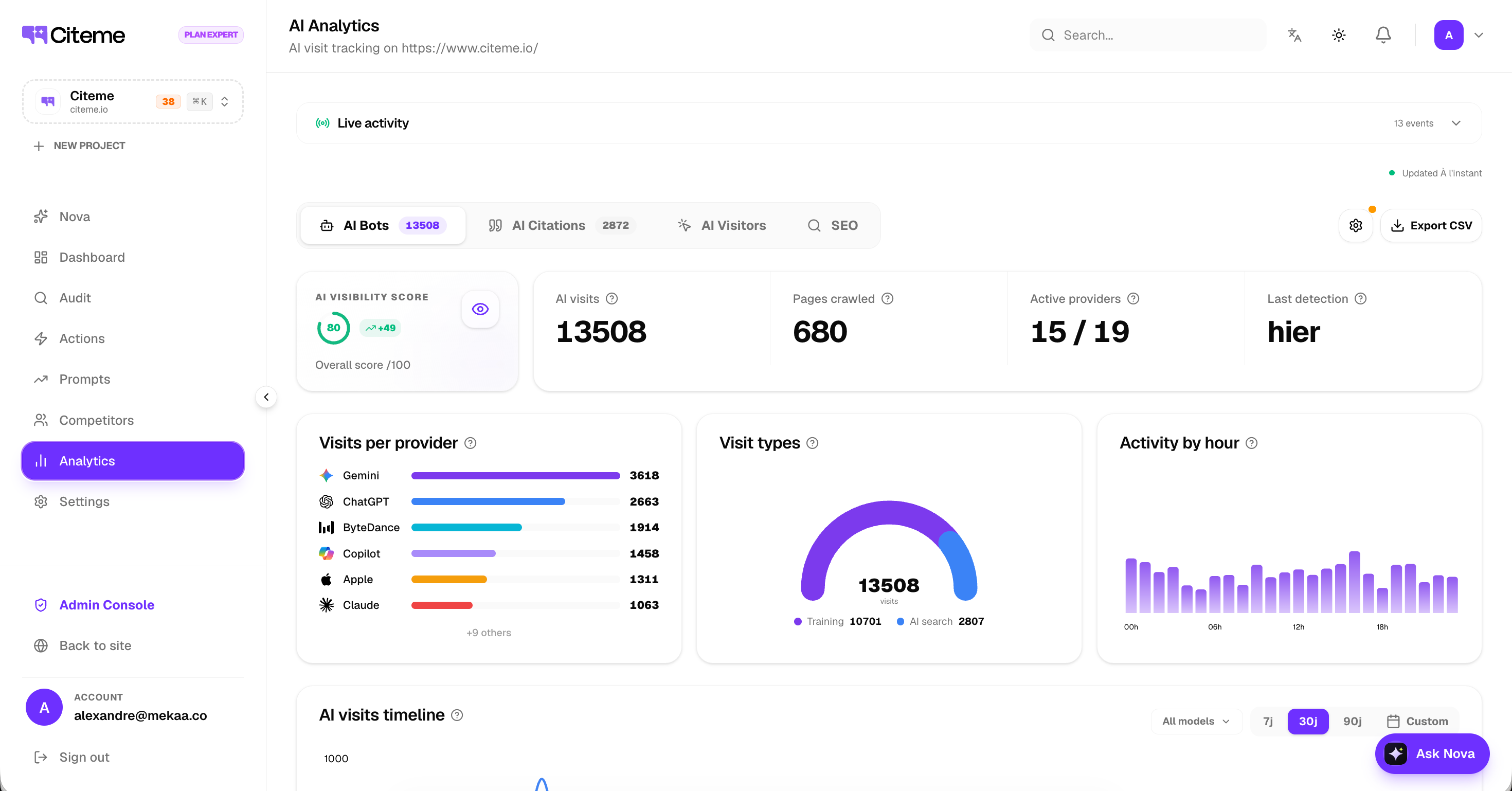
Several indicators let you track your AI visibility: how often your brand or domain is cited in the answers of the main answer engines, referral traffic from Perplexity or ChatGPT, citation frequency across a panel of target queries tested regularly, and the trend in your branded searches. Worth noting, a new metric is quietly replacing classic search volume: prompt volume, the number of prompts that trigger an answer in your topic area.
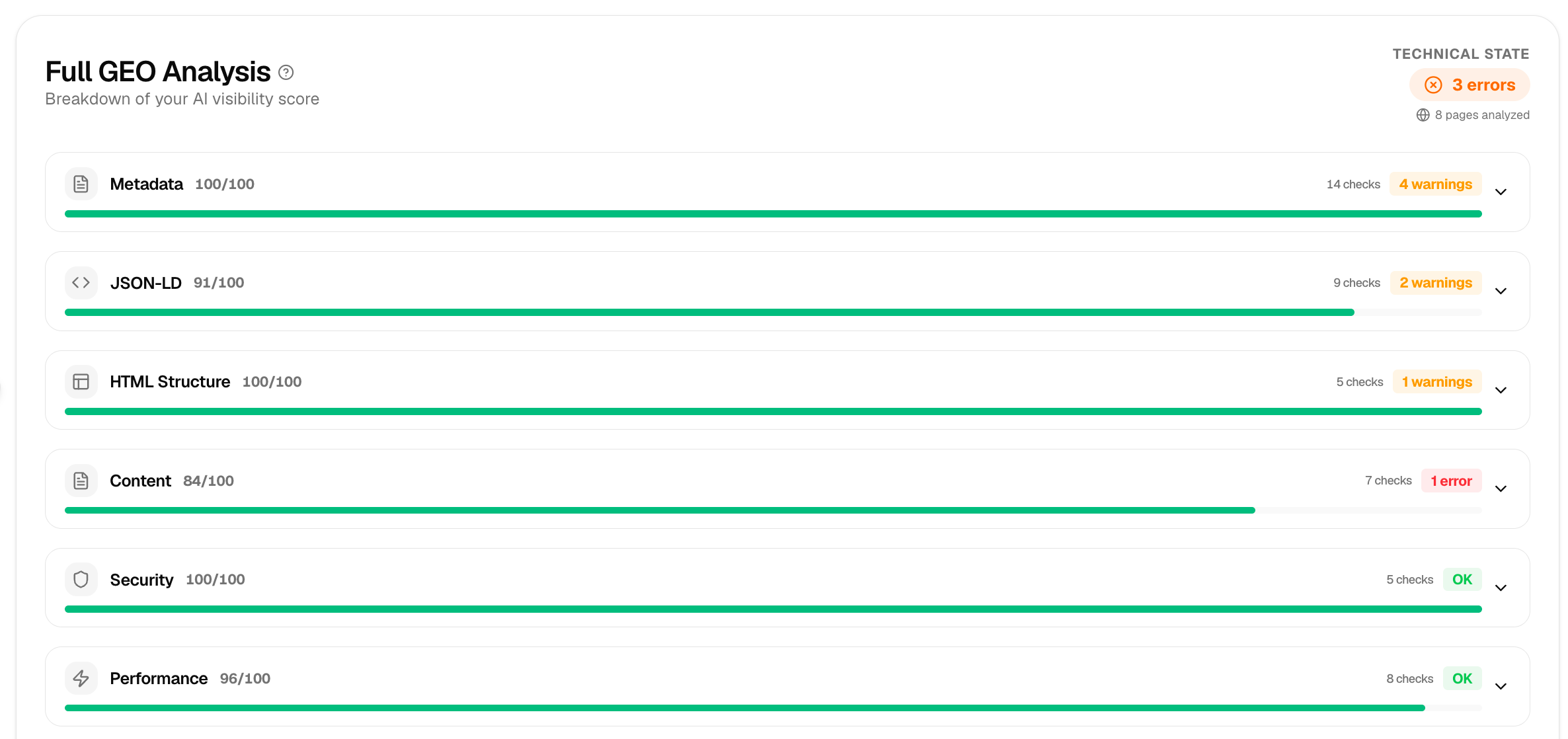
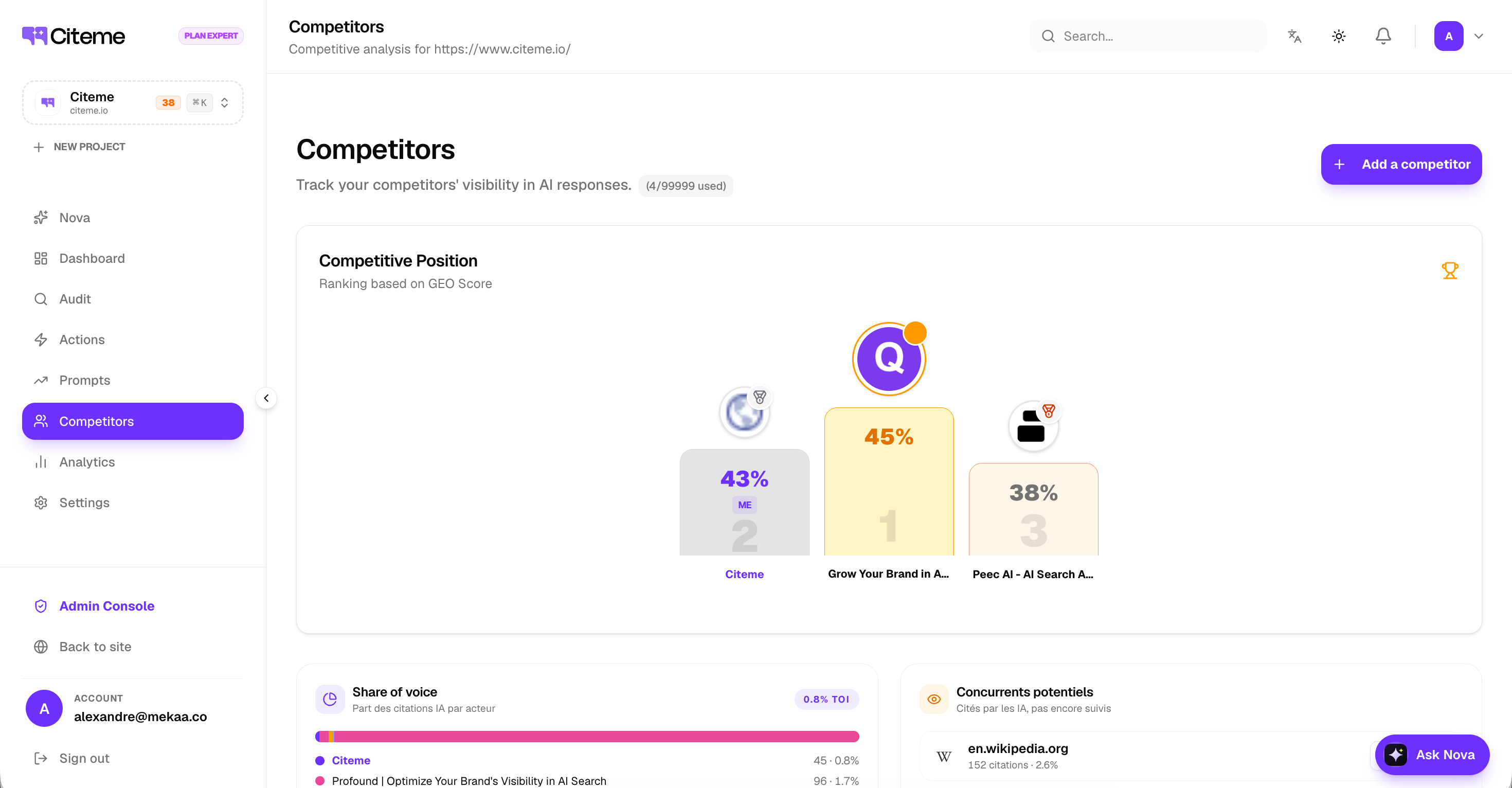
Manual tracking hits its limits fast, because AI answers vary by user and by day. That is exactly the problem Citeme solves: automatically tracking your brand citations across ChatGPT, Perplexity, Gemini, and other answer engines, benchmarking your position against competitors, and surfacing the queries where you are missing. This kind of GEO audit turns AEO into a data-driven discipline instead of guesswork: the same prompt is sent to ten engines at once, the chat models through their official APIs and Google AI Overviews through SERP capture, and the result is consolidated into a GEO Score from 0 to 100 built from visibility, authority and sentiment.
Should you invest in AEO or stick with SEO?
Both, and the framing is a trap. AEO does not replace SEO, it extends it into a second surface. The two rest on the same foundations: content quality, domain authority, technical structure. (For the tactic of borrowing another site's authority instead, see parasite SEO.) What changes is the final criterion, a position in the links for SEO, a citation in an answer for AEO.
The most advanced teams no longer separate the two in their workflows. They produce content that satisfies classic crawlers and LLMs at once: an immediate answer to the main question, structured markup, a coherent heading hierarchy, explicit definitions, and short sentences. A single writing effort serves both goals.
In short, AEO is not one more channel to fund separately. It is an additional layer of the same visibility strategy, one that diversifies your traffic sources and reduces your dependence on Google algorithm updates.
Key takeaways
- AEO means optimizing content to be cited by answer engines like ChatGPT, Perplexity, Gemini, and AI Overviews, rather than merely clicked.
- LLMs do not rank, they select: put yourself in the AI's shoes and produce fragments that are clear, self-contained, and factual.
- SEO, AEO, and GEO do not compete, they compound. The success criterion changes, not the foundations.
- The pillars of effective AEO are structure, chunk-friendly writing, topical authority, E-E-A-T, and technical crawlability.
- You cannot pilot what you do not measure: track your brand citations across answer engines to make AEO a data-driven discipline.
Frequently asked questions about AEO
Will AEO replace SEO?
No. AEO extends SEO rather than replacing it. SEO aims for a ranking in a list of links, AEO aims to become the answer itself. The two reinforce each other, because they share the same foundations of quality and structure: content optimized well for one usually improves on the other. The dependency also runs one way, which is worth knowing before you reallocate budget. Answer engines find their sources through traditional indexes, so a page that Google cannot crawl or index will never be quoted by an engine that relies on that index. Dropping SEO to fund AEO removes the supply line feeding it. The practical approach is to keep the technical foundations intact and add a second layer of work on how each passage reads when it is extracted from its page and quoted on its own.
What is the difference between AEO and GEO?
AEO covers optimization for all answer engines, which includes AI Overviews, voice assistants and any surface that returns a direct answer rather than a list. GEO is narrower and focuses on generative engines built on large language models, and specifically on how they chunk content, weight sources and decide which brands to name. In common usage, AEO is often the umbrella term that includes GEO, and the two labels are used interchangeably by most practitioners. The distinction matters less than the shared discipline underneath. Whichever term you use, the work is the same: write passages that stand alone when extracted, keep your facts in parseable text, describe your brand consistently across the web, and measure whether you are actually being cited rather than assuming it, because the two labels describe the same underlying problem.
How does answer engine optimization work technically?
An answer engine retrieves your page, splits it into semantic fragments, converts each fragment into a vector, then selects the ones closest to the query and most trustworthy to assemble its answer. That pipeline explains most of what practical AEO involves. Because selection happens at fragment level rather than page level, a brilliant article whose key claim is spread across four paragraphs may lose to a mediocre one that states the same claim completely in a single passage. Optimizing for AEO therefore means producing fragments that are clear, self-contained, factual and well marked up. A useful test: take any paragraph out of its page and read it cold. If it still answers a question on its own, it can be quoted. If it depends on what came before, it probably will not be.
Does AEO apply to every industry?
No industry is fully exempt, but the stakes vary a lot by search pattern. They are highest where informational search dominates: education, health, law, finance, marketing and tech all see a large share of their queries answered directly, without the user ever reaching a website. Transactional sectors are affected too, though at a different point in the journey. Nobody buys a machine tool from a chat window, but the comparison and advice queries that precede that purchase increasingly happen inside an AI answer, and the shortlist formed there decides who gets contacted. Local and service businesses sit somewhere in between. The practical question is not whether your industry is concerned, but which specific questions your buyers ask before choosing, and whether your brand is named when an engine answers them.
How long before you see AEO results?
It depends on your starting authority and on how fresh the target engines are. Perplexity, which crawls in real time, can pick up new content within days, so a well-structured page published this week may appear in its answers almost immediately. Engines that lean on a periodically refreshed index take longer, and anything that depends on the model's training data rather than live retrieval can take much longer still, since that layer only changes when the model is retrained. Expect weeks for the retrieval layer and months for the memory layer. Either way, regular measurement is what tells you whether the strategy works, because a single check proves nothing: answers vary between runs, and only a repeated series across several engines, run over several weeks, reveals a trend you can actually act on. Getting the structure right first is what our AI search architecture service covers.
Sources (7)
The public documents behind the facts in this article.
- Overview of OpenAI Crawlers · OpenAI
- Perplexity Crawlers · Perplexity
- Google users are less likely to click on links when an AI summary appears in the results · Pew Research Center
- ChatGPT users send 2.5 billion prompts a day · TechCrunch
- Perplexity received 780 million queries last month, CEO says · TechCrunch
- Creating helpful, reliable, people-first content · Google Search Central
- AEO - Authorised Economic Operator · European Commission, Taxation and Customs Union
Useful resources
Keep digging
- GEOGenerative engine optimization: how to optimize your content for AIA practical guide to Generative Engine Optimization: how to structure content, earn citations, and get your brand into AI answers on ChatGPT, Perplexity and Gemini.Read
- GEOBest GEO tool? Top generative engine optimization platformsFind the best GEO tool for your engine! Optimize content for AI search engines with top generative engine optimization platforms. Rank higher now.Read
- GEOBest Shopify apps for GEO in 2026: get your store cited by AIThe Shopify apps that help with GEO, sorted by job: what Shopify already does, AI visibility tracking, structured data, llms.txt and product content. Prices and ratings from the Shopify App Store on October 21, 2026.Read
- GEOAEO agency: what it delivers, what it costs and 7 agencies to shortlistAn AEO agency gets your brand cited in ChatGPT, Perplexity and AI Overviews answers. Here is what the work should include, what it really costs, and seven agencies checked on their own sites.Read