AI search optimization: build a site LLMs can read.
AI search optimization is the work of structuring a site so AI search engines can understand it, index it and cite it. Before ChatGPT, Claude, Gemini, Perplexity, Grok, Siri AI or the AI Overviews can quote you, they have to parse you. We rebuild your information architecture, entities, structured data (schema.org), llms.txt and citable content so your pages become legible to machines. It is the foundation the rest of GEO (Generative Engine Optimization) stands on.
What you get
Concrete deliverables, visible on your shared board, never a black box.
Information architecture for AI search
Pages, headings and internal links reorganized so engines grasp your topics and their relationships.
Entity & schema.org layer
Organization, product, FAQ and article markup so AI search resolves who you are and what you sell.
llms.txt & machine-readable facts
A map at your domain root plus clean, quotable facts, written for the crawlers that adopt them.
Chunked, citable content
Content split into self-contained passages an engine can lift verbatim, the format AI search cites most.
How it works
Diagnose readability
We inventory what stops AI search from parsing you: flat architecture, missing entities, no llms.txt.
Rebuild the structure
Architecture, schema.org, llms.txt and content chunking deployed on your stack; you approve each change.
Verify with live bots
The platform shows every AI bot reading your site in real time, proving the structure is legible.
Tracked across
 ChatGPT
 Claude
 Gemini
 Perplexity
 Grok
GrokWhat AI search optimization actually changes on your site
AI search optimization changes the unit of work from the page to the passage: an engine retrieves a block of text, not a URL, so every block has to answer on its own. Citeme's own indexer shows the pipeline at work. It follows sitemap.xml, keeps the main content and drops navigation, footers, ads and scripts, cuts the rest into chunks of roughly 300 words aligned with the heading hierarchy, then turns each chunk into a vector. We work backwards from that: flatten ambiguous navigation, name entities consistently, add schema.org markup, publish an llms.txt map, rewrite long pages so each block stands alone. One limit comes first though: a page behind a login, marked noindex or missing from your sitemap is never indexed at all.
Why entities and structured data decide who AI search cites
Retrieval is a distance calculation, not a keyword match: the question and your passages are both turned into vectors, and the passage closest to the question in cosine distance is the one an engine reads. Two things shorten that distance. Entity consistency, so a machine can tell your product, your company and your category apart, which is exactly what schema.org markup spells out. And factual density, where facts are not equal: figures and statistics weigh more than named entities, then dates, comparisons and citations. Our working target is around five verifiable facts per section of 200 to 300 words. What density does not buy is the final choice, since retrieval returns candidates and a re-ranking step picks the one that gets quoted.
How AI search architecture connects to the rest of GEO
Architecture is the one GEO layer whose absence cancels every other one: a passage that is never retrieved cannot be cited, however well it is written. That fixes the order of work. The site has to be reachable first, which means HTTPS on the root URL, a sitemap listing the pages that matter, and firewall and robots rules that let crawlers through, Citeme's own CiteMeBot/1.0 included. Strategy then picks the questions worth winning, content answers them, authority work makes third-party pages agree with you. Everything published afterwards inherits a format engines already parse. The ceiling stays real: a typical AI answer names only one to three sources, so a legible site wins the right to compete, not the citation.


Your GEO team, without thehiring
A dedicated GEO lead, a content and technical crew, and a shared board where you approve and track every action. The same people, month after month: an extension of your team, not a vendor you have to chase.
 Audit, production, implementation, reporting: handled
 You approve, we execute
 Replies within 24 h, on your board
We knew AI answers were sending buyers to our competitors, and nobody in-house had time to own it. Citeme became that team: audit, content, technical fixes, reporting. We just approve on the board. Gemini now cites us on the queries that matter.
 Arthur HumeauA team that executesCEO @ BrandAppart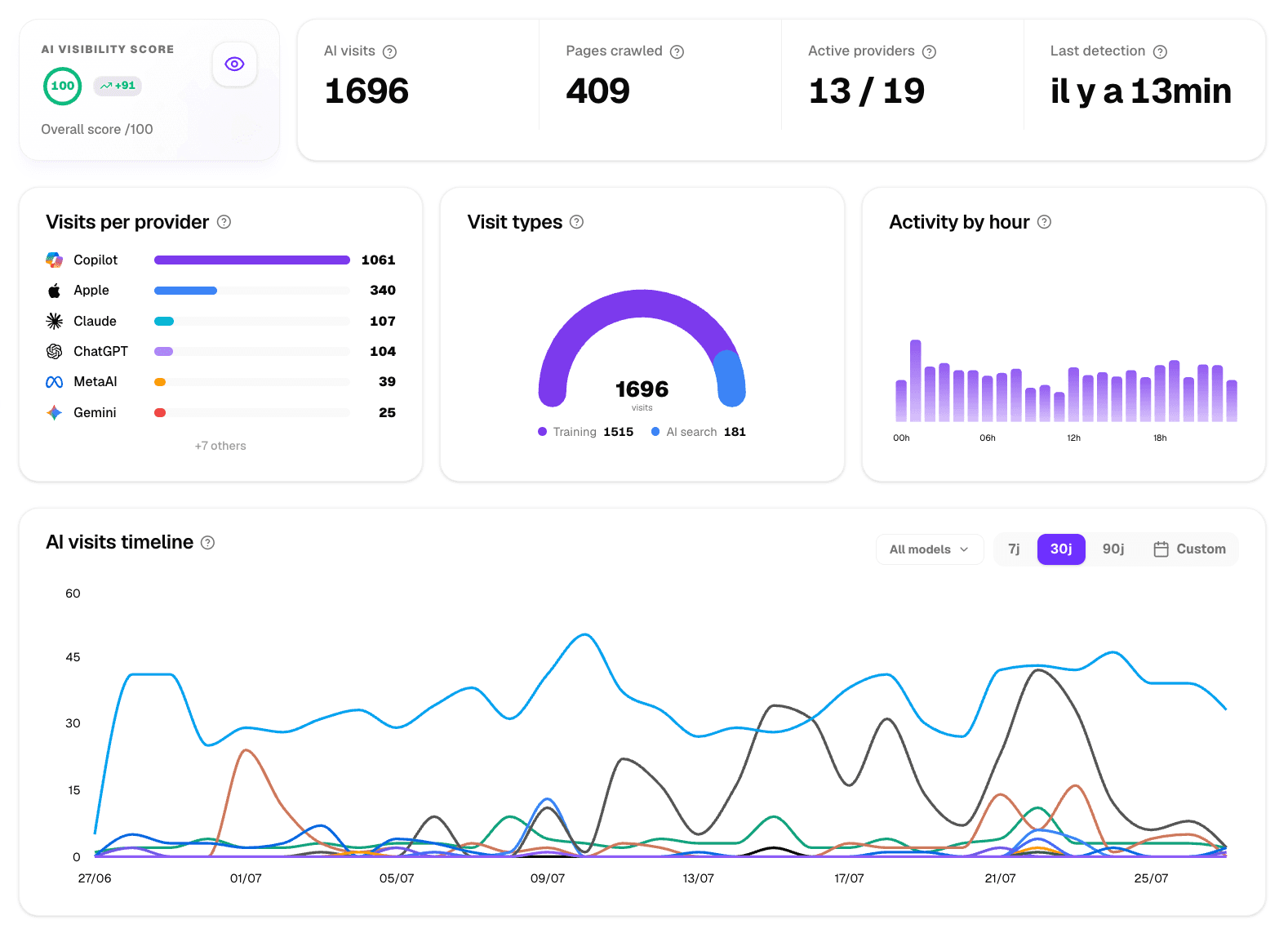
Our articles on this topic
All articlesBest GEO tool? Top generative engine optimization platforms
Find the best GEO tool for your engine! Optimize content for AI search engines with top generative engine optimization platforms. Rank higher now.
 Maël BourdinGEO
AI visibility: how to win search visibility in AI answers (2026)
Learn how to optimize for AI visibility and get your brand cited in ChatGPT, Perplexity, and Google AI Overviews. Actionable strategies for marketers.
Maël BourdinProductCiteme vs Profound: which AI visibility tool to choose in 2026?
Profound is the enterprise leader in AI search visibility; Citeme is our self-serve alternative at 59 € excl. VAT a month. An honest comparison of pricing, engines, data and action layers as of October 2026.
Maël BourdinGEOQuestions about this service
See if AI cites meAI search optimization is the practice of structuring a site technically and semantically so AI search engines can understand it, index it and cite it. That covers information architecture, entity consistency, structured data through schema.org, an llms.txt map at your domain root, and content split into self-contained passages. The reason it exists as a distinct discipline is that engines select at passage level rather than page level, so a brilliant article whose key claim is spread across four paragraphs can lose to a plainer one that states the same claim completely in a single block. Before ChatGPT, Claude, Gemini, Perplexity, Grok, Siri AI or the AI Overviews can quote you, they have to parse you first. This is the layer that makes parsing possible, and every other part of GEO is built on top of it.
The other levers we put to work
Every plan combines these services into one coordinated GEO engine.


Ready to become theanswer?
30 minutes with a GEO expert, your AI visibility put under the microscope, and a clear plan. No commitment.
 See if AI cites me
Tracked across
ChatGPTGrokPerplexityGeminiClaude