

GEO audit: know exactly what AI says about you
Run a free GEO audit. Citeme queries the ten AI engines, from ChatGPT to Google AI Overviews, via real APIs and shows exactly who gets cited, you or your competitors.
- Cancel in one click
- Results in minutes
- 10 AI engines covered
What is a GEO audit?
A GEO audit (generative engine optimization audit) measures how visible your website is inside AI-generated answers (ChatGPT, Claude, Gemini, Perplexity, Grok, Siri AI) rather than in a list of links. Unlike a classic SEO audit, an AI visibility audit checks whether the engines cite you, where you rank in their answers, and what sentiment they attach to your brand. Citeme is a free GEO audit tool that runs this analysis in minutes: paste your URL, and we do the rest.
A full diagnosis, not a vanity score
Every audit crawls your site, runs your prompts against the real engines, extracts the citations and grades the technical conditions that decide whether a model can read you at all. You get the score and, crucially, the reasons behind it.
10 engines, official APIs and SERP capture
ChatGPT, Claude, Gemini, Perplexity, Grok 4.3, Google AI Overviews, Siri AI, DeepSeek, Meta AI and Mistral: the ten engines run inside the same audit, the chat models through their official APIs and the AI Overviews through SERP capture. The same prompt hits all of them at once, so you compare apples to apples, in real time.
Prompts auto-generated
Citeme writes the audit prompt list for you, from your own site. Before any scan the crawler follows your sitemap.xml, extracts the main content of each page, drops navigation, footers, ads and interface chrome, cuts what is left into segments of roughly 300 words along the H1 to H6 heading hierarchy, and turns those segments into embeddings. From that semantic reading it identifies your products, services and positioning, then generates the questions a prospect would actually put to an assistant. The list is sorted into three families: brand queries, comparative queries such as cheaper alternatives to a named rival, and problem or solution queries describing the need you answer. You can edit it under Configuration then Keywords, to reach a specialist segment or add a query the system missed. The documentation advises starting from the generated set and refining after your first audit. The limit is your sitemap: pages behind a login, pages marked noindex and pages absent from the sitemap are never indexed, so they never feed prompt generation. Behind Cloudflare or a strict WAF you have to allow the CiteMeBot/1.0 user agent first.
Citation extraction
For every answer Citeme returns three readings, not one flag. Mention detection looks for your brand, a product name, your URL or any associated entity, and relies on NLP rather than string matching, so implicit mentions and paraphrases count too. Sentiment classification labels each mention positive for an explicit recommendation, neutral for a factual citation, negative for a warning or a criticism. Ranking position measures where you land when the model lists several solutions, because being named first weighs far more than a closing aside. The same keyword is asked in three prompting styles: zero-shot as a direct question, chain-of-thought asking the model to reason step by step, and few-shot with examples of the expected format. Per keyword you can open the raw answer from each model, your exact position inside it, the competitors cited alongside you, your sentiment, and the excerpts showing how the model talks about you. Aggregated, that produces citation frequency, recommendation rate, which counts only the answers ranking you first, and share of voice broken down per model.
Technical scan, with or without the engines
Alongside the citation test, every audit scans the conditions a model needs to read you at all: whether the AI crawlers are allowed in your robots.txt, your JSON-LD and structured data, your metadata, your heading hierarchy and the way your pages break into segments. The project record keeps a structured data score and a metadata quality score next to the number of pages analysed and the date of the last automated check, so the technical half is a tracked series like the rest rather than a one-off report. The scan also runs on its own. A light audit crawls the site and performs the technical GEO scan without calling any model, which consumes no credits and surfaces the blocking problems straight away, while a full audit adds the citation test on the engines and returns its score a few minutes later. In practice you run the light one while you are still fixing things, and the full one when you want to know whether the answers actually changed.
Target by region
France, US, UK, Germany, Spain, Italy, Canada or Global. The engines answer differently per market, so you audit where your buyers actually are.
History, not snapshots
Every audit is kept as a record, so visibility becomes a series rather than a photograph. A run takes two to five minutes depending on how many keywords and how many models are in scope, and it is stored with its score, its status, its duration in milliseconds, its creation timestamp and the technical details of the run, including which model answered and which region was simulated. The dashboard charts each metric across that history, which is what lets you attribute a movement to a change you shipped instead of arguing about it. The API exposes the same thing: a GET on the audits of a project returns the full list, which is how you pull scores into your own reporting. Two limits are worth knowing. Triggering a fresh audit through the API is restricted, and every audit launched consumes monthly quota credits. And because the displayed score blends the current run with previous ones, a genuine improvement shows up over two or three audits rather than instantly.
What actually happens in an audit
An audit runs in three stages. First it defines the queries: the semantic reading of your site produces the prompts a prospect would actually put to an assistant, sorted into brand queries, comparative queries and problem or solution queries. Then it simulates: those prompts go to the engines through their official APIs, and every answer is read on three axes, mention detection through NLP so paraphrases and references to your URL count too, sentiment classification, and your ranking position when the model lists several solutions. Only then are the answers aggregated into a score.
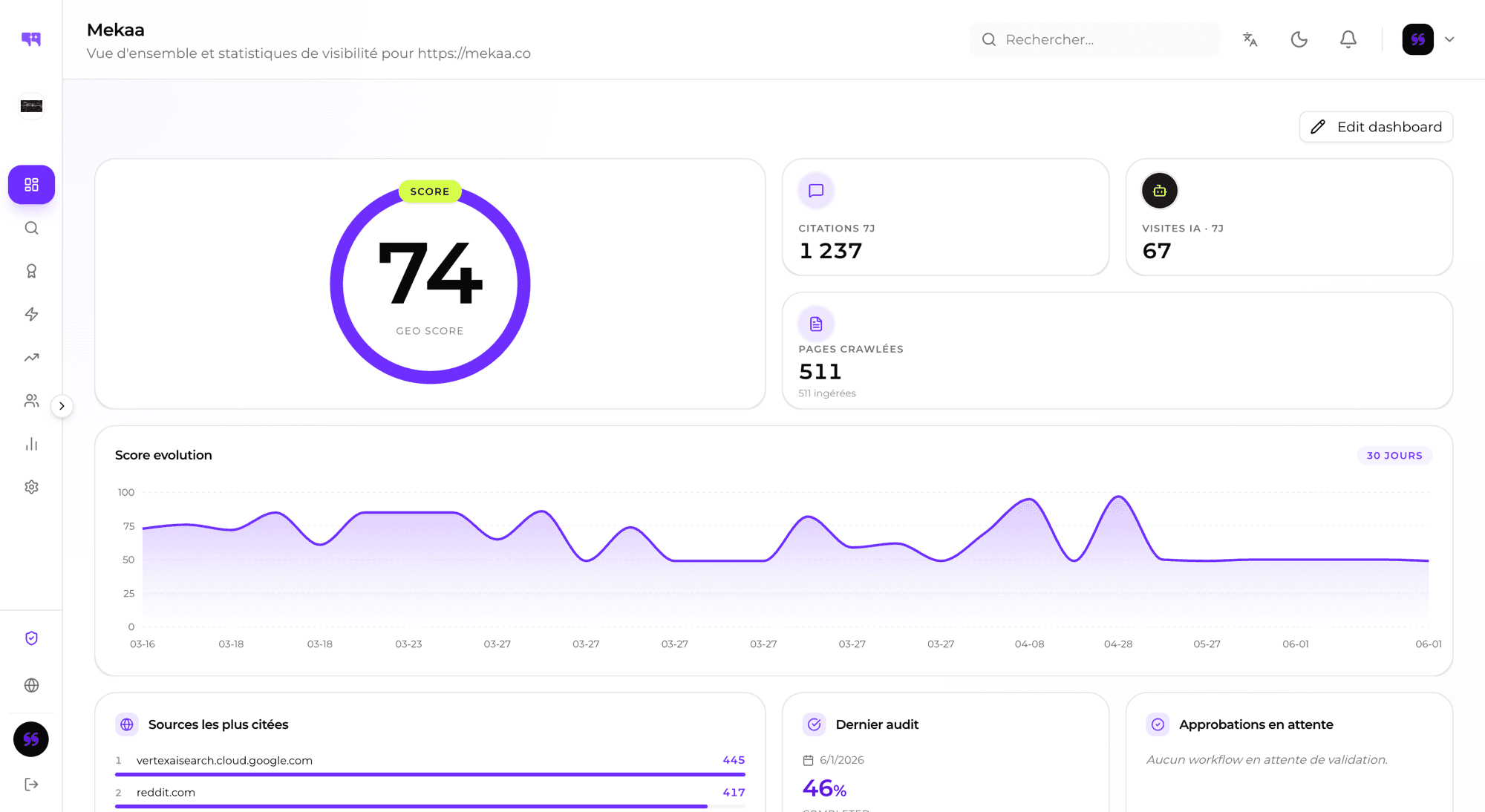
What comes back is not a single number. The results report citation frequency, the recommendation rate that counts only the answers placing you first, share of voice per engine, and the movement over time. Per keyword you can open the raw answer from each model, your position inside it, the competitors cited next to you, the sentiment attached and the excerpts that show how the model talks about you.
- Prompt families: brand, comparative, problem and solution
- Mention detection through NLP, paraphrases included
- Sentiment: positive, neutral expert, negative, not relevant
- Ranking position recorded answer by answer
- Citation frequency, recommendation rate, share of voice per engine
- A light run scans the technical side with no model call
 ChatGPT
 Claude
 Gemini
 Perplexity
 Grok
10
AI engines queried
40/30/30
visibility · authority · sentiment
2-5 min
per full audit
0-100
transparent GEO Score
How it works
- 1
Paste your URL
Crawl, sitemap detection and prompt generation are automatic.
- 2
Run the audit
The 10 engines are queried simultaneously on your prompts, in your region.
- 3
Read the verdict
Citations, sources, sentiment and the technical scan, engine by engine.
Our articles on this topic
All articlesAEO vs GEO vs SEO
Three acronyms, three targets, one practical question: which one do you work on first? The difference explained, with citation data measured across the brands we track.
 Alexandre TeilletGEO
AirOps review 2026
AirOps has the widest search footprint of any tool in this category. What that buys you, what the opaque pricing hides, and where it stops. Our score: 3.8 out of 5.
Alexandre TeilletMarketingSearchable AI review 2026
What Searchable does, what its own search footprint says about it, and where it fits against the rest of the category. Our score: 3.5 out of 5.
Alexandre TeilletMarketingGood to know
A GEO audit (Generative Engine Optimization audit) is a structured, data-driven evaluation of how your website is represented inside AI-generated answers (ChatGPT, Claude, Gemini, Perplexity, Grok, Siri AI). Where a classic website audit checks page speed or broken links, a GEO audit answers a fundamentally different question: when a potential customer types a question into an AI engine, does it cite your brand, your content, or your competitors'? Citeme generates the commercial queries your target market actually types into AI engines, then fires them at the real APIs, no simulation, no scraping. It measures citation frequency (how often you appear), citation position (primary source, supporting mention, or absent), sentiment (positive, neutral, or negative language attached to your brand), and the technical conditions that affect AI readability: structured data, metadata, HTML semantics, page speed, and accessibility to AI crawlers. The result is a GEO Score from 0 to 100, built from visibility, authority and sentiment. You see exactly which dimensions hold you back, which competitors are capturing the citations you should be getting, and a prioritized list of fixes ranked by expected impact.
All features
See it on your own market
Run your first GEO audit for free: your prompts, your competitors, real AI answers.