Most brands are invisible to AI. Not because their content is bad, but because they are optimizing for a completely different game. While SEO still matters, the rules for showing up in AI answers have shifted so fast that even seasoned marketers are scrambling to catch up. If your content never appears in AI responses from ChatGPT, Perplexity, or Google AI Overviews, you are losing a growing share of qualified traffic to competitors who figured this out first.
This guide breaks down how ai visibility actually works, what ai search optimization looks like in practice, and how to track whether your brand appears in ai responses. Whether you are a b2b marketer, an agency strategist, or a founder trying to understand where your pipeline went, every section here is built around one goal: making your brand the primary source of truth for the ai systems that are reshaping how people discover products and services.
In summary: AI visibility is no longer earned through traditional search alone. Brands must adapt their SEO and content strategies to optimize for ai-driven search experiences like Google's AI Overviews, ChatGPT, and Perplexity, or risk becoming invisible to a growing segment of high-intent buyers.
What is ai visibility and why does it matter now?
AI visibility refers to how often, and how favorably, your brand appears in ai-generated answers. When someone asks ChatGPT "what is the best project management tool for startups?" or runs a query on Perplexity about CRM software, the AI synthesizes information from multiple sources and produces a single response. If your brand is not among the sources it trusts, you are simply not part of that conversation.
This is different from traditional search in a fundamental way. In the old model, you optimized for keyword rankings and competed for blue links. Users clicked through to your site. In ai-driven search, there is often no click at all. The AI provides the answer directly, and the only brands that benefit are the ones mentioned in that answer. According to a Gartner forecast, traditional search engine volume could drop by 25% by 2026, with much of that traffic redirected through generative ai experiences.
For marketers, this is not a minor shift. It is a completely different game. Your brand's visibility across platforms like ChatGPT, Perplexity, and Google AI is now a critical metric, one that most analytics dashboards still do not measure.
How do ai systems decide which brands to cite?
Understanding what drives ai citation is essential if you want to optimize for ai visibility. LLMs like GPT-4, Claude, and Gemini do not rank pages the way Google does. They do not care about your domain authority score or how many backlinks you have (at least not directly). That also limits parasite SEO, which rents exactly that signal. Instead, they synthesize content from sources they consider authoritative, well-structured, and frequently referenced across the web.
Here is what matters most to ai models when generating responses:
- Consistency of brand mentions: if your brand name appears consistently across industry publications, third-party review sites, and authoritative content, llms are more likely to include you. Brand mentions act as a trust signal.
- Structured content: clear headings, FAQ sections, comparison tables, and schema markup help ai systems understand your content and extract it cleanly.
- Citation density: content that cites specific data points, studies, and expert sources is more likely to be cited in return. LLMs favor content that looks like it was written by someone with expertise.
- Recency: ai systems often prioritize recent content, especially for queries where freshness matters. Stale blog posts from 2021 will not win visibility in ai-generated responses.
One thing most marketers get wrong: they assume that ranking #1 on Google automatically means they will appear in ai answers. It does not. AI search optimization is a separate discipline, and the overlap with SEO is real but far from complete.
What is the difference between SEO and ai search optimization?
SEO and ai search optimization share common foundations (quality content, structured data, topical authority), but they diverge in critical ways. Traditional SEO is about earning placement in search results, typically the ten blue links on a Google page. Generative engine optimization, or GEO, is about earning placement inside the AI's answer itself.
Think of it this way: SEO gets your page listed. GEO gets your brand recommended.
The brands and agencies that treat ai visibility as a separate workstream, rather than an afterthought of SEO, are the ones seeing visibility gains right now. For a deeper look at how GEO differs from SEO, the technical breakdown is worth reading.
How can you track if your brand appears in ai answers?
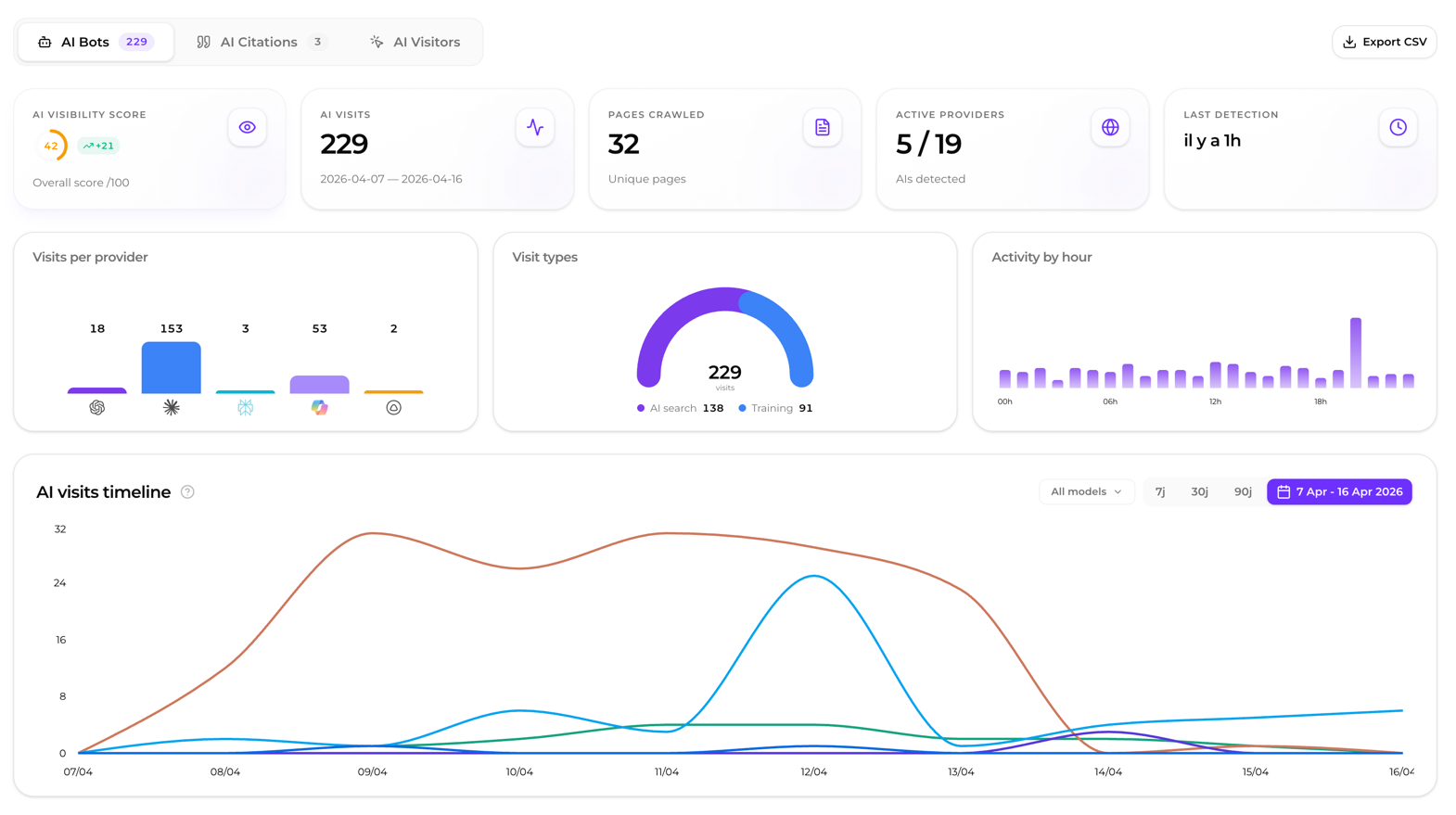
Here is the uncomfortable truth: most marketers have zero idea whether their brand is mentioned in ai responses or not. Traditional analytics tools like Google Analytics and Search Console do not track ai citation. They can show you branded search volume and organic traffic, but they cannot tell you whether ChatGPT mentioned your product in response to a prompt about your category.
That is a visibility gap you cannot afford to ignore.
Tracking ai visibility requires dedicated tools. Citeme, for example, lets you run an ai visibility audit that queries multiple llms (ChatGPT, Claude, Gemini, Perplexity) with the prompts your customers would actually use, then shows you exactly which brands are appearing in ai answers, and where you stand. AI visibility tools like Citeme help you measure metrics like citation frequency, sentiment, and source attribution across platforms. For a side-by-side comparison of the options, see our roundup of the 10 best AI visibility tools in 2026.
What should you track? Start with these:
- Ai citation rate: how often does your brand get mentioned in ai responses for relevant queries?
- Competitor citation: who else appears in ai answers for your target queries? What are they doing differently?
- Source attribution: when an AI cites your brand, what content is it pulling from? Is it your homepage, a blog post, a third-party review?
- Prompt coverage: for how many of your high-intent keyword queries does your brand appear?
Without this data, you are flying blind. And every ai response that recommends a competitor instead of you is a lost opportunity that never shows up in your analytics.
What type of content gets cited by ai models?
Not all content is created equal when it comes to ai-driven search. LLMs are built to synthesize, summarize, and recommend. The type of content that performs well in ai responses is content that is easy for these models to parse and extract.
In practice, that means:
Definitional content works exceptionally well. When your page clearly defines a concept ("X is a Y that does Z"), ai systems can extract that sentence and use it directly in their responses. Think of these as answer capsules: self-contained statements that an LLM can drop into a generated answer without needing to paraphrase.
Comparative content also performs strongly. When someone asks an ai assistant "what is the best email marketing tool for e-commerce?", the AI looks for content that compares options. If your blog post includes a well-structured comparison with specific criteria, that content is far more likely to be cited.
Data-rich content signals expertise. Articles that include specific figures ("our clients saw a 47% increase in ai citation rate within 8 weeks of implementing structured data") give llms something concrete to reference. Vague claims like "significantly improved results" get ignored.
And here is something most people overlook: content on platforms like Reddit, G2, and Capterra feeds ai training data and retrieval. If your brand has strong reviews and active community discussion, those third-party signals help ai systems decide you are trustworthy enough to recommend.
In summary: AI models prioritize structured, data-rich, and definitional content. To optimize for ai search, create content that provides clear answers, specific comparisons, and verifiable figures. The goal is to become a source that ai systems understand and trust enough to cite.
How do brand mentions and authority influence ai visibility?
Here is a pattern we have seen repeatedly: brands with strong content on their own site but zero presence on third-party platforms struggle to win visibility in ai-generated responses. Why? Because llms are trained on (and retrieve from) a broad web corpus. If your brand only appears on your own domain, the model has limited evidence that you are a credible player in your space.
Brand mentions across authoritative sources, including industry publications, review platforms, news coverage, and even Reddit threads, act as a trust signal for ai systems. The more consistently your brand appears in ai-relevant contexts, the higher the probability that an LLM will cite you when answering a related query.
This is where content marketing and digital PR intersect with ai search optimization. A placement in a respected industry publication does double duty: it drives referral traffic and feeds the brand authority signals that llms use to decide which brands are appearing in their answers.
For b2b companies especially, this matters enormously. When a decision-maker asks a generative ai tool "what are the best analytics platforms for mid-market SaaS?", the AI does not just pull from Google's index. It synthesizes across everything it has seen. If your brand's ai presence is thin, you will not make the cut.
What role does schema markup and structured data play?
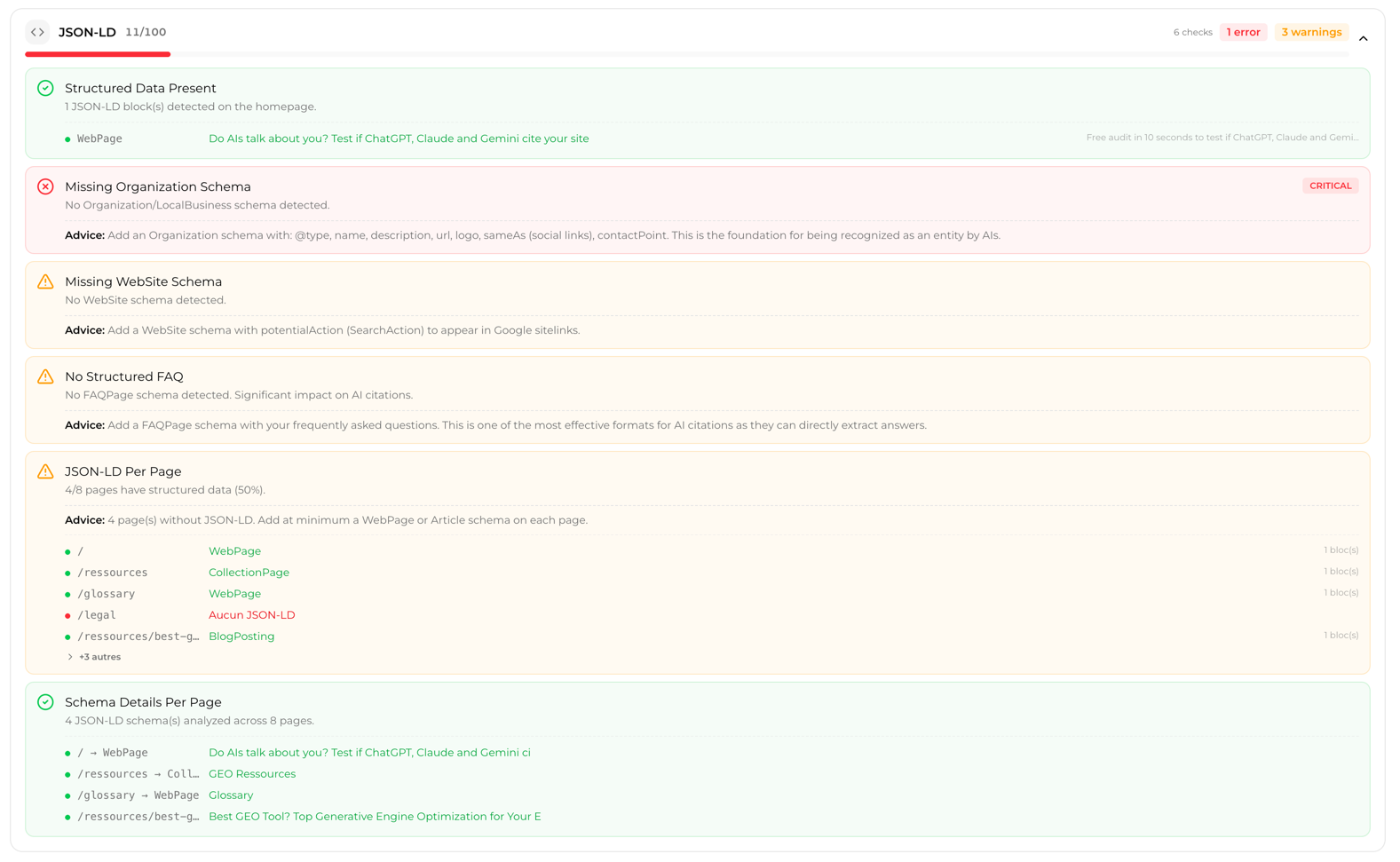
Schema markup helps ai systems understand your content at a structural level. When you implement structured data (FAQ schema, Article schema, Organization schema), you are essentially giving llms a machine-readable map of your page. This does not guarantee ai citation, but it dramatically increases the odds.
According to a BrightEdge analysis, structured, high-quality content with proper schema is consistently more likely to be cited by ai platforms than equivalent content without it. The reason is simple: ai models need to parse and extract information efficiently. Schema markup reduces friction.
Here is a practical checklist for schema optimization:
- Implement FAQ schema on pages with question-answer content
- Add Article schema with proper
datePublishedanddateModifiedfields - Use Organization schema to reinforce your brand entity
- Include Product schema on product and comparison pages
- Validate everything with Google's Rich Results Test before deployment
One common mistake: implementing schema but filling it with thin or generic content. Schema is a delivery mechanism, not a substitute for quality. The content behind the markup still needs to be authoritative and detailed enough that ai systems find it worth citing.
How should you optimize for specific ai platforms?
Each ai platform has slightly different behaviors, and a smart marketer tailors their approach accordingly.
ChatGPT tends to favor well-known brands with broad web presence. Brand mentions in diverse contexts (forums, reviews, expert content) increase your chances. ChatGPT also uses ai search now, pulling real-time data from the web, so freshness matters.
Perplexity is citation-heavy by design. Every ai response includes source links, making it closer to a traditional search experience. Perplexity favors structured, recent content with clear metadata. If your content has a visible publication date, clean HTML, and strong topical depth, you have a better chance of being cited.
Google AI Overviews still draw on pages that rank in traditional search, but less and less on the top 10 alone: in Ahrefs' 2026 update, only 38% of cited URLs ranked in the top 10, down from 76% in July 2025. This is where SEO and GEO overlap most directly. Ranking on page one for a relevant search query significantly increases your odds of appearing in the AI overview for that same query.
The common thread across platforms: create structured content that is authoritative, recent, and easy to parse. Then monitor your visibility across each platform separately, because being cited by ChatGPT does not mean you are mentioned in Perplexity, or vice versa. Citeme's platform queries all major llms simultaneously so you can spot visibility gaps across platforms before they cost you pipeline.
What are the biggest mistakes brands make with ai search?
After working with dozens of companies on their ai visibility strategy, a few mistakes come up again and again.
Mistake #1: assuming SEO is enough. Ranking on Google is necessary but not sufficient. If your content is not structured for ai extraction, you can sit at position one and still be invisible to llms.
Mistake #2: ignoring third-party mentions. Your website is only one piece of the puzzle. AI systems weigh external validation heavily. Brands that invest in digital PR, review management, and community presence on platforms like Reddit see meaningfully higher citation rates.
Mistake #3: not measuring ai visibility at all. You cannot optimize what you do not measure. Most companies have no idea whether they are being mentioned in ai responses, let alone how often or in what context. An AI visibility audit takes seconds and reveals exactly where you stand.
Mistake #4: publishing content that is too generic. AI models already know the basic facts. What they need, and what earns citation, is specific expertise, proprietary data, or a clear point of view that adds value beyond the consensus. If your blog post reads like a Wikipedia entry, it will not get cited.
How does ai visibility translate into revenue?
AI visibility turns into sales through three mechanisms, and confusing them is why teams underprice the work. The first is direct attribution: a buyer asks ChatGPT for recommendations, sees your brand cited, clicks through and converts. Easiest to measure, smallest in volume. The second is indirect attribution, where most of the lift sits: buyers see your brand cited, internalize it as social proof, and later type your brand name into Google or arrive through another channel. The conversion shows up as branded or direct traffic, but the trigger was the citation seen days earlier. The third is qualification: visitors referred by AI engines arrive after an answer that already compared the options, and convert roughly 4.4 times better than classic SEO traffic (Semrush, 2025).
Connecting this to revenue takes thirty minutes. Add a custom channel in GA4 with a source regex matching AI referral domains (chatgpt.com, perplexity.ai, gemini.google.com, copilot.microsoft.com), use landing page as a secondary dimension to see which pages drive AI-sourced visits, and pipe the data into your CRM through UTM parameters or a hidden field on demo bookings so sales can attribute deals back to the AI source. Without this loop, even a strong visibility program cannot defend its spend.
How do you build a practical ai visibility strategy?
Let us be specific about what actually works. Here is the framework we recommend for brands and agencies that want to close the gap between traditional SEO and ai search visibility.
Step 1: audit your current ai visibility. Use ai visibility tools like Citeme to find out which queries your brand appears in, which llms cite you, and where your competitors are winning.
Step 2: map your high-intent queries. Identify the prompts your ideal customers would type into an ai assistant. These are not always the same as your SEO keyword list. Think conversational: "what is the best X for Y?" or "compare X and Y for Z use case."
Step 3: create optimized content. For each priority query, create or update content that is structured, data-rich, and clearly answers the question. Use schema markup, include specific figures, and write definitional sentences that ai models can extract directly.
Step 4: strengthen brand authority signals. Invest in content marketing, guest placements in industry publications, and active presence on review platforms. The goal is to make your brand's name appear consistently across the sources it trusts.
Step 5: monitor and iterate. AI visibility is not a one-time project. Track your citation rate monthly, watch for visibility gains and losses, and adjust your GEO strategy based on what the data shows.
In summary: A practical ai visibility strategy combines auditing, structured content creation, brand authority building, and continuous monitoring. Brands that treat this as an ongoing program, not a one-off SEO project, will win visibility in ai-driven search over the long term.
Conclusion
AI visibility is no longer optional. As search evolves toward ai-driven experiences, the brands that will thrive are those that optimize for citation, not just clicks. Every marketer needs to understand that visibility is no longer earned through seo alone. It requires a deliberate strategy that spans structured content, brand authority, and continuous measurement.
The shift is already underway. Platforms like chatgpt, perplexity, and google ai overviews are becoming a primary discovery layer for millions of users. Your brand's visibility in these systems directly impacts whether you are part of the conversation or left out entirely.
Start by auditing where you stand today. Identify your visibility gaps. Then build the structured, authoritative content that makes your brand the source ai systems recommend. The brands that move now will own the placement that matters most in modern ai search.
Sources (6)
The public documents behind the facts in this article.
- We Studied the Impact of AI Search on SEO Traffic. Here's What We Learned. · Semrush
- GEO: Generative Engine Optimization · arXiv (Aggarwal et al., Princeton University)
- AI features and your website · Google Search Central
- Do people click on links in Google AI summaries? · Pew Research Center
- Update: 38% of AI Overview Citations Pull From The Top 10 · Ahrefs
- Perplexity Crawlers · Perplexity
Useful resources
Keep digging
- Product7 best Peec AI alternatives for AI visibility in 2026Looking for a peec ai alternative in 2026? Compare the 7 best peec ai alternatives for ai visibility tracking, citation analytics, and ai seo workflows.Read
- GEOCiteme vs Profound: which AI visibility tool to choose in 2026?Profound is the enterprise leader in AI search visibility; Citeme is our self-serve alternative at 59 € excl. VAT a month. An honest comparison of pricing, engines, data and action layers as of October 2026.Read
- GEO17 AI visibility tools compared: pricing and engines (2026)Seventeen AI visibility tools ranked on what they cost and which AI engines each plan actually queries, with every price checked at the vendor's own pricing page on 7 October 2026.Read
- GEOllms.txt file: the complete guide (2026)Discover what llms.txt is, how it works like robots.txt for AI, and why adding it to your site boosts visibility in ChatGPT, Claude, and Perplexity.Read