Which AI visibility tool is right for you?
Answer 5 quick questions and find out which tool from this ranking actually matches your goals, budget and team.
What's your main goal with AI visibility?
If your brand is not showing up inside ChatGPT, Perplexity, or Google AI Overviews, it is invisible to a rapidly growing share of your audience. AI search is no longer a future trend: according to Semrush research, around 93% of Google AI Mode searches now end without a click, meaning millions of users get answers directly from AI responses without ever visiting a website. Your brand either shows up in those answers, or it does not.
This shift has created a new discipline: AI visibility optimization, also called generative engine optimization (GEO) or answer engine optimization (AEO). And at the heart of any solid GEO strategy is the right AI visibility tool. These platforms tell you where your brand appears in AI answers, which competitors are getting cited instead, which sources the AI trusts, and what you can do to close the gap.
In this guide, we compare 17 AI visibility tools in 2026: the ten we ranked against a published comparison method, plus seven more profiled in the August update, covering features, pricing, ideal use cases, and what makes each one worth considering. Whether you are a solo marketer, a growing SaaS team, or an enterprise running multi-brand campaigns, there is a right tool for your situation.
AI visibility in 2026 means more than SEO. Traditional search visibility measures how well you rank on Google. AI visibility measures how often your brand is cited, recommended, or referenced inside AI-generated answers on platforms like ChatGPT, Perplexity, Gemini, and Google AI Overviews. The two disciplines overlap but require different tools and different strategies.
Why AI visibility tracking matters in 2026
Before diving into the tools themselves, it is worth understanding why AI visibility has become a strategic priority for marketing and SEO teams this year.
The numbers are hard to ignore. Search behavior has shifted dramatically toward conversational AI interfaces. Users ask ChatGPT "what is the best project management tool for remote teams?" rather than typing fragmented keywords into Google. Those AI answers cite specific brands, pull from specific sources, and shape purchasing decisions before a single website is ever visited.
For brands, this creates a visibility problem that traditional SEO tools are not built to solve. Google Search Console tells you how you rank on search results pages. It tells you nothing about whether ChatGPT recommends you, whether Perplexity cites your blog, or whether Google AI Overviews surfaces your competitors instead of you. That blind spot is exactly what AI visibility tools in 2026 are designed to close.
AI visibility tracking typically covers several dimensions at once:
- Brand mentions: how often your company name appears in AI-generated answers
- Source citations: which pages and domains the AI models cite when answering relevant queries
- Sentiment: whether AI platforms frame your brand positively, neutrally, or negatively
- Competitor share of voice: how your visibility compares to competitors across the same prompt set
- Prompt-level tracking: which specific questions trigger (or fail to trigger) your brand in AI responses
The best AI visibility platforms combine all of these signals into a single dashboard, allowing teams to measure, benchmark, and optimize over time. If you are not already using one of these tools, there is a good chance you are losing ground to competitors who are.
What to look for in an AI visibility tool
Not all visibility platforms are built the same. Before picking one, it helps to know which capabilities actually matter.
AI engine coverage is the first thing to evaluate. The major platforms you want tracked in 2026 are ChatGPT, Google AI Overviews, Google AI Mode, Perplexity, Gemini, Claude, and Grok. Some tools cover two or three. The best ones cover five or more. Make sure the tool tracks the engines your audience actually uses.
Prompt tracking is the mechanism that makes AI visibility measurable. You define a set of queries relevant to your brand ("what are the best tools for AI search visibility?", "how do I track my brand in ChatGPT?"), and the tool runs those prompts regularly across AI platforms to report who gets mentioned and who does not. Custom prompt tracking, where your prompts stay consistent over time, is far more reliable than tools that use proprietary prompt databases with shifting samples.
Source and citation analysis tells you which websites and domains the AI models are pulling from. This is some of the most actionable data an AI visibility tracker can provide, because it points directly to the content and publishers you should target with your SEO, PR, and link-building efforts.
Sentiment tracking shows how AI platforms frame your brand: as a recommended solution, a neutral mention, or a cautionary example. Negative sentiment in AI responses can undermine sales conversations before they even start.
Competitor benchmarking gives you the share-of-voice view: across a set of prompts, how often are you mentioned versus your top three competitors? This is what separates a monitoring tool from a strategic intelligence platform.
Finally, consider pricing transparency, integrations with tools you already use, and whether the platform offers data you can act on or just data you can look at.
How we compared these AI visibility tools
This ranking is not a copy-paste of vendor claims. It is a comparison of what each vendor publishes, cross-checked against data anyone can measure from the outside. For every tool we read the public offer at source: the list price and billing terms, the AI engines the vendor states it queries, the capabilities documented in its own help centre and changelog, and the limits written into each plan. We then looked at what is verifiable without an account: the domain profile, how the product shows up in search results and in AI answers about this category, its authority and how long it has been publishing. Finally we recorded what each vendor offers as proof, a free audit, an open demo, a documented benchmark, and we say so when a vendor offers none. One consequence is worth stating plainly: a comparison built on public sources can be re-run by any reader, line by line, which a private trial never can.
How we ranked them
A note on this update: the ranked ten below were scored on the five criteria that follow. The August 2026 update added seven further platforms, profiled after the ranking, whose published specifications we verified at source but which have not yet been scored on that same grid. We would rather say so than fold them into a ranking they were not scored for.
The ten ranked platforms were scored against the same five criteria, in this order of weight:
- AI engines covered: how many of the surfaces that matter in 2026 (ChatGPT, Google AI Overviews, AI Mode, Perplexity, Gemini, Claude, Grok) the tool actually queries.
- Monitoring depth: consistent prompt-level tracking over time, brand mentions and source citations reported separately, sentiment, and competitor share of voice.
- Ability to fix, not just monitor: does the platform tell you which pages to change, which structured data to add, and which publishers to target, or does it stop at a dashboard?
- Pricing transparency: published plans you can subscribe to today score higher than "book a demo" enterprise contracts.
- Ease of setup: self-serve onboarding and time to first useful data.
Where a vendor publishes a free audit or an open demo, as Citeme, Ahrefs Brand Radar and Reaudit do, that counted in its favour, because you can reproduce the output yourself before paying anything. Vendors that publish neither a price nor a demo were assessed from their own documentation and from independent published reviews, and that limitation is stated in their write-up rather than smoothed over. Pricing and engine coverage for the ranked ten were last verified in July 2026; the seven platforms added in the August update were verified at source in August 2026, and where a vendor publishes no pricing we say so instead of quoting a third-party figure.
The 10 best AI visibility tools in 2026, compared
1. Citeme: the GEO-native AI visibility platform
Citeme is built from the ground up for one purpose: helping brands get cited by AI models. Where most tools focus on tracking, Citeme goes further by combining AI visibility measurement with actionable GEO recommendations that tell you exactly what to change to improve your citation rate.
The platform queries ChatGPT, Claude, Gemini, Perplexity, Grok, Google AI Overviews, Siri AI, DeepSeek, Meta AI and Mistral simultaneously, analyzes whether your brand is cited, how it is framed, and which sources the AI relied on. Its proprietary GEO Score algorithm weighs citation frequency, source trust, and provider diversity to give you a single performance metric that improves as your optimization efforts take effect.
What sets Citeme apart from other AI visibility tools is the optimization layer. Rather than simply telling you that your brand is missing from AI answers, Citeme generates specific content recommendations: which pages to update, which structured data to add, which publishers to target for coverage. The platform also tracks competitors in real time, so you can see who is gaining ground and why.
For teams already investing in SEO, Citeme's approach aligns GEO work with traditional search strategy rather than treating them as separate workstreams. The free audit tool lets you check your AI citation rate across major models in ten seconds, without registration. Its AI search analytics dashboard also shows which AI bots are crawling your pages in real time, and a remote MCP server exposes the same read-only data to an AI assistant. If you want to understand how generative engine optimization applies to your specific situation, Citeme is the clearest entry point in the market.
Pricing is deliberately simple: a single plan at €59 per month, or €49 billed yearly, which puts full multi-engine tracking and GEO recommendations within reach of teams that would otherwise be limited to free spot-checks.
Pros:
- Actionable GEO recommendations, not just monitoring dashboards
- Tracks 10 AI engines including Grok, queried simultaneously
- Free 10-second audit with no registration required
- Single transparent plan: €59/month, or €49 billed yearly
- Real-time AI bot crawl analytics on your own pages
Cons:
- Newer platform than incumbent SEO suites like Semrush or Ahrefs
- Focused on AI visibility and GEO, so you still need a separate tool for traditional rank tracking
Best for: Brands that want AI visibility data and optimization guidance in the same platform. Key engines tracked: ChatGPT, Claude, Gemini, Perplexity, Grok, Google AI Overviews, Siri AI, DeepSeek, Meta AI, Mistral. Notable feature: Actionable GEO recommendations alongside citation tracking.
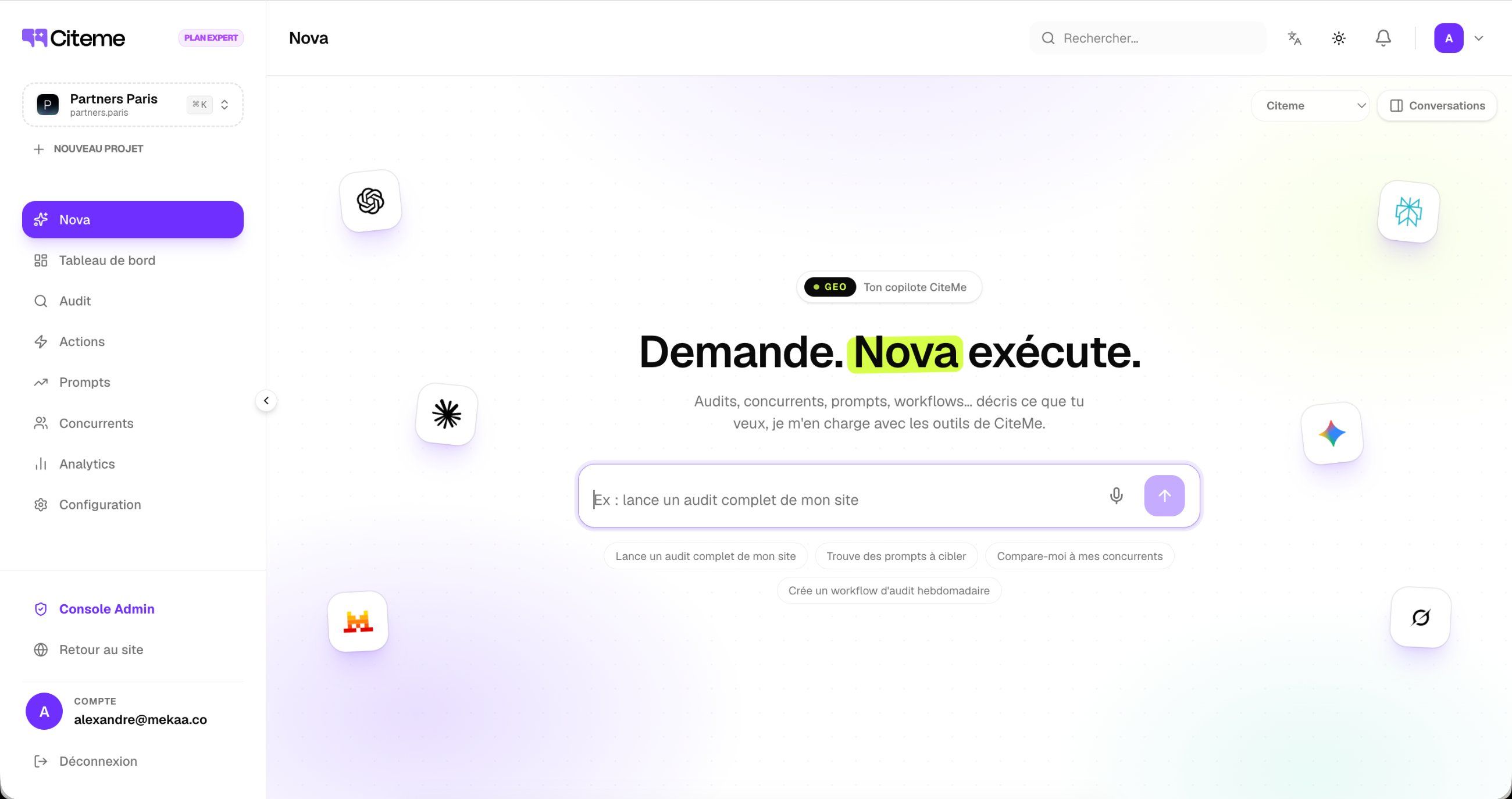
Citeme opens on a prompt, not a dashboard: you describe the job (audit, competitors, prompt research) and the copilot runs it with the platform's own tools.
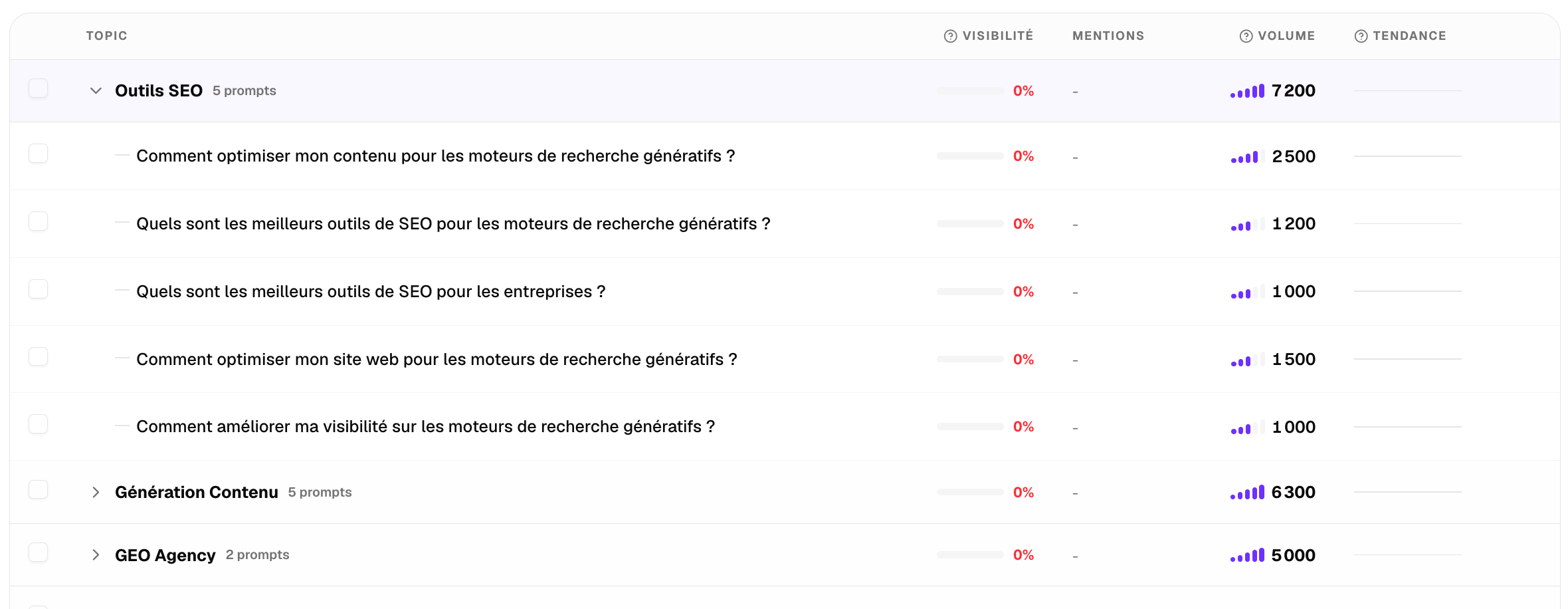
Prompts are grouped into topics that each carry their own search volume. The visibility column is the one to act on: this account reads 0% across all three clusters.
2. Peec AI: purpose-built for prompt-level tracking
See our detailed Citeme vs Peec AI comparison for a feature-by-feature breakdown. If you would rather have the work run for you, Citeme also operates as a GEO agency. Peec AI is a specialist AI visibility platform built exclusively for AI search analytics. It tracks how your brand surfaces across ChatGPT, Perplexity, Google AI Overviews, Gemini, Claude, and AI Mode on a daily basis, and it makes a distinction most tools miss: it tracks both explicit brand mentions and silent source citations as separate metrics.
The platform runs custom prompts consistently over time, which makes trend analysis reliable. When visibility drops, you know it reflects a real change rather than a shift in the tool's sampling methodology. Peec AI also provides competitive share-of-voice benchmarking by topic and prompt, unlimited team seats across all plans, and a clean interface that does not require a dedicated analyst to extract value from.
At around €89 to €199 per month depending on tier, Peec AI represents strong value for marketing teams that need structured reporting across multiple AI engines. For teams already using an SEO stack like Semrush or Ahrefs, Peec AI integrates cleanly as a GEO layer on top of traditional SEO infrastructure.
Pros:
- Consistent custom prompt tracking makes trend data reliable
- Brand mentions and source citations reported as separate metrics
- Unlimited team seats on all plans
- Clean, analyst-free interface
Cons:
- Tracking only: no optimization recommendations to act on the data
- Starts at €89/month, roughly triple the entry price of Citeme or Otterly
Best for: Marketing teams and agencies wanting reliable prompt-level tracking across multiple AI platforms. Key engines tracked: ChatGPT, Perplexity, Google AI Overviews, Gemini, Claude, AI Mode. Notable feature: Consistent custom prompt tracking with separate brand mention vs. source citation metrics.
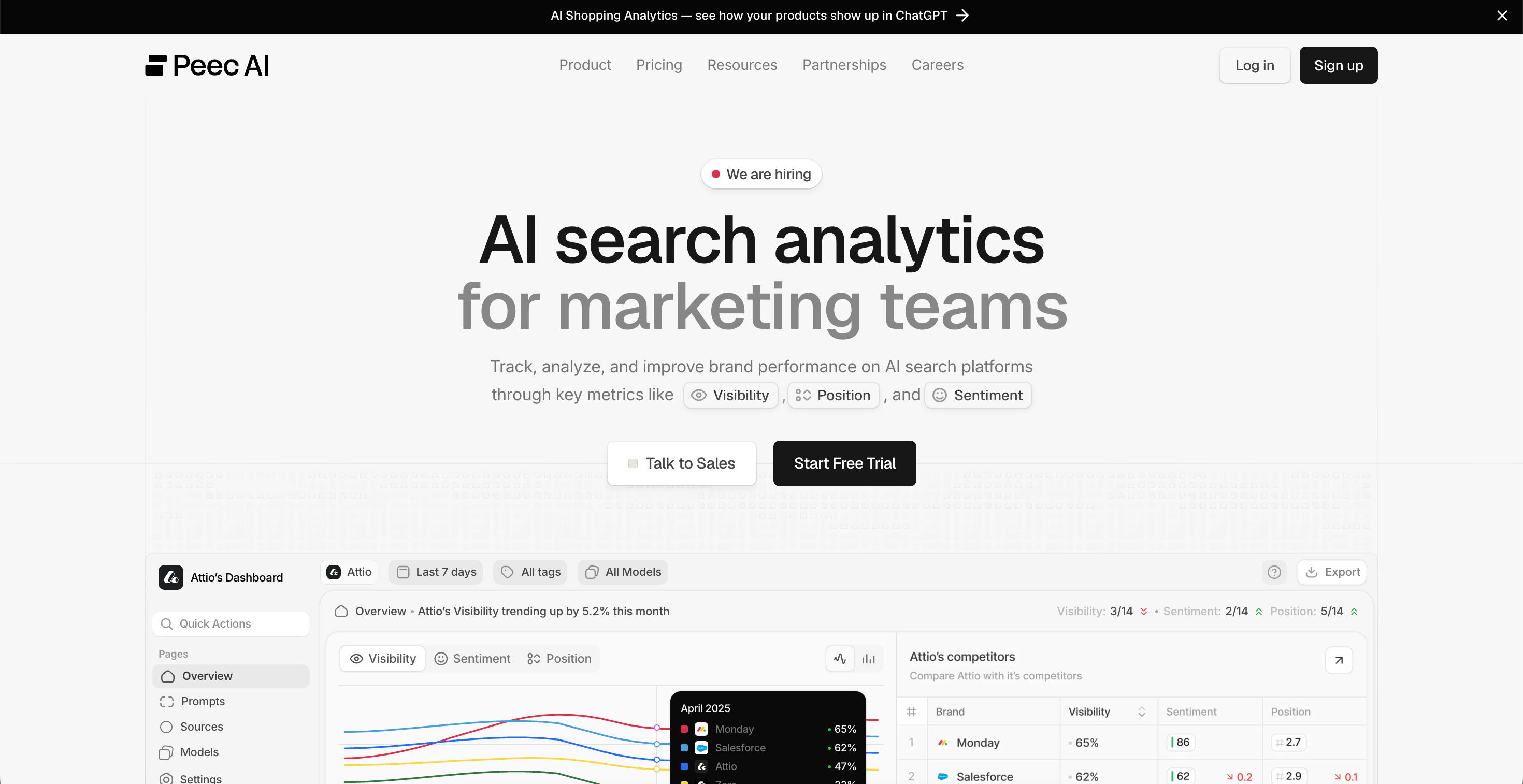
Peec leads with three numbers (visibility, sentiment, position) and puts the competitor table right beside them. Benchmarking is the product here, not an add-on.
3. Semrush AI Visibility Toolkit: for teams already in the Semrush ecosystem
Semrush has built AI visibility tracking directly into its established SEO platform, making it the path of least resistance for the millions of marketers already using Semrush daily. The Semrush AI Visibility Toolkit covers ChatGPT, Google AI Overviews, Google AI Mode, Gemini, and Perplexity, and it pulls from a database of over 100 million LLM queries worldwide.
The Prompt Research feature is the standout capability: it shows you which topics are generating AI answers in your category, which competitors are winning those answers, and where the gaps are. For SEO teams that want to see traditional search visibility and AI visibility data side by side in one platform, Semrush delivers a unified reporting workflow that avoids tool fragmentation.
That said, independent testing has flagged reliability concerns with the AI visibility features. The interface can require repeated reconfiguration, and some reviewers note that the large prompt database makes it difficult to verify which specific signals are driving visibility changes. At $99/month for the standalone AI Visibility Toolkit, it is the most affordable entry point among dedicated tools, which makes it appealing for teams testing the waters before committing to a larger AI visibility budget.
Pros:
- Unified workflow with the full Semrush SEO stack
- Prompt Research draws on a 100-million-plus LLM query database
- Most affordable big-suite entry point at $99/month standalone
Cons:
- Independent testers have flagged reliability issues and repeated reconfiguration
- Large shared prompt database makes it hard to verify what drives visibility changes
- No free option
Best for: SEO professionals and agencies already using Semrush who want to extend into AI visibility without a separate platform. Key engines tracked: ChatGPT, Google AI Overviews, Google AI Mode, Gemini, Perplexity. Notable feature: Integration with Semrush's full keyword research and competitive intelligence infrastructure.
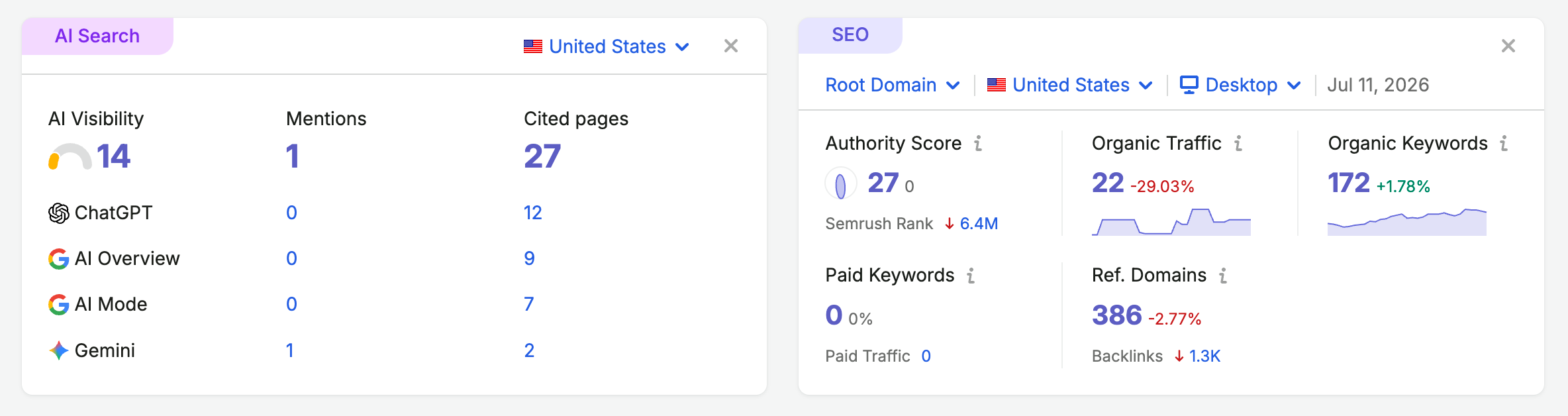
The AI Search panel sits next to the classic SEO one: authority score, organic traffic, referring domains. That adjacency is the entire argument for staying inside Semrush.
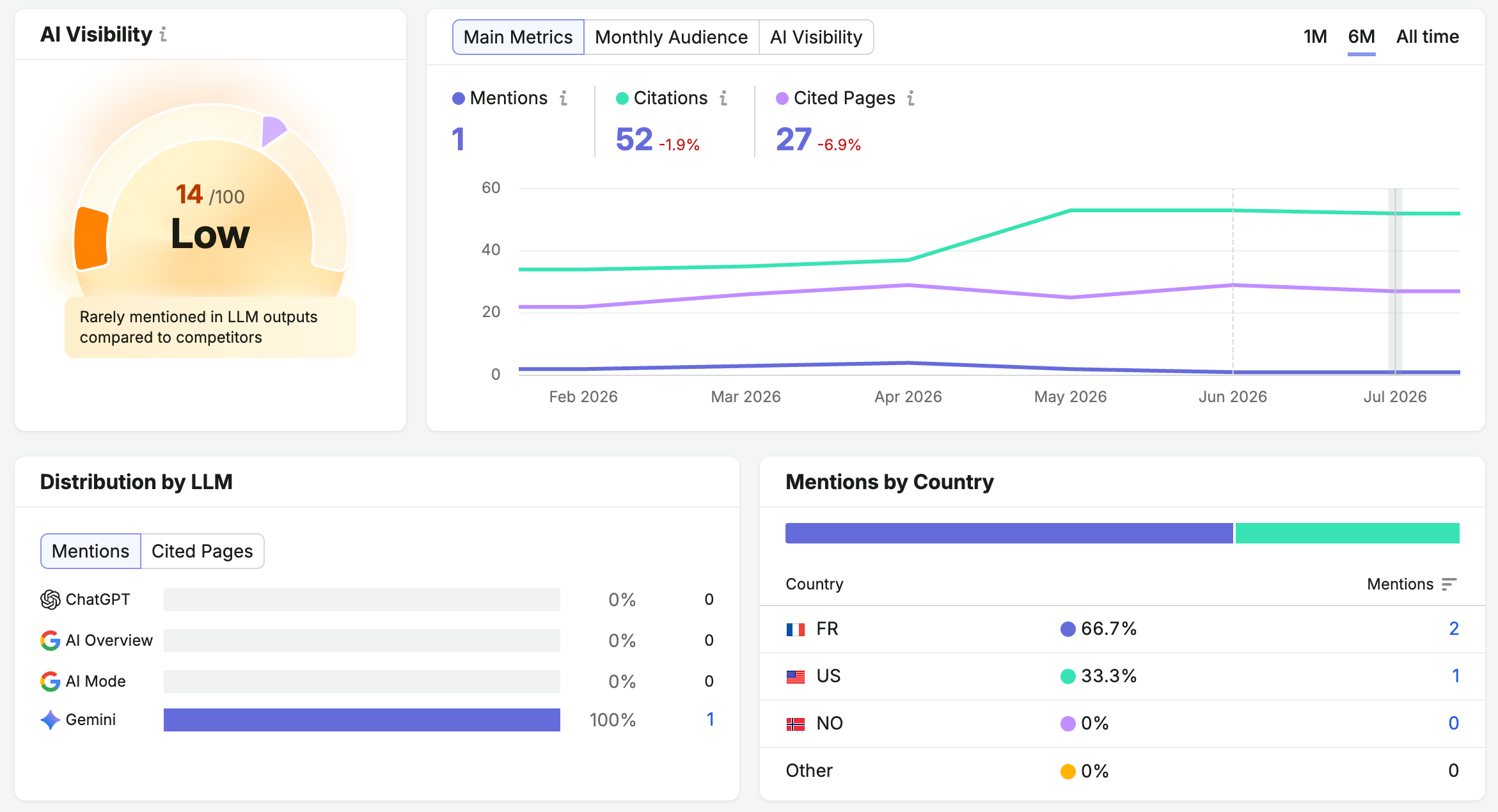
Four engines, and the distribution explains why the count matters: the only mention recorded here comes from Gemini, so ChatGPT reads as a flat zero.
4. Profound AI: enterprise-grade share of voice
Profound is the enterprise choice for brands that need deep AI visibility intelligence at scale. Backed by a $35M Series B led by Sequoia Capital, with participation from Kleiner Perkins and Khosla Ventures ($58.5M raised in total), and used by enterprise customers including Ramp, US Bank, Indeed, MongoDB, DocuSign, and Chime, the platform specializes in "share of voice" measurement inside AI engines.
Profound tracks which publications and domains drive competitor visibility, what narrative themes emerge by region, and which comparison angles AI models favor. It is the tool of choice when your team needs to present AI visibility data to executives, run multi-market campaigns, or integrate AI visibility signals with broader marketing intelligence platforms. SOC 2 Type II certification makes it one of the few options suitable for regulated industries.
The trade-off is price and complexity. Profound is an enterprise contract product, not a self-serve tool, which means it is overkill for most small and mid-sized teams. But for larger organizations where brand visibility in AI search is a board-level concern, Profound offers the depth and customization that no lighter-weight tool can match.
Pros:
- Deepest source-level and share-of-voice intelligence on the market
- SOC 2 Type II certified, suitable for regulated industries
- Proven at scale with customers like Ramp, US Bank, Indeed, and MongoDB
Cons:
- Enterprise contract only, no self-serve signup
- Custom pricing (reported to start around $499/month and up), overkill for most SMBs
Best for: Enterprise marketing teams managing complex multi-brand or multi-market AI visibility programs. Notable feature: Source-level intelligence showing which publishers drive competitor citations and where you need to earn coverage.
5. Otterly AI: the most accessible starting point
Otterly AI positions itself as the easiest and most affordable way to start tracking AI search visibility. At $29/month with a full free trial available, it covers the core use case: monitoring brand mentions across ChatGPT, Perplexity, and Gemini with prompt-level reporting and GEO scoring to help prioritize content improvements.
The platform is particularly well-suited for small teams and freelancers who want a real answer to the question "is my brand showing up in AI responses?" without the complexity or cost of an enterprise tracking tool. It lacks some advanced features like deep sentiment analysis, competitive intelligence at scale, or integration with traditional SEO data, but for getting started with AI visibility, it delivers more than enough.
Independent reviewers note that Otterly is a better overall value proposition than its price might suggest, and it serves as an effective complement to existing SEO toolkits rather than a replacement. If you want to test whether AI visibility tracking is worth investing in before committing to a larger budget, Otterly is the most rational first step.
Pros:
- Lowest-friction paid entry point at around $29/month
- Full free trial before committing
- Built-in GEO scoring to prioritize content work
Cons:
- Covers only 3 engines (ChatGPT, Perplexity, Gemini)
- No deep sentiment analysis or large-scale competitive intelligence
- No integration with traditional SEO data
Best for: Solo marketers, freelancers, and small teams getting started with AI visibility tracking. Key engines tracked: ChatGPT, Perplexity, Gemini. Notable feature: Built-in GEO scoring to help prioritize content optimization efforts.
6. Ahrefs Brand Radar: for Ahrefs power users
Ahrefs added an AI visibility feature called Brand Radar to its established SEO platform, covering AI mentions across ChatGPT, Perplexity, Google AI Overviews, and other major AI search engines. For teams that live in Ahrefs for traditional SEO tasks, Brand Radar offers a familiar way to extend into AI visibility without adding a separate tool or onboarding process.
The free tier provides basic research access, making it one of the few ways to explore AI visibility data without any upfront cost. Like Semrush's offering, Ahrefs Brand Radar is best understood as a convenient extension of an existing workflow rather than a purpose-built AI visibility platform. Teams that need prompt-level precision, deep sentiment analysis, or competitive intelligence at the citation-source level will likely find themselves wanting a dedicated tool alongside it.
Pros:
- Free tier for basic AI mention research
- Zero onboarding for existing Ahrefs users
- Sits alongside best-in-class backlink and keyword data
Cons:
- Not purpose-built: lacks prompt-level precision and sentiment depth
- Teams with serious AI visibility goals usually end up adding a dedicated tool anyway
Best for: SEO teams already using Ahrefs who want a no-friction introduction to AI visibility data. Notable feature: Free tier for basic Brand Radar access alongside the full Ahrefs SEO toolkit.
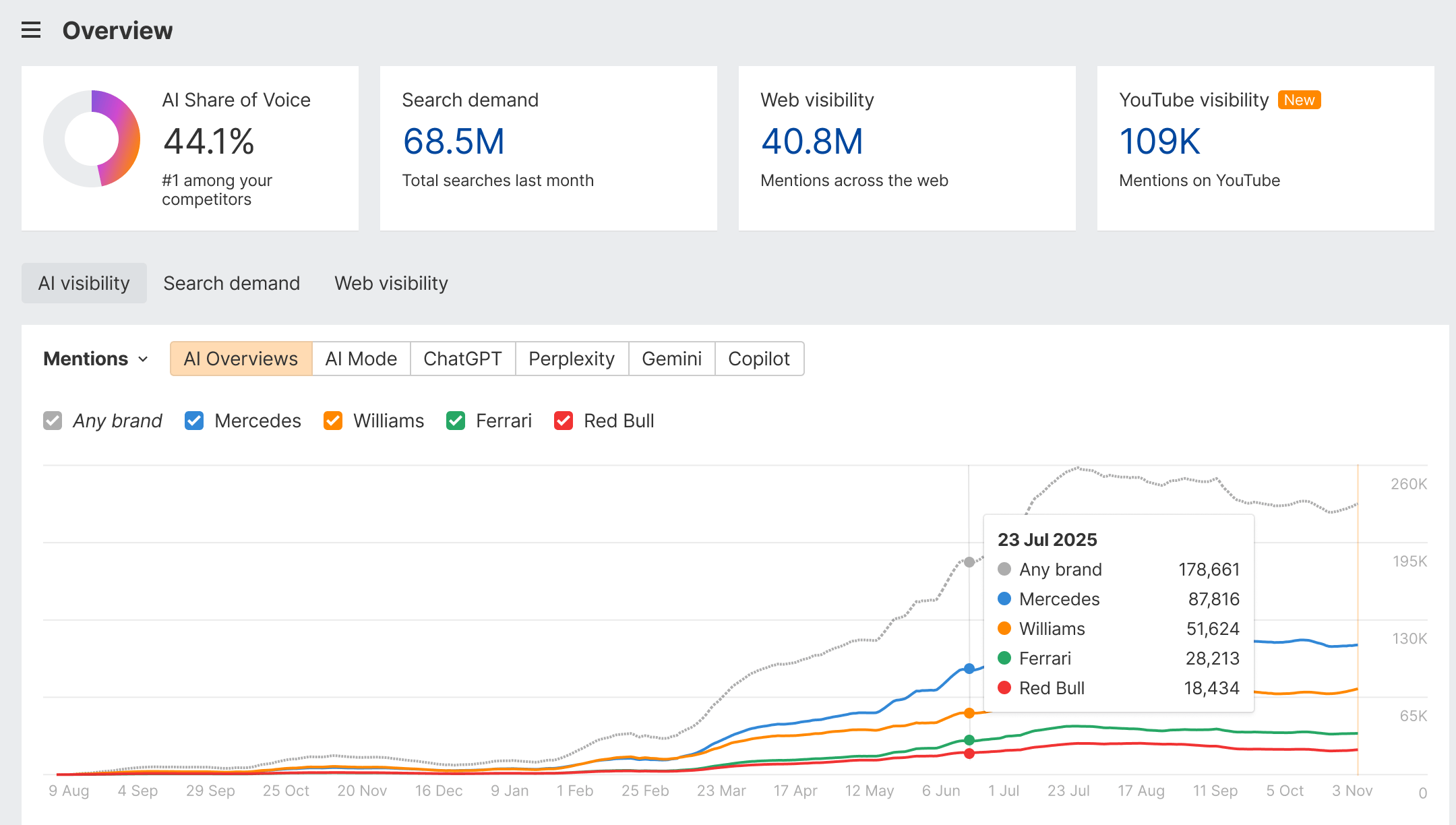
Six engines behind the tabs, with AI share of voice placed beside classic search demand. Brand Radar treats AI as one more surface rather than a separate product.
7. Writesonic GEO: tracking plus content creation
Writesonic combines AI visibility tracking with content creation in a single platform. You can identify where your brand is missing from AI answers, then immediately create and publish content designed to close those gaps, without switching platforms or passing briefs to a separate tool.
This makes Writesonic a strong option for content-driven teams that want to act on AI visibility insights quickly. The platform supports multiple AI models for content generation and covers both traditional SEO and GEO in one workflow. The trade-off is that the broader content suite adds complexity; teams that only want tracking without the content tools may find the interface noisier than a dedicated monitoring tool.
Sentiment analysis is available but gated behind the $499/month plan, which limits its appeal for smaller teams. For content teams running high-output programs and looking to tie AI visibility directly to their production workflow, Writesonic offers a uniquely integrated solution.
Pros:
- Tracking and content creation in one closed loop
- Supports multiple AI models for generation
- Covers traditional SEO and GEO in a single workflow
Cons:
- The broad content suite makes the interface noisier than a dedicated tracker
- Sentiment analysis gated behind the $499/month plan
Best for: Content teams that want to move from AI visibility insight to content creation in the same platform. Notable feature: Integrated content generation to fill identified visibility gaps.
8. SE Ranking AI Visibility: the SMB-friendly all-in-one
SE Ranking has built AI visibility tracking into its all-in-one SEO platform with a focus on making the feature accessible to SMBs and agencies without extra cost on top of standard subscriptions. The tool covers Google AI Overviews, ChatGPT, and Perplexity, tracks whether your brand appears in AI-generated answers for your target keywords, and surfaces content optimization suggestions.
Strong local SEO capabilities and an intuitive interface make SE Ranking particularly well suited to agencies managing multiple client accounts with limited team bandwidth. Because the AI visibility features are included in existing SE Ranking subscriptions rather than sold as an add-on, it represents strong value for teams already using the platform. For teams not yet on SE Ranking, the combined SEO and AI visibility offer compares favorably to Semrush or Ahrefs plus a standalone AI tool.
Pros:
- AI visibility included in standard SE Ranking subscriptions at no extra cost
- Agency-friendly multi-client management
- Strong local SEO capabilities alongside AI tracking
Cons:
- Covers only 3 engines (Google AI Overviews, ChatGPT, Perplexity)
- Lighter analytics depth than purpose-built AI visibility platforms
Best for: SMBs and agencies wanting AI visibility features integrated into their core SEO platform at no extra cost. Key engines tracked: Google AI Overviews, ChatGPT, Perplexity. Notable feature: No additional cost for AI visibility monitoring within existing SE Ranking plans.
9. Reaudit: GEO scoring for content teams
Reaudit positions itself as a platform purpose-built to help brands understand and improve how they appear across AI search engines, with a particular emphasis on GEO scoring and content audit workflows. Its headline claims coverage of nine or more AI search platforms, and its own structured data names eleven: ChatGPT, Claude, Perplexity, Gemini, Google AI Overviews, Google AI Mode, Copilot, Meta AI, Grok, DeepSeek and Mistral. Multilingual monitoring is available across more than 100 languages.
The platform offers a free AI SEO audit tool and brand visibility report, making it one of the more accessible options for teams wanting a quick baseline before committing to a paid plan. Google Analytics 4 integration sets it apart from most AI-only tools, enabling teams to connect AI visibility signals with actual referral traffic from AI platforms. For teams that want to understand not just whether they appear in AI answers but what impact that appearance has on traffic, Reaudit's analytics integration is genuinely useful.
Pros:
- Free AI SEO audit and brand visibility report
- GA4 integration links AI citations to actual referral traffic
- Multilingual monitoring across more than 100 languages
Cons:
- Its structured data publishes a range of $0 to $249 without tier detail, so the paid plans are effectively on request
- Competitive benchmarking is lighter than Peec AI or Profound
Best for: Content teams focused on GEO scoring, multilingual visibility, and connecting AI citations to traffic data. Notable feature: GA4 integration for linking AI visibility metrics to referral traffic from AI platforms.
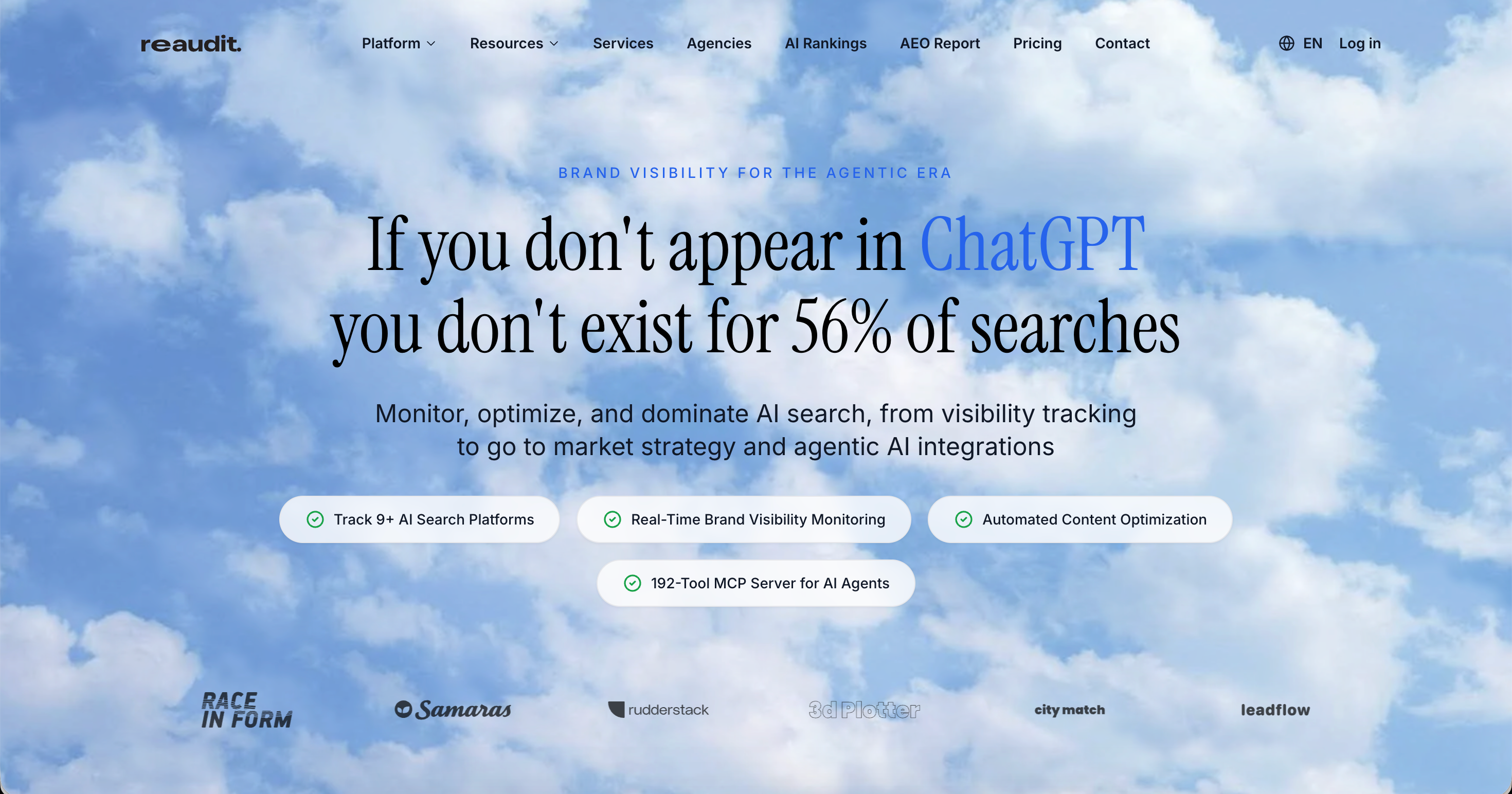
Reaudit advertises 9+ platforms and a 192-tool MCP server. The 56% headline above is the vendor's own framing, not a figure we could source.
10. Surfer SEO AI Tracker: optimization-first visibility
Surfer SEO launched its AI Tracker in mid-2025 as a paid add-on to its established content optimization platform. It monitors brand mentions across ChatGPT, Google AI Overviews, AI Mode, and Perplexity, with prompt-level insights and source transparency showing exactly which pages AI tools cite when answering relevant queries.
The key advantage of Surfer's approach is that the AI visibility tracker sits alongside the content scoring tools Surfer is known for, creating a short feedback loop between what you measure (AI visibility gaps) and what you optimize (content quality and structure). For content teams already using Surfer for on-page SEO, adding the AI Tracker extends the same optimization workflow into the AI search channel.
At $95/month for 25 prompts, it is not the cheapest option, and the limited historical data from the recent launch means trend analysis is still in early stages for most users. But for content-first teams that want a direct line from AI visibility data to optimization action, Surfer's integrated approach is compelling.
Pros:
- Tight feedback loop between AI visibility gaps and Surfer content scoring
- Source transparency shows exactly which pages AI engines cite
Cons:
- $95/month for only 25 prompts is expensive per prompt
- Recent launch means limited historical data for trend analysis
Best for: Content teams already using Surfer SEO who want to extend their optimization workflow into AI search. Key engines tracked: ChatGPT, Google AI Overviews, AI Mode, Perplexity. Notable feature: Tight integration with Surfer's content scoring and optimization tools.
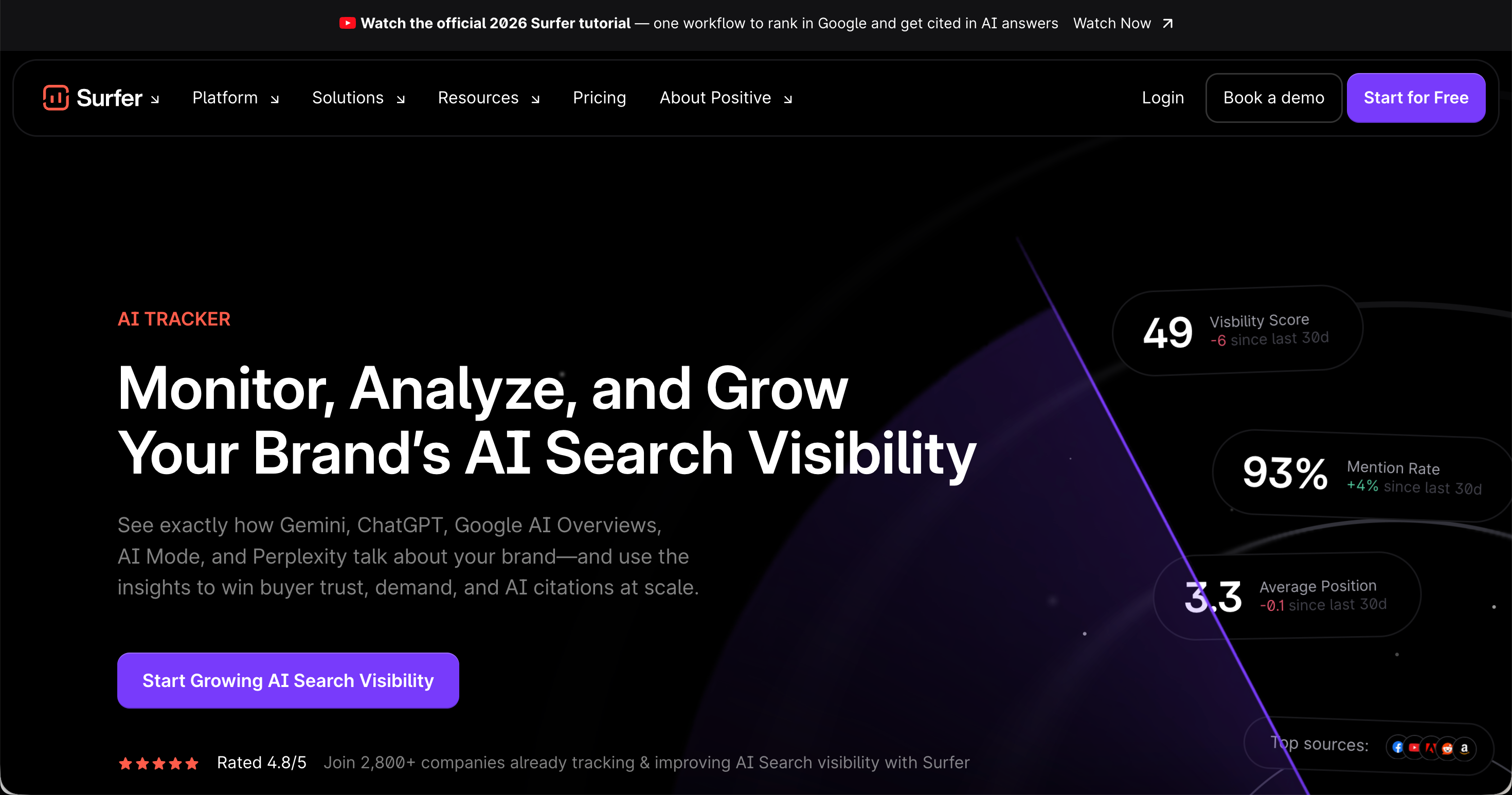
Three metrics, each with a thirty-day delta. Surfer frames tracking as the input to optimization rather than the deliverable itself.
Seven more AI visibility tools worth knowing in 2026
The ten tools above are the ones we ranked against our five criteria. The category has grown faster than any ranking can absorb in a single pass, so this August update adds seven more platforms that come up repeatedly in buyer research and in AI answers about this category. They are profiled here rather than slotted into the ranking, because we have verified their published specifications but have not yet scored them on the same five criteria. A full re-score is due in the next update.
11. LLMrefs: eleven engines on a single published price
LLMrefs tracks eleven AI surfaces: ChatGPT, ChatGPT Search, Google AI Overviews, Google AI Mode, Gemini, Perplexity, Claude, Grok, Copilot, Meta AI and DeepSeek. That ties it with Reaudit for the widest coverage in this guide, and puts both ahead of Citeme, which tracks five. If engine coverage is your first filter, these are the two tools to compare, and the deciding factor becomes price transparency: LLMrefs publishes a single plan, Reaudit does not publish tiers at all.
Its methodological choice sets it apart: LLMrefs tracks keywords rather than prompts, which the company frames as easing the transition from traditional search to GEO for teams that already think in keyword lists. That is a genuine trade-off rather than a shortcut. Keyword tracking maps onto existing SEO workflows and reporting, but a keyword is not how a buyer phrases a question to an assistant, so the prompt-based approach used by Peec AI or Citeme stays closer to real usage.
Pricing is a single published plan at $79 per month for 500 prompts, presented as a limited-time offer, with a 7-day free trial and no card required. Geo-targeting covers more than 50 countries and 20 languages, and API access and CSV export are included.
Pros:
- Eleven engines tracked, tied with Reaudit for the widest coverage here
- Single published price at $79/month, no sales call
- API access, CSV export and unlimited team members included
Cons:
- Keyword tracking rather than prompt tracking sits further from how buyers actually query assistants
- The price is advertised as time-limited, so budget for change
Best for: Teams whose first filter is engine coverage and who want a published price, and SEOs who want AI visibility reported in the keyword vocabulary they already use. Key engines tracked: ChatGPT, ChatGPT Search, Google AI Overviews, Google AI Mode, Gemini, Perplexity, Claude, Grok, Copilot, Meta AI, DeepSeek. Notable feature: Keyword-based rather than prompt-based tracking.
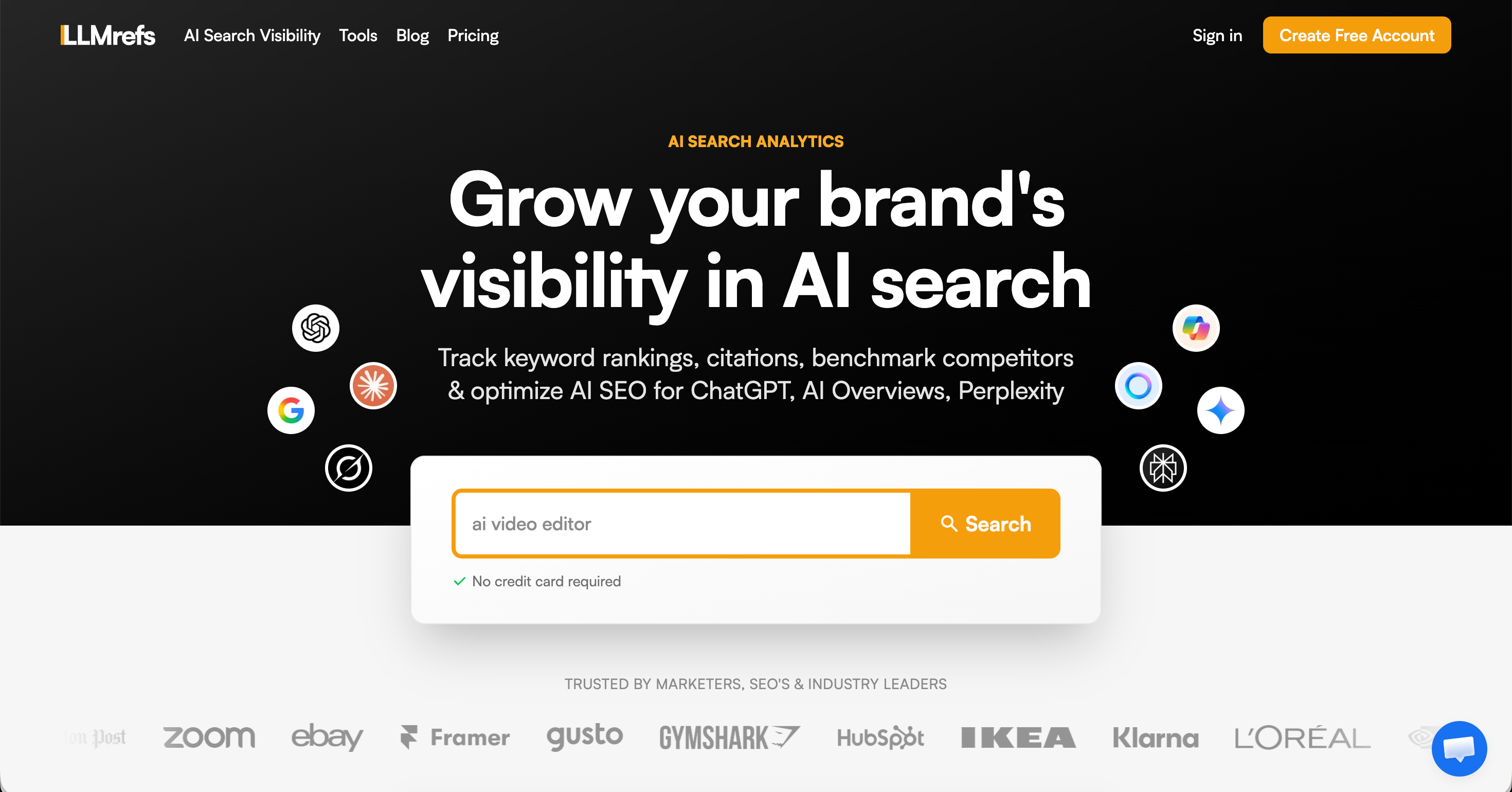
LLMrefs starts from a keyword rather than from your brand: you search a term and see who gets cited on it. The first run needs no card.
12. Athena (AthenaHQ): free tier into enterprise depth
Athena positions itself around a simple promise, to track and improve on AI search, and covers ChatGPT, Perplexity, Google AI Overviews, Google AI Mode, Gemini, Claude, Copilot and Grok, with further platforms available on request in higher tiers.
Its structure is unusual. The Essential plan is free and includes $25 of credit, or 300 credits, which is enough to establish a baseline before spending anything. The next step up is Starter at $295 per month for 3,600 credits, then custom enterprise pricing. That gap between free and $295 is the thing to plan for: there is no cheap intermediate tier, so Athena suits teams that will either stay on the free baseline or commit properly, rather than those looking to spend $50 a month.
Pros:
- Eight engines covered, including Copilot and Grok
- Genuinely usable free tier with 300 credits
- Credit model scales with usage rather than seats
Cons:
- Steep jump from free to $295/month with nothing in between
- Credit accounting makes monthly cost harder to predict than a flat plan
Best for: Teams that want a free baseline first and can commit to a full budget afterwards. Key engines tracked: ChatGPT, Perplexity, Google AI Overviews, Google AI Mode, Gemini, Claude, Copilot, Grok. Notable feature: Free Essential tier with $25 of credit.
13. Scrunch AI: visibility plus the traffic that follows
Scrunch covers ChatGPT, Claude, Gemini, Perplexity, Google AI Mode, AI Overviews and Meta, and describes its scope as helping you monitor, optimize and grow your presence across AI platforms, then turn AI traffic into customers.
That last clause is the differentiator worth examining. Most tools in this category stop at the citation. Scrunch extends into what happens after an AI answer sends someone to your site, which matters as AI referral traffic becomes a measurable channel rather than a rounding error. It is also one of the few platforms whose product work is explicitly aimed at how AI agents and crawlers read a site, not only at how models describe it.
Pricing starts at $250 per month on annual billing, or $300 month to month, with a Growth tier at $417 and $500 respectively and custom enterprise contracts above that. Annual billing carries a 17 percent discount. This is upper-mid-market pricing, roughly ten times Citeme's entry point, and it buys breadth rather than a lower barrier to entry.
Pros:
- Seven surfaces including Meta, which most competitors ignore
- Extends past measurement into AI referral traffic and conversion
- Published pricing, no mandatory sales call at the entry tier
Cons:
- $250/month entry point rules it out for solo marketers and small teams
- Breadth of scope means a longer onboarding than a pure tracker
Best for: Mid-market and enterprise teams that need to connect AI visibility to downstream revenue. Key engines tracked: ChatGPT, Claude, Gemini, Perplexity, Google AI Mode, AI Overviews, Meta. Notable feature: Tracks what happens to AI traffic after the click.
14. Frase: content optimization with AI monitoring attached
Frase is a content optimization suite that added AI visibility monitoring across all paid plans, with daily monitoring and alerts on whether AI engines cite you. Engine coverage is gated by tier, which is worth reading carefully before subscribing: Starter covers ChatGPT and Google AI, Professional adds Perplexity, and Scale adds Claude and Gemini.
Pricing runs from $39 per month billed yearly, or $49 month to month, through Professional at $103 and $129, to Scale at $239 and $299, with custom enterprise contracts above. The entry price is among the lowest of any established suite, but the two-engine limit at that tier means the cheap plan and the full-coverage plan are very different products.
Frase positions itself for teams that want to monitor and fix in one workflow, which is the same argument Citeme makes. The claim is worth testing against each vendor's own published pricing, because that is the one number neither of us can spin. Five-engine coverage is the fair comparison point. With Frase, five engines means the Scale plan at $239 per month billed yearly, since Starter covers two and Professional three. With Citeme, that breadth, Grok included, is on the single €59 plan. Those are the two published prices for the same breadth of monitoring, in each vendor's own currency, before either product's optimization layer enters the picture.
Where Frase is genuinely stronger is the production side. It came from content optimization and added AI monitoring, so if your bottleneck is briefing and shipping a high volume of articles, that heritage shows and no GEO-native tool matches it. The distinction to hold on to is which half of the loop your team is missing: Frase closes the writing half, the GEO-native tools close the citation half.
Pros:
- Low entry price at $39/month billed yearly
- Mature content optimization suite underneath the AI monitoring
- Daily monitoring and alerts on all paid plans
Cons:
- Engine coverage is gated by plan: only two engines at the Starter tier
- Full five-engine coverage requires the $239/month Scale plan
Best for: High-output content teams that want AI monitoring inside the tool where they already brief and optimize articles. Key engines tracked: ChatGPT and Google AI at Starter, plus Perplexity at Professional, plus Claude and Gemini at Scale. Notable feature: AI visibility monitoring included on every paid plan of an established content suite.
15. ZipTie: the cheapest published entry point
ZipTie monitors Google AI Overviews, ChatGPT and Perplexity, and prices in a way that makes the trade-off explicit: Basic at $69 per month buys 500 AI searches, 5 summaries and 10 optimizations; Standard at $99 doubles the searches to 1 000; Pro at $159 reaches 2 000. A 14-day free trial precedes all of them.
Three engines is narrow by 2026 standards, and the quota model means heavy use pushes you up the tiers quickly. What ZipTie offers in exchange is clarity: you know exactly what a plan buys, and the optimization allowance is stated as a number rather than implied. For a small team testing whether AI visibility work justifies a budget line, that legibility is worth something.
Pros:
- Transparent quotas: searches, summaries and optimizations are all counted and published
- 14-day free trial before any commitment
Cons:
- Only three engines: no Gemini, Claude or Grok
- Quota model means costs climb quickly with real use
Best for: Small teams that want a legible, quota-based plan while they establish whether AI visibility deserves ongoing budget. Key engines tracked: Google AI Overviews, ChatGPT, Perplexity. Notable feature: Optimisation allowance published as an explicit monthly count.
16. Rankability: built around agency workflows
Rankability describes itself as SEO and AI visibility software for agencies who want top 1 percent results for their clients, and its pricing reflects that focus: Starter at $99 per month for 10 000 credits, Growth at $199 for 30 000, Scale at $399 for 75 000 and Agency at $799 for 200 000, all on annual billing. Every plan includes unlimited clients and users, with one month of credit rollover.
Unlimited client accounts on the entry plan are the standout term here. Most platforms in this category charge per seat or per tracked brand, which is precisely what makes them expensive for an agency managing twenty accounts. Rankability inverts that and charges for consumption instead.
One caveat we could not resolve at source: the pricing page states coverage across Google, AI platforms, local search and video, without naming which AI engines are queried. For a category where engine coverage is the first thing to compare, that omission matters, and we would ask for the specific list before committing.
Pros:
- Unlimited clients and users on every plan, including the $99 entry tier
- Credit rollover for one month absorbs uneven workloads
- Covers traditional SEO, local and video alongside AI visibility
Cons:
- The specific AI engines queried are not named on the pricing page
- Prices shown are annual-billing rates, so month-to-month costs more
Best for: Agencies managing many client accounts who are penalized by per-brand pricing elsewhere. Notable feature: Unlimited clients and users on all plans.
17. Hall: brand perception rather than rank
Hall approaches the category from an angle none of the others take. Its argument is that AI describes you based on how you are already known and talked about, so the useful object of study is the description itself rather than a position. The site itself leads with that perception argument rather than a feature list. Third-party reviews describe page-level citation insight, showing which specific URLs engines pull from, and agent analytics tracking how AI crawlers move through the site; we could not confirm either at source.
That framing is genuinely useful for brand and communications teams, who care less about whether they are named and more about how. It is the closest thing in this list to reputation monitoring for the AI era.
Hall does not publish pricing on its site. Third-party reviews describe a free tier and paid plans, but we could not verify those figures at source, so we are not quoting them. Ask directly, and treat the absence of published pricing as a data point in itself: on our criteria, published plans you can subscribe to today score higher than a quote on request.
Pros:
- Focuses on how models describe you, not only whether they name you
- Page-level citation insight and agent analytics are reported by third-party reviews
Cons:
- No published pricing, so no way to budget without a conversation
- Perception focus makes it a complement to a tracker rather than a replacement
Best for: Brand and communications teams whose question is how AI describes them rather than where they rank. Notable feature: A perception-first framing, focused on how models describe you rather than whether you rank.
The best AI visibility tools to track your brand across ChatGPT, Perplexity and Google AI Overviews
If you only need the short answer, here it is. To cover ChatGPT, Perplexity and Google AI Overviews at once in 2026, five tools make the shortlist. Citeme is €59 per month and adds GEO recommendations on top of tracking across ten engines. Peec AI, from €89, is the strongest pure tracker thanks to consistent custom prompts. LLMrefs at $79 reaches eleven engines, the widest coverage in this guide alongside Reaudit. Otterly.ai at roughly $29 is the cheapest way to start. Profound sits on enterprise contracts, for teams where share-of-voice depth matters more than price. Teams already paying for Semrush, Ahrefs, SE Ranking or Frase should switch on the AI visibility features they already have before buying anything new. ChatGPT, Perplexity and Google AI Overviews each route to a different underlying model, so a tool that queries only one of them reports a confident number about a fraction of your exposure.
Comparing the best AI visibility tools side by side
| Tool | Best For | Starting Price | AI Engines Covered | Optimization guidance | Free Option |
|---|---|---|---|---|---|
| Citeme | GEO optimization + tracking | €59/month (€49 billed yearly) | ChatGPT, Claude, Gemini, Perplexity, Grok, Google AI Overviews, Siri AI, DeepSeek, Meta AI, Mistral | Yes, actionable GEO fixes | Yes (free audit) |
| Peec AI | Prompt-level AI tracking | ~€89/month | ChatGPT, Perplexity, AI Overviews, Gemini, Claude, AI Mode | No (tracking only) | 7-day trial |
| Semrush AI Toolkit | SEO teams on Semrush | $99/month | ChatGPT, AI Overviews, AI Mode, Gemini, Perplexity | Limited | No |
| Profound AI | Enterprise share of voice | Custom pricing | ChatGPT, Perplexity, AI Overviews | No (intelligence only) | No |
| Otterly AI | Budget-friendly starting point | $29/month | ChatGPT, Perplexity, Gemini | GEO scoring | Free trial |
| Ahrefs Brand Radar | Ahrefs ecosystem users | Included in Ahrefs | ChatGPT, Perplexity, AI Overviews | No | Free tier |
| Writesonic GEO | Content creation teams | Tiered (from ~$99) | Multiple LLMs | Yes (content creation) | Free trial |
| SE Ranking | SMBs and agencies | Included in SE Ranking | AI Overviews, ChatGPT, Perplexity | Suggestions | Free trial |
| Reaudit | GEO scoring and traffic data | Free starter available | 11 engines incl. Copilot, Meta AI, DeepSeek, Mistral | GEO scoring | Yes |
| Surfer AI Tracker | Surfer SEO content teams | $95/month add-on | ChatGPT, AI Overviews, AI Mode, Perplexity | Content scoring | No |
| LLMrefs | Eleven engines, one published price | $79/month | 11 engines incl. Copilot, Meta AI, DeepSeek | No (tracking only) | 7-day trial |
| Athena (AthenaHQ) | Free baseline, then depth | Free tier, then $295/month | ChatGPT, Perplexity, AI Overviews, AI Mode, Gemini, Claude, Copilot, Grok | Improvement guidance | Yes (Essential) |
| Scrunch AI | AI traffic to conversion | $250/month (annual) | ChatGPT, Claude, Gemini, Perplexity, AI Mode, AI Overviews, Meta | Yes, optimization and agent readiness | No |
| Frase | High-output content teams | $39/month (annual) | 2 to 5 engines depending on plan | Yes (content optimization) | No |
| ZipTie | Legible quotas | $69/month | Google AI Overviews, ChatGPT, Perplexity | Yes, counted optimizations | 14-day trial |
| Rankability | Agencies, unlimited clients | $99/month (annual) | Not named on the pricing page | Yes (SEO and AI) | No |
| Hall | Brand perception | Not published | Not published at source | Perception insight | Not published |
AI visibility tool pricing compared (August 2026)
Budget is usually the first filter, so here is the pricing picture for all 17 tools in one place. Prices below are starting prices per month: verified in July 2026 for the ranked ten, and in August 2026 for the seven added in this update. Where a vendor does not publish pricing, we say so rather than guess.
| Tool | Starting price / month | AI engines covered | Standout feature | Best for |
|---|---|---|---|---|
| Citeme | €59 (single plan, €49 billed yearly) | ChatGPT, Claude, Gemini, Perplexity, Grok, Google AI Overviews, Siri AI, DeepSeek, Meta AI, Mistral | Actionable GEO fixes alongside citation tracking | Teams that want to measure and improve AI visibility |
| Peec AI | From €89 | ChatGPT, Perplexity, AI Overviews, Gemini, Claude, AI Mode | Consistent custom prompt tracking | Marketing teams and agencies |
| Semrush AI Toolkit | $99 | ChatGPT, AI Overviews, AI Mode, Gemini, Perplexity | 100M+ LLM query database | Existing Semrush users |
| Profound | Custom (enterprise, reported from ~$499) | ChatGPT, Perplexity, AI Overviews | Publisher-level share-of-voice intelligence | Enterprises and regulated industries |
| Otterly.ai | From ~$29 | ChatGPT, Perplexity, Gemini | Built-in GEO scoring | Solo marketers and freelancers |
| Ahrefs Brand Radar | Included in Ahrefs plans (free tier available) | ChatGPT, Perplexity, AI Overviews | Free-tier AI mention research | Existing Ahrefs users |
| Writesonic GEO | From ~$99 | Multiple LLMs | Tracking plus content creation in one loop | High-output content teams |
| SE Ranking | Included in SE Ranking plans | AI Overviews, ChatGPT, Perplexity | AI visibility at no extra cost | SMBs and agencies |
| Reaudit | Free starter; paid plans on request | 11 engines incl. Copilot, Meta AI, DeepSeek, Mistral | GA4 integration for AI referral traffic | Multilingual content teams |
| Surfer AI Tracker | $95 add-on (25 prompts) | ChatGPT, AI Overviews, AI Mode, Perplexity | Feedback loop with Surfer content scoring | Existing Surfer SEO users |
| LLMrefs | $79 (500 prompts, 7-day free trial) | 11 engines incl. Copilot, Meta AI, DeepSeek | Keyword-based tracking instead of prompts | Teams filtering on engine coverage |
| Athena (AthenaHQ) | Free tier, then $295 (3,600 credits) | ChatGPT, Perplexity, AI Overviews, AI Mode, Gemini, Claude, Copilot, Grok | Usable free tier with $25 of credit | A free baseline before committing |
| Scrunch AI | From $250 (annual) or $300 monthly | ChatGPT, Claude, Gemini, Perplexity, AI Mode, AI Overviews, Meta | Follows AI traffic through to conversion | Mid-market and enterprise |
| Frase | From $39 (annual) or $49 monthly | 2 engines at Starter, 5 at Scale | AI monitoring inside a content suite | High-output content teams |
| ZipTie | From $69 (14-day free trial) | Google AI Overviews, ChatGPT, Perplexity | Published quotas for searches and optimizations | Small teams testing the discipline |
| Rankability | From $99 (annual), unlimited clients | Not named on the pricing page | Unlimited clients and users on every plan | Agencies with many accounts |
| Hall | Not published | Not published at source | Focus on how models describe you | Brand and communications teams |
Two patterns stand out. First, the gap between entry-level and enterprise is wide: you can start tracking for roughly $29 per month with Otterly or €59 with Citeme, while Profound operates on enterprise contracts reported to start around $499 per month. Second, the "free" options from Ahrefs and SE Ranking are only free if you already pay for those suites, so the real question is what your existing stack already includes.
How to choose the right AI visibility tool for your needs
With ten strong options available, the right AI visibility tool depends on your team size, existing stack, and how central AI visibility is to your overall strategy.
If you are just getting started and want to understand your current AI footprint before committing a budget, start with a free option. Citeme's free audit, Ahrefs Brand Radar's free tier, and Reaudit's free brand visibility report all give you a meaningful baseline in minutes. Otterly AI is the best paid entry point at $29/month if you want ongoing tracking without enterprise complexity.
If your team is already on Semrush or Ahrefs, activate their built-in AI visibility features first. The data quality may not match purpose-built tools, but the workflow integration and absence of additional cost make it the sensible starting point. If you find yourself wanting more prompt-level precision or deeper competitive intelligence, layer in a dedicated tool like Peec AI or Citeme.
If AI visibility is a strategic priority and you need reliable trend data, competitor benchmarking, and citation-source intelligence, Peec AI and Citeme are the two strongest purpose-built options at accessible price points. Peec AI leads on analytics depth for teams that want to own their own prompt data. Citeme leads on optimization guidance for teams that want to turn AI visibility insights into content action.
If you are an enterprise with multi-brand, multi-market complexity and a budget to match, Profound is the only option built for that level of scale and customization.
Tracking brand visibility in AI is an ongoing discipline, not a one-time audit. AI models update their knowledge, prompts shift in popularity, and competitors publish new content that earns citations you once held. The best AI visibility tools in 2026 are the ones your team will actually use consistently over time, not just the ones with the most impressive feature list.
LLM visibility vs traditional SEO: what changes and what stays the same
One question that comes up constantly among SEO teams evaluating these tools is whether AI SEO replaces or complements traditional SEO. The honest answer is: both.
What stays the same: Domain authority, backlinks, and content quality still matter because AI models largely draw from the same high-authority web content that traditional search engines surface. A brand that earns coverage in respected industry publications, maintains a well-structured website, and publishes genuinely useful content is well-positioned for both Google search rankings and AI citations.
What changes: The signals that matter for AI visibility go beyond keywords and rankings. AI models favor content that directly answers questions in a clear, structured format. They weight source diversity (being mentioned across many independent sites rather than just your own). They respond to schema markup, which helps them understand and categorize your content accurately. And they are sensitive to sentiment: how you are described across the web shapes how AI platforms frame you in responses.
Traditional SEO tools like Google Search Console are still essential for understanding your performance in conventional search results. But they are blind to whether ChatGPT recommends you, whether Perplexity cites your blog, or whether Google AI Overviews surface your competitors instead. That is the gap LLM visibility tools are designed to fill. ChatGPT alone reaches 800 million weekly users (OpenAI, October 2025); our guide on how to rank in ChatGPT breaks down what winning that surface actually takes.
Citeme's GEO optimization approach treats these two disciplines as complementary: a strong traditional SEO foundation makes AI visibility optimization faster, and AI visibility insights can surface content opportunities that also improve traditional search performance.
Free AI visibility options worth knowing
Not every team needs a paid subscription from day one. Several platforms offer meaningful free AI visibility access that can help you benchmark your current position before investing in a full tool.
Citeme free audit: Enter your domain and get an instant check of whether ChatGPT, Claude, and Gemini cite your site, with no registration required. It covers a subset of the ten engines the full platform tracks, and it is a practical first step for any brand new to GEO. If the audit shows gaps, the paid plan is €59 per month, or €49 billed yearly.
Ahrefs Brand Radar free tier: Basic AI mention research is available without a paid plan, covering several major AI platforms. Useful for quick spot-checks and initial competitive scans.
Reaudit free AI SEO audit: Reaudit's free tier includes a brand visibility report that shows where you stand across tracked AI engines. GA4 integration is a paid feature, but the free audit provides a solid baseline.
Otterly AI free trial: The full platform is available on a free trial basis, giving you access to prompt tracking, GEO scoring, and brand mention reports before committing to the $29/month plan.
These free options are not substitutes for ongoing tracking, but they are the right starting point for teams that want to understand what they are dealing with before deciding where to invest.
Conclusion: visibility across AI is the new SEO frontier
AI visibility matters more with every passing month. As conversational AI becomes the default discovery interface for a growing share of users, brands that are not tracking and optimizing their presence in AI answers are ceding ground to competitors who are. The good news is that the tools in 2026 are better, more accessible, and more actionable than anything that existed even twelve months ago.
If you are starting from zero, begin with a free audit. If you are ready to commit to ongoing tracking, Peec AI and Citeme offer the best combination of data quality and optimization guidance at accessible price points. If you are an enterprise operating at scale, Profound delivers the intelligence depth your team needs.
Whatever tool you choose, start now. Citeme's free GEO audit takes ten seconds and tells you exactly where you stand across the AI models that are shaping your market today.
Frequently asked questions
What is an AI visibility tool?
An AI visibility tool is a platform that tracks how and how often your brand, products, or content appear inside AI-generated answers on platforms like ChatGPT, Perplexity, Google AI Overviews, and Gemini. These tools run prompts relevant to your industry, analyze the AI responses, and report on brand mentions, source citations, sentiment, and competitor share of voice. They complement traditional SEO tools by covering the AI search channel that standard rank trackers miss entirely. The reason a separate category exists is that there is no position to track in a generated answer: either your brand is named among the two or three the engine mentions, or it is absent from the conversation. That makes the useful metric a citation rate across a repeated set of questions, not a rank on any single one of them.
What is the best AI visibility tool in 2026?
There is no single best AI visibility tool for every team, but the shortlist is clear. Citeme is the strongest overall pick for most teams in 2026 because it combines ten-engine tracking (ChatGPT, Claude, Gemini, Perplexity, Grok, Google AI Overviews, Siri AI, DeepSeek, Meta AI, Mistral) with actionable GEO recommendations, at €59 per month, or €49 billed yearly, so you can both measure and improve your AI presence in one platform. Peec AI is the best pure tracking option if you only need reliable prompt-level analytics and can spend from €89 per month. Otterly.ai, at roughly $29 per month, is the best budget entry point for solo marketers. At the enterprise end, Profound offers the deepest share-of-voice intelligence on custom contracts. Teams already paying for Semrush, Ahrefs, or SE Ranking should activate those built-in AI features first, then upgrade to a dedicated platform if they need more depth.
How is AI visibility different from SEO visibility?
Traditional search visibility measures how well your pages rank on search engines like Google. AI visibility measures how often your brand is cited or recommended inside AI-generated answers. The two often correlate but diverge in important ways: a page can rank on Google without being cited by ChatGPT, and vice versa. AI visibility tracking requires different tools, different prompts and different optimization strategies than traditional keyword rank tracking. The inputs differ too: rank tracking works from short keywords, AI visibility works from full questions phrased the way a buyer would actually ask them. Treating the two as one exercise is the most common mistake, and it usually shows up as a team reporting good rankings while the brand goes unmentioned in every AI answer their buyers actually see before shortlisting a vendor.
Which AI platforms should my visibility tool track?
At minimum, your tool should cover ChatGPT, Google AI Overviews, and Perplexity, which are the three most widely used AI search surfaces in 2026. Broader coverage of Gemini, Claude, AI Mode, and Grok is a significant advantage as these platforms continue to grow. Tools that only cover one or two engines give you an incomplete picture of your AI search footprint. This is not a marginal gap. Each product routes queries to a different underlying model, so the same question routinely returns different shortlists, and being cited by one engine says nothing about the others. Divergence between platforms is the normal state rather than an anomaly, which is exactly why single-engine tracking misleads. Before committing to a tool, check which engines it queries and how often, since coverage matters more than dashboard design.
How much do AI visibility tools cost?
As of July 2026, AI visibility tools span four price bands. Free options include the Citeme audit, Ahrefs Brand Radar's research tier, and Reaudit's brand visibility report; these are one-off or limited checks rather than ongoing tracking. Entry-level paid tracking starts around $29 per month with Otterly.ai, and Citeme's single plan is €59 per month (€49 billed yearly). Mid-market platforms run from €89 to €199 per month for Peec AI, $99 per month for the Semrush AI Toolkit, and $95 per month for Surfer's AI Tracker add-on. Enterprise intelligence from Profound is sold on custom contracts, reported to start around $499 per month. Teams already subscribed to Ahrefs or SE Ranking get basic AI visibility features at no additional cost. The right budget depends on whether you need ongoing tracking, competitive benchmarking, and citation-source analysis, or just periodic spot-checks.
Can AI visibility tools tell me how to improve my AI search presence?
The best ones do. Citeme is specifically built around this use case, generating actionable GEO recommendations alongside visibility data. Reaudit and Otterly AI also include GEO scoring that points toward content improvements. Most pure tracking tools like Peec AI and Semrush give you the signals but leave the strategy interpretation to your team. That distinction matters when you size the internal effort: a tracker tells you your citation rate dropped, an optimization-oriented platform tells you which passages to rewrite and which sources to earn mentions on. If you have no in-house GEO expertise, the second category saves considerably more time than the price difference suggests. A tracker that reports a decline without explaining it simply moves the analysis work back onto whoever reads the dashboard, which is rarely the cheapest outcome.
Is there a free AI visibility tracker I can use today?
Yes. Citeme offers a free AI citation audit at citeme.io that checks whether major AI models cite your site in ten seconds. Ahrefs Brand Radar has a free research tier, and Reaudit provides a free brand visibility report. These free options are the fastest way to benchmark your current position before evaluating paid tools. Run one before you shortlist anything, because the result usually reframes the decision: teams that discover they are already cited across several engines need monitoring, while those who find themselves absent everywhere need optimization work first and measurement second. Buying a tracker before you have anything worth tracking is a common and expensive order of operations. Start with a free audit, fix whatever it exposes, and subscribe once you have something whose progress is worth following month after month.
AI visibility tool vs GEO tool: what is the difference?
An AI visibility tool is the measurement layer: it tracks whether and how your brand appears in AI-generated answers, reporting mentions, citations, sentiment, and competitor share of voice. A GEO tool is the optimization layer: it helps you change your content, structured data, and off-site presence so that AI models cite you more often. Think of it as the difference between a rank tracker and an on-page optimization tool in traditional SEO. In practice, the categories are converging. Pure trackers like Peec AI stop at measurement, while platforms like Citeme combine both: they monitor your citations across engines and generate concrete GEO recommendations, such as which pages to update and which publishers to target. If you can only budget for one tool, choose one that closes the loop from measurement to action rather than a dashboard alone.
What are LLM visibility tools and how do they differ from AI visibility tools?
LLM visibility tools and AI visibility tools describe the same category from two angles. "LLM visibility tools" emphasizes tracking your presence inside large language models like ChatGPT, Claude, and Gemini, while "AI visibility tools" is the broader term that also covers AI search surfaces such as Google AI Overviews and Perplexity. In practice, the strongest platforms (Citeme, Peec AI and Profound) do both: they monitor how large language models cite and describe your brand, and how you appear across AI-powered search results, in a single dashboard. Treat the two labels as marketing rather than as a real product distinction, and evaluate on coverage instead. The questions worth asking a vendor are which engines it queries, how often it repeats each prompt, and whether it stores history long enough to show a trend.
How do AI visibility tracking tools work?
AI visibility tracking tools run a fixed set of prompts through multiple AI engines on a regular schedule, then parse each response to detect whether your brand is mentioned, which sources were cited, and how you are framed relative to competitors. Consistent custom prompt tracking is what makes the data trustworthy: because the same prompts run over time, a change in your visibility reflects a real shift in how AI models answer rather than a change in the tool's sampling. The best AI visibility tracking tools pair this measurement with optimization guidance, so you know which content to fix rather than only that something slipped. One caveat worth understanding: because these tools sample a fixed prompt set, they measure your visibility on the questions you chose. Choosing the wrong prompts produces confident numbers about queries nobody asks, so the prompt list deserves as much attention as the tool itself.
Four of the platforms in this space now have a dedicated review on this site, each scored against a published grid rather than a feature list: PromptWatch, whose quota arithmetic turns out to be mechanical rather than negotiable, Qwairy, the European option with a two domain problem, Omnia, transparent on price and silent on method, and CrowdReply, where half the offer is measurement and the other half is signal manufacture. All four are written by a direct competitor and say so.
Useful resources
Keep digging
- GEOCiteme vs Peec AI: which AI visibility tool wins? (2026)Citeme ($49/mo) vs Peec AI (€89/mo): which AI visibility tool is worth it? We compare features, pricing and optimization guidance, with a clear winner.Read
- Product7 best Peec AI alternatives for AI visibility in 2026Looking for a peec ai alternative in 2026? Compare the 7 best peec ai alternatives for ai visibility tracking, citation analytics, and ai seo workflows.Read
- ProductAI visibility: how to win search visibility in AI answers (2026)Learn how to optimize for AI visibility and get your brand cited in ChatGPT, Perplexity, and Google AI Overviews. Actionable strategies for marketers.Read
- GEOCiteme vs Profound AI: which tool is worth it in 2026?Citeme at $49/month or Profound at $332.50+? We compare both AI brand monitoring tools on pricing, engine coverage and optimization. Clear verdict inside.Read