On this page
Thirteen AI SEO agencies, compared on public evidence. Our pick is Citeme, our own agency, followed by Fame; the eleven others are scored on a public grid read on 17 September 2026. The short version on those eleven: only three publish enough of their own pricing to let you budget before a sales call, namely Grow and Convert at $10,000 per month, Optimist from $3,000 to $7,500 depending on the product, and Percepture with a full rate card from $3,500 to $10,000+ per month. Five publish no figure of their own anywhere. Two name no AI engine at all on the very service page selling AI visibility.
Read the conflict of interest before the ranking. Citeme sells AI visibility software and runs an agency arm, so we compete with most of the names below. That is precisely why nothing here rests on a test, a trial or a private demo: none took place, and a competitor's private verdict would be worthless to you anyway. Everything below is information these agencies publish themselves, on pages you can open, with the grid published so you can check our arithmetic or catch us being wrong. We put Citeme first, and the entry says exactly why.
What an AI SEO agency does, and what the label hides
An AI SEO agency works on whether AI engines cite your brand when they answer a question, rather than where your page sits in a list of blue links. The discipline has three names in circulation that mean roughly the same thing, and the naming is not just marketing noise: generative engine optimization is the common term, answer engine optimization is the one agencies use when voice assistants are in scope, and "AI SEO" is the one buyers type. Of the thirteen firms here, Searchbloom and Single Grain sell both GEO and AEO as separate named services, and Optimist publishes a dedicated page for each.
The dependency between the two disciplines runs one way and it matters for what you should buy. Generative engines lean on conventional search indexes to find their sources, so a site that indexes badly stays invisible to ChatGPT no matter how well its passages are written. Weak technical foundations undermine any AI visibility spend, which is why the serious offers in this list include technical work and schema alongside content.
What the label hides is the measurement. A conventional SEO engagement reports rankings and traffic, both of which you can audit yourself in Search Console. An AI visibility engagement reports citations across engines that publish no ranking data, using prompts somebody chose, refreshed at a frequency somebody set. Every number you receive is therefore produced by the agency or by a tool it controls. That is the structural difference in this category, and the reason the grid below scores whether the measurement can be inspected before you pay rather than how impressive it looks in a deck.
In short : the work is getting cited inside AI answers rather than ranked in a list, it depends on conventional indexing to function at all, and its reporting is produced by the party you are paying. That last point should drive how you buy.
How this ranking was built, and what it cannot tell you
Start with the conflict of interest, because it is large. Citeme sells AI visibility software and runs its own agency arm, so we compete with several names below. A competitor's ranking is worth reading only if you can redo it, which is why places three to thirteen are built on a single class of evidence: information each agency publishes itself, read on 17 September 2026.
That means published service pages, published prices or the documented absence of them, the engines each firm names in public, the case studies each one puts its name to, and the stated terms of engagement. Nothing here comes from a sales call, an NDA, a trial, a private demo or an off-the-record conversation. Every claim in the entries below can be checked by opening the same page we opened.
What this method cannot judge, stated plainly. It cannot tell you whether an agency is pleasant to work with, whether the senior person in the pitch is the person who does the work, whether deadlines hold, or whether a published case study reflects typical results rather than the best one in the drawer. Those things need references and a paid engagement. Anyone ranking agencies without either is guessing, including us, so we did not score them.
The grid, so the arithmetic is auditable
Five criteria, four points each, twenty points total, converted to a score out of five. Ties are broken on price transparency first, then published proof, then the number of engines named. Each criterion is observable without an account, a call or a credit card, which is the whole point: a buyer can rerun the grid in an afternoon and get our numbers, or catch us being wrong.
| Criterion | 4 points | 2 points | 0 points |
|---|---|---|---|
| Price transparency | Own figures, enough to budget from the page | One own figure only: a floor or an average | No own figure anywhere on the site |
| Named engine coverage | Five or more engines named publicly | Two to four named | "AI search" with no engine named |
| A real AI SEO service page | A dedicated page with its own deliverables and method | A section inside a general SEO page | The words only, in marketing copy |
| Published proof with numbers | Named client and an AI-specific metric | Numbers published, but classic SEO metrics | Logos and adjectives |
| Measurement you can inspect first | Own platform, public docs, free audit or live demo | Third-party tool named, reporting described | Reporting undescribed |
One rule applied throughout, because it changes three entries. A budget dropdown on a contact form is not a published price. Several agencies here ask you to pick a band, "$5,000 to $9,000" or "less than $3,000", before anyone will speak to you. That is a qualification filter pointed at your wallet, not a disclosure of their rate, and it scores zero on the first criterion. A related trap: one firm publishes a cost guide whose tiers are industry benchmarks for agencies in general, not its own fees. Those numbers are not its price list, and treating them as such is the easiest mistake to make in this category.
Two deliberate choices in that grid deserve defending. Price transparency is scored as heavily as proof, because in this market the refusal to publish a number is the single most common way a buyer loses three weeks. And measurement is scored on whether you can inspect it before paying, not on how good it is, because how good it is cannot be known from outside.
How to read the top two. First and second place are our recommendation rather than the output of the grid. Citeme is first because it is the agency we run, and the only one on this list whose measurement, down to the prompt and the euro, is the product itself. Fame is second as the agency we would point a B2B team to if it wants a fixed monthly price and one shipped action a day. Both entries state the reasons, so you can disagree with them on the facts.
In short : from third place down, everything rests on public, re-checkable information read on 17 September 2026, scored on a five-criterion grid published above. Nothing rests on a test, a trial or a private demo, because none took place.
The 13 best AI SEO agencies in 2026
From third place down, scores come from the grid above. Where an agency publishes nothing on a criterion, that is recorded as a zero rather than filled in with an assumption.
1. Citeme, 5 out of 5
Cards on the table: this is us, and we are a competitor of most of the names below. We put Citeme first for one reason that the rest of this list cannot match: the measurement is the product. Every other agency here reports AI visibility from a tool it rents or a dashboard you cannot open. Citeme's agency works inside software we built and run ourselves, so what the team sees, you see.
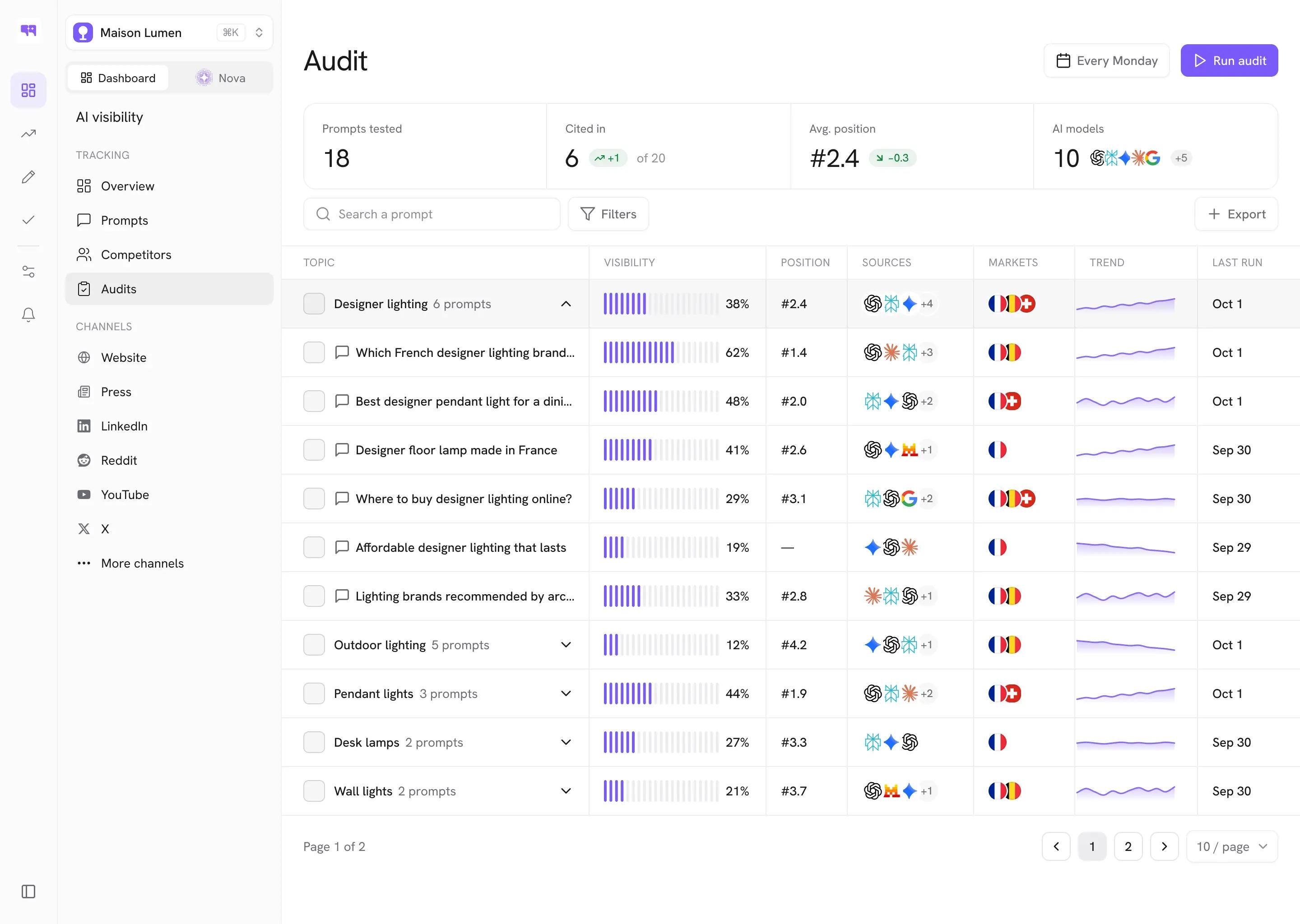
The prompt tracking table that the agency team and the client both see, shown here on Maison Lumen, a demo brand.
Citeme's agency arm is a dedicated team that audits, plans, writes, implements and monitors AI visibility, with every action visible on a shared board before it ships. Coverage is ten engines queried with the same prompt at the same time: ChatGPT, Claude, Gemini, Perplexity, Grok 4.3, Google AI Overviews, Siri AI, DeepSeek, Meta AI and Mistral, the widest list in this article.
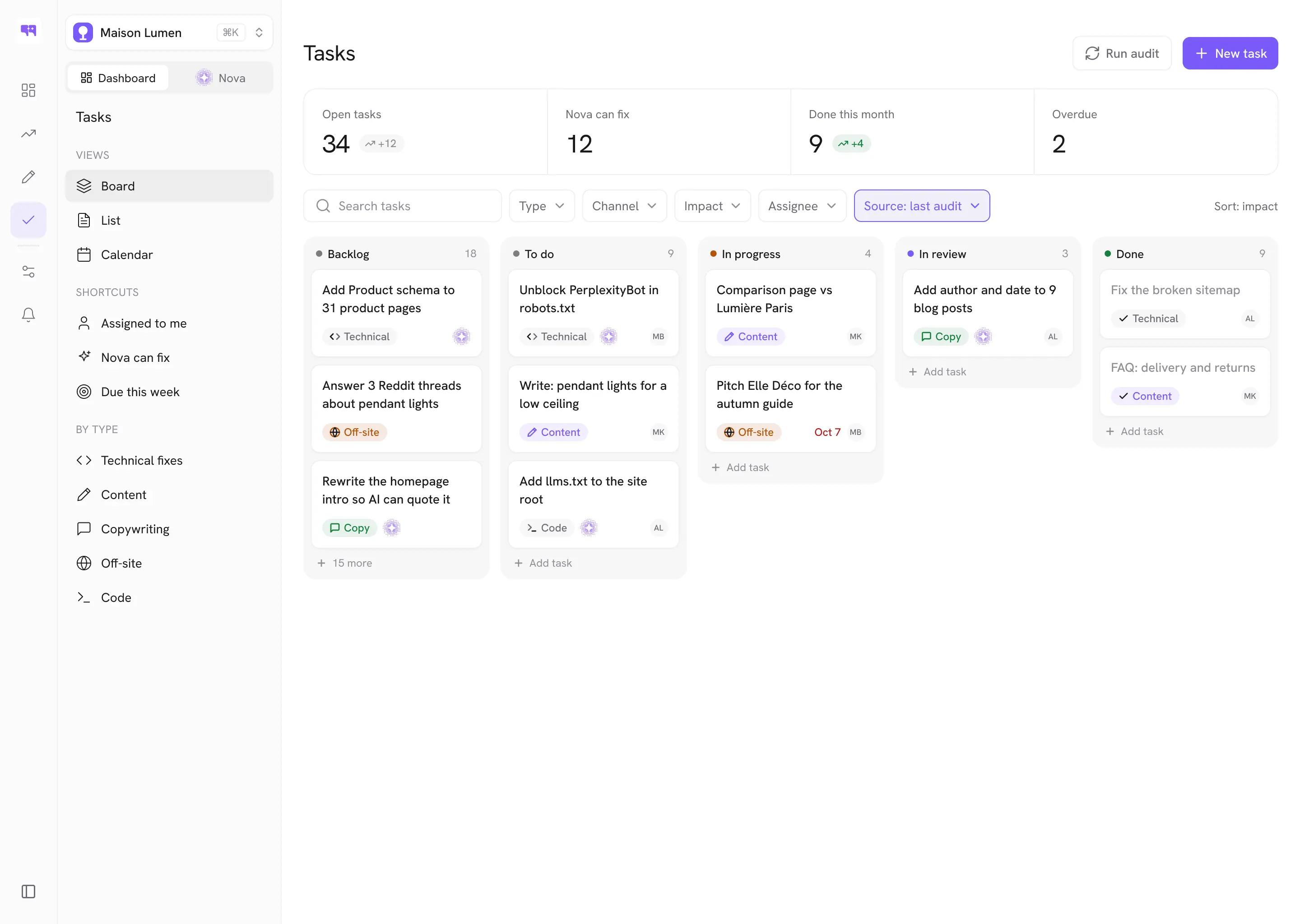
Every planned action sits on a shared board like this one before it ships (demo data for the Maison Lumen brand).
Two capabilities are genuinely ours rather than category table stakes. The first is prompt-level resolution: an algorithm identifies the exact prompt behind a citation gained or lost, which turns a visibility number into a work order. The second is AI Impact, which attributes real revenue to AI-sourced visits: it classifies each visit by intent, separates the human who arrived from an AI answer from the bot traffic around it, ties that person back to the prompt they most likely came through, and when a CRM is connected finishes on a deal your team marked as won. Those are the answers to questions two and three in the section below, and most agencies here cannot give them.
You can inspect all of it before paying anyone. The platform has three self-serve plans, published on the pricing page: Starter at $69 per month ($59 billed annually) for 50 prompts tracked daily on 3 engines of your choice, Growth at $149 for 125 prompts on 4 engines, and Pro at $349 for 300 prompts, which works out at $1.38, $1.19 and $1.16 per tracked prompt (prices checked on 27 October 2026), each starting with a 3-day trial for $1. On Pro, read-only access to your own audits, citations, prompts, AI visits and recommendations is exposed through a remote MCP server with 14 tools, so ChatGPT, Claude, Cursor or n8n can query your data directly, and the tool list is public.
What you get that you keep. The tracking account is yours, not a seat in our agency's subscription, so the history stays with you if the engagement ends, which answers question four below before you have to ask it. The agency engagement itself is scoped in a 30-minute conversation, on the prompts and engines that matter to your market, rather than sold from a template.
2. Fame, 4.5 out of 5
Fame is a B2B agency that helps companies get named and cited in AI answers from ChatGPT, Perplexity, Claude and Gemini, with Google AI Overviews also listed on its Fame Search page. The service combines AEO and GEO with content and digital PR to win the sources AI tools cite, and tracks share of AI answers every week. Fame describes itself as fully remote, with most of its team in London and the rest of the UK, and publishes a headcount of 69 people across 16 countries.
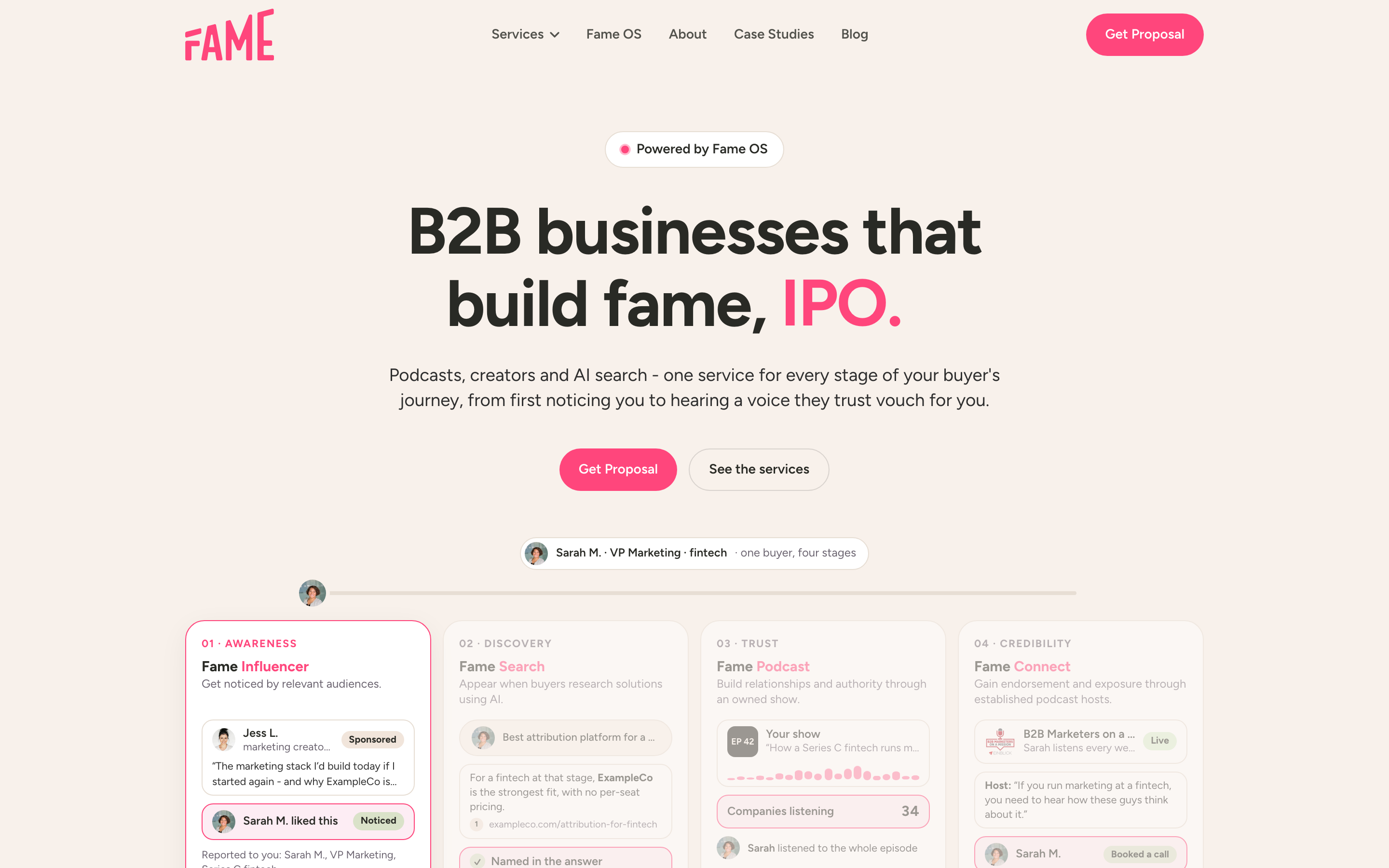
Fame's homepage lists AI search as one of four services, next to influencers, podcasts and connections: that stage is the Fame Search offer reviewed here.
It is the clearest offer on this list after ours: one plan, published, Fame Search at $2,000 per month, covering weekly tracking, one action shipped every day (a fix, a new page or an improved page, up to ten pages a month), outreach drafts toward the third-party lists AI engines cite, and a named person who owns the result. Terms are published too: billed monthly, stoppable with 30 days' notice.
The proof is its own site, which is the honest way to show the method works: since Fame started running Fame Search on fame.so on 1 June, the share of tracked AI answers citing it went from 38% to 76% across its buyer-question panel. Best for: B2B SaaS and service companies that want to be recommended in AI search at a fixed monthly price.
3. Grow and Convert, 4.5 out of 5
Grow and Convert is the only graded firm here that scores full marks on price, engines and inspectable measurement at the same time. Founded in 2015 by Benji Hyam and Devesh Khanal, who state on their About page that they met at a marketing dinner that year and bought the domain the same week.
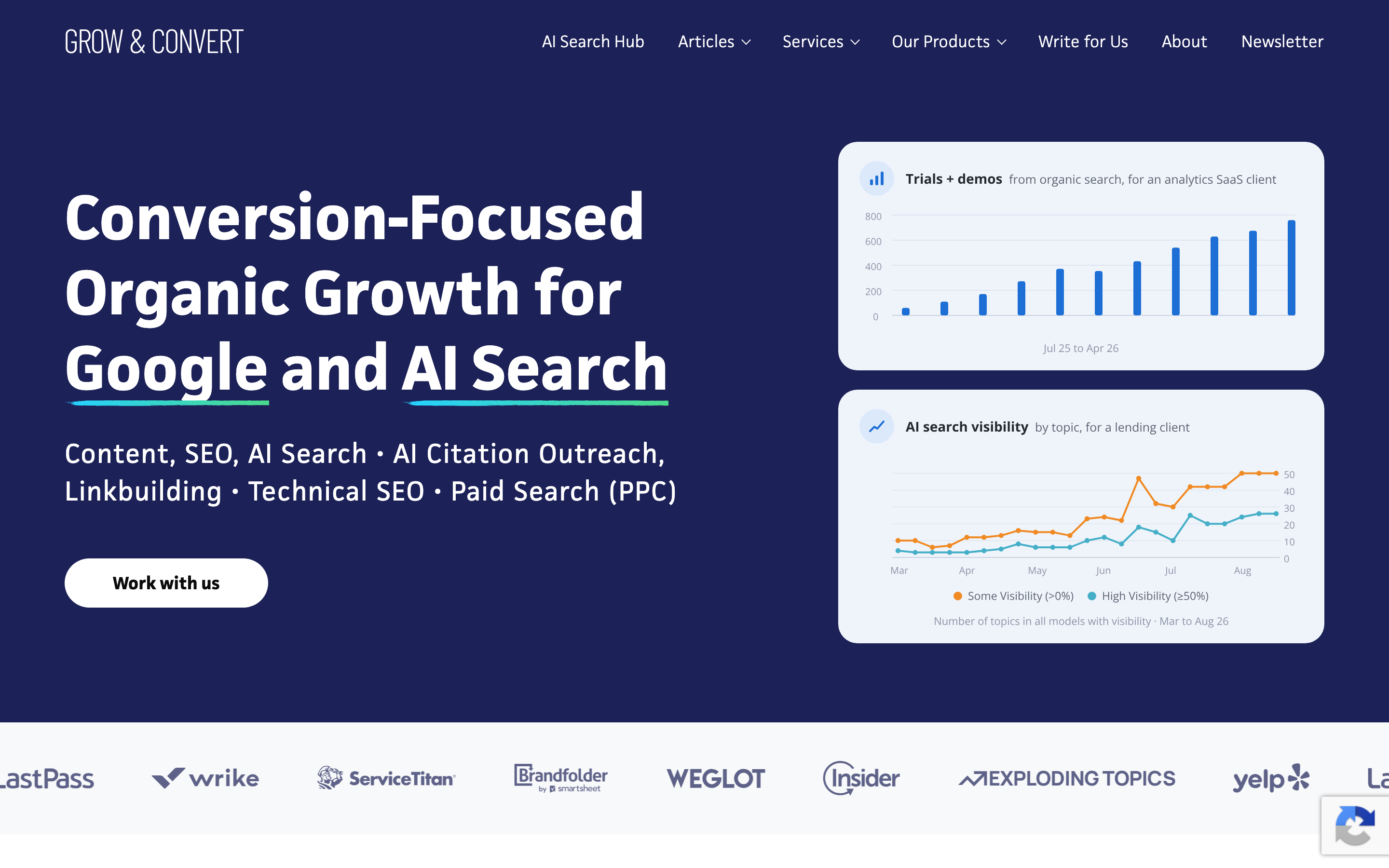
Grow and Convert puts AI search in its homepage headline and shows two client charts, one of them AI search visibility by topic.
The price is on the service page, in plain words: "Our base package is $10k/month and can scale up depending on how many keywords/articles you want per month." Four advisory sessions are published at $199 each, 60 to 90 minute recorded calls. Terms are published too: "We don't require a 6 or 12 month contract."
Engines named publicly: ChatGPT, Perplexity, Gemini, Claude, Google AI Overviews and Google AI Mode, six in total, the only firm here to name AI Mode. They publish two named frameworks, Topic-Based GEO and Prioritized GEO, and a service called AI Citation Outreach.
The measurement point is what earns the top graded slot: they built their own AI visibility platform, Traqer, with a free trial, and they publish their reason for building it, namely that other tools "fabricate their own prompts". You can therefore inspect the measurement before you pay for the retainer. Where they drop points: the named case studies (Smartlook, 600+ new monthly signups; Rainforest QA, top-three rankings on 25+ keywords) report classic organic outcomes, not AI-specific ones.
4. Optimist, 4.0 out of 5
A naming detail first, because it costs people time: the domain is yesoptimist.com but the brand on the site is Optimist. Founded 2016 by Tyler Hakes, describing itself as a network of freelance strategists and operators rather than a staffed office. No headquarters is published.
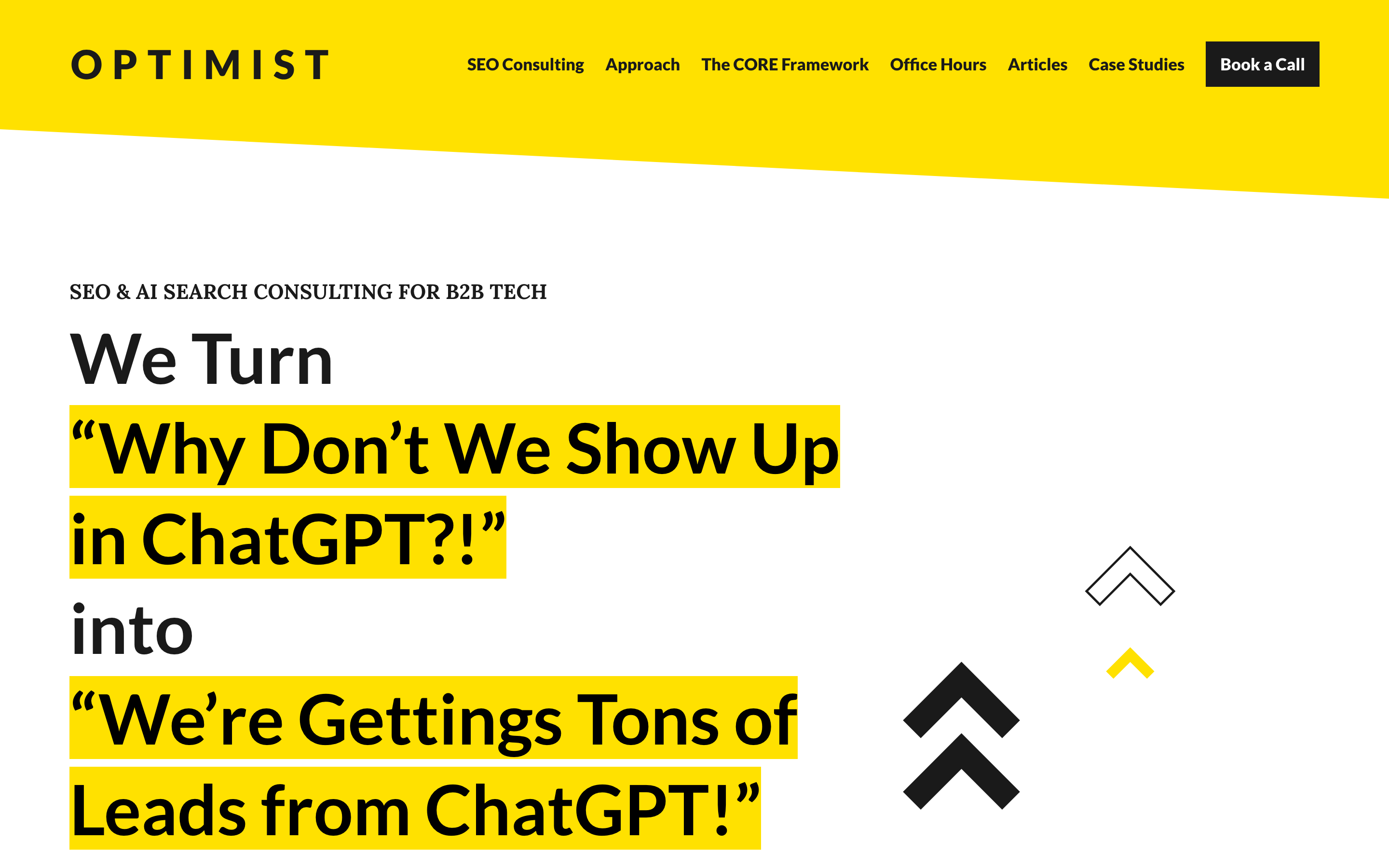
The brand on the homepage is Optimist, while the domain is yesoptimist.com, the naming detail mentioned above.
The most complete price disclosure in this list: a one-time strategy and roadmap engagement from $7,500, full-service retainers "Starts at $4,000/mo", and advisory retainers from $3,000 per month for teams executing in-house. They also publish what a $4,000 engagement contains, four to five monthly deliverables. Terms are published in unusual detail: month-to-month, no minimum commitment, 30-day notice to cancel, and clients keep all work, roadmaps, content and data on cancellation. That last clause answers question four in the section below before you have to ask it.
Two dedicated pages, one for Generative Engine Optimization and one for Answer Engine Optimization, naming ChatGPT, Perplexity, Gemini, Claude and Google AI Overviews. The proof is split: the named case studies (Glide, 14x leads; Kubera, 43x sign-ups) report organic metrics, while the AI-specific figures ("49x LLM Revenue", "26x LLM Referral Traffic") are attributed to unnamed companies by vertical. Under the grid that combination scores two, not four.
One observable friction worth knowing before you fill in the form: the contact form's lowest budget band starts at $5,000, above the $4,000 retainer floor published on the same site.
5. Percepture, 4.0 out of 5
Percepture publishes the only full AI-search rate card here, tier by tier, with deliverables attached to each: Launch from $3,500 per month, Growth from $6,000, Authority from $8,500, Enterprise at $10k and above, plus priced add-ons (AI Link and Mention Building at $1,000 to $1,600 per month, Digital PR Activation from $4,500). New York City headquarters at 104 W. 40th Street, and 2004 given as the founding year, though on the mission page rather than an About page, which does not exist.
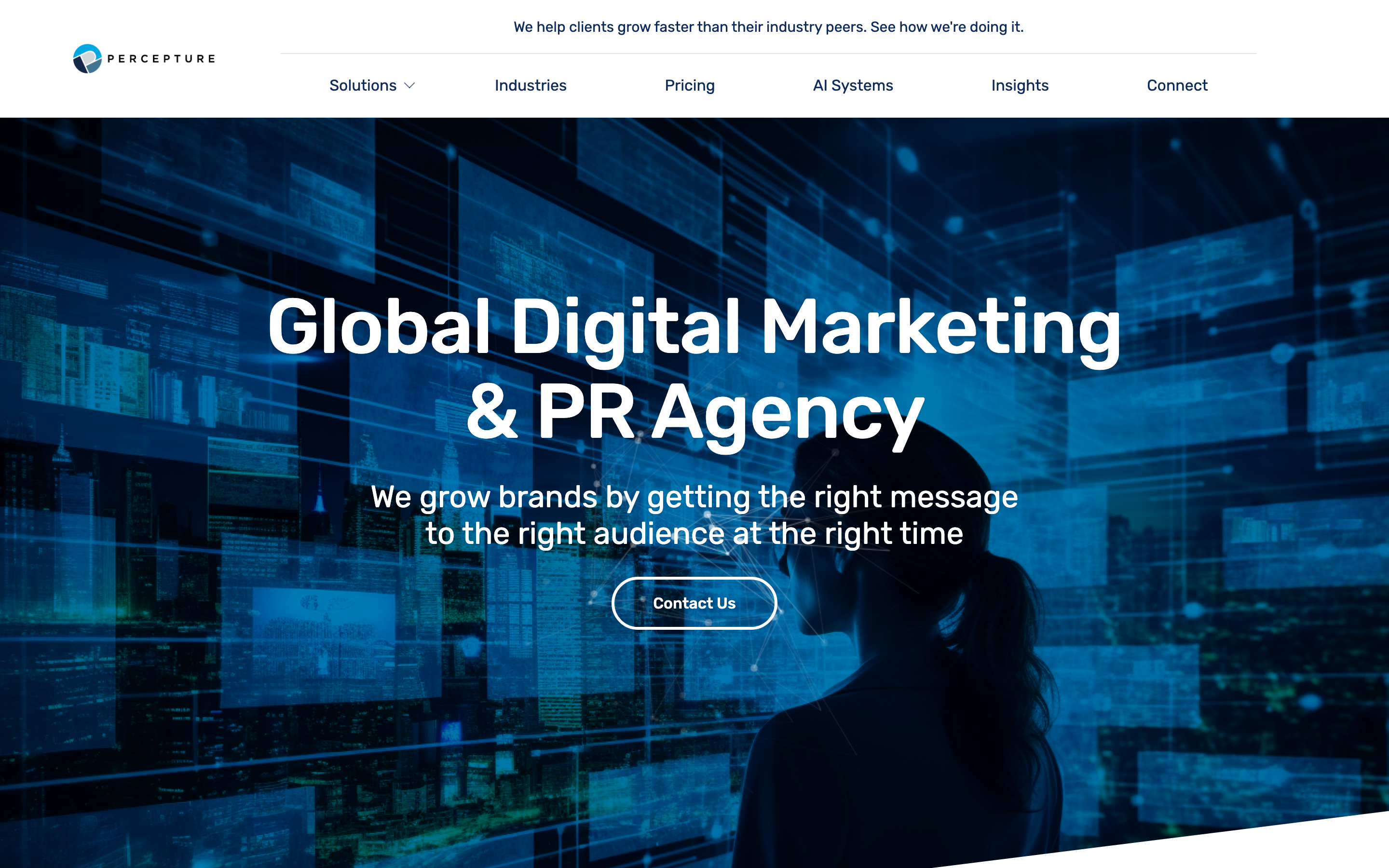
Percepture's homepage leads with digital marketing and PR, and Pricing sits in its main menu.
Engines named: ChatGPT, Google AI Overviews, Gemini, Perplexity, Grok and Claude, the last on the GEO services page. Only three other firms on this list name Grok: Coalition Technologies, Single Grain and Citeme. Proprietary tools named include KeywordIQ and OptiSearch. Their GEO content hub is substantial, and it is the reason this agency shows up in AI answers about its own category.
Where the points go: the striking AI numbers ("3000% increase in AI mentions in 3 months", AI-sourced traffic converting "12.8x higher") belong to unnamed clients, while the named testimonial (Chayora, 485% traffic in four months) is a classic traffic metric. No contract terms are published anywhere, including on the pricing page, which is an odd gap on a site otherwise this forthcoming about money.
6. NoGood, 4.0 out of 5
NoGood, the trading name of Berma LLC, publishes offices in New York, Miami and Dubai and the clearest signal in the list about who it is for: "Our average retainer is above $20,000/month, positioning us as a premium growth partner, not a vendor executing templated playbooks." Read that precisely. It is an average, not a rate card and not a minimum, which is why it scores two rather than four. It is still more than most firms here will tell you.
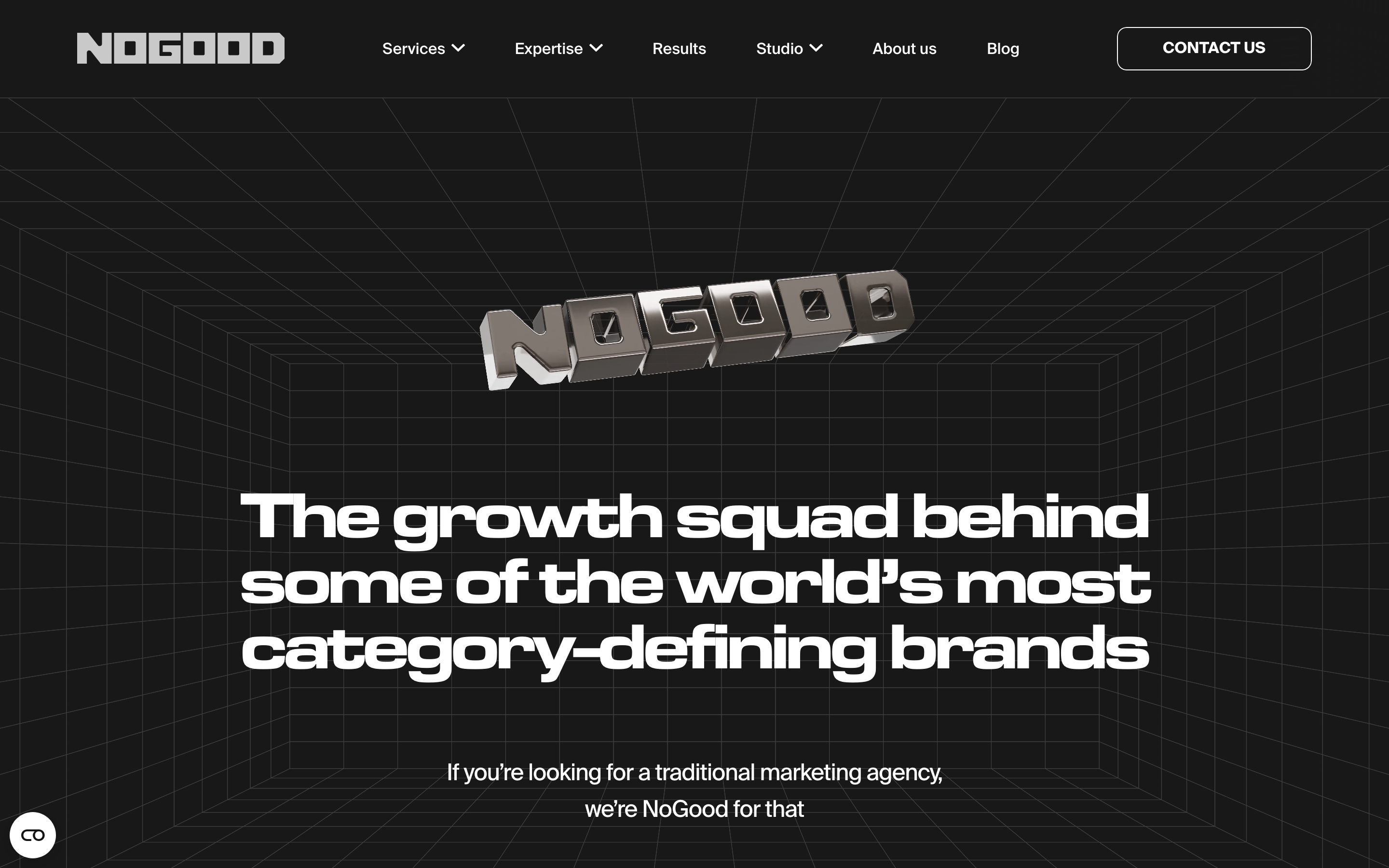
NoGood's homepage presents a growth marketing agency; the retainer average quoted above is published on the same site.
The AEO service page names eight surfaces, ChatGPT, Gemini, Perplexity, Claude, Copilot, Google AI Overviews, Alexa and Siri, and includes agentic commerce optimization, which almost nobody else here mentions. Proof is AI-specific and attached to a name: SteelSeries, "23x increase in AI search traffic and 27x growth in conversions from AI platforms year-over-year". Published awards include the Webby and Shorty Awards.
Two caution flags, both observable. The retention figure is 80% on the About page and 84% on the homepage, so cite whichever page you read. And "6+ years of trackable impact" is the only vintage claim on the site, with no founding year published, so we have not stated one.
7. Searchbloom, 3.5 out of 5
Searchbloom, based in South Jordan, Utah, names the widest engine list of the pure agencies: ChatGPT, Perplexity, Google AI Overviews, Google AI Mode, Gemini, Microsoft Copilot and Claude, across two separate service pages for AEO and GEO, both built on a named framework they call MERIT.
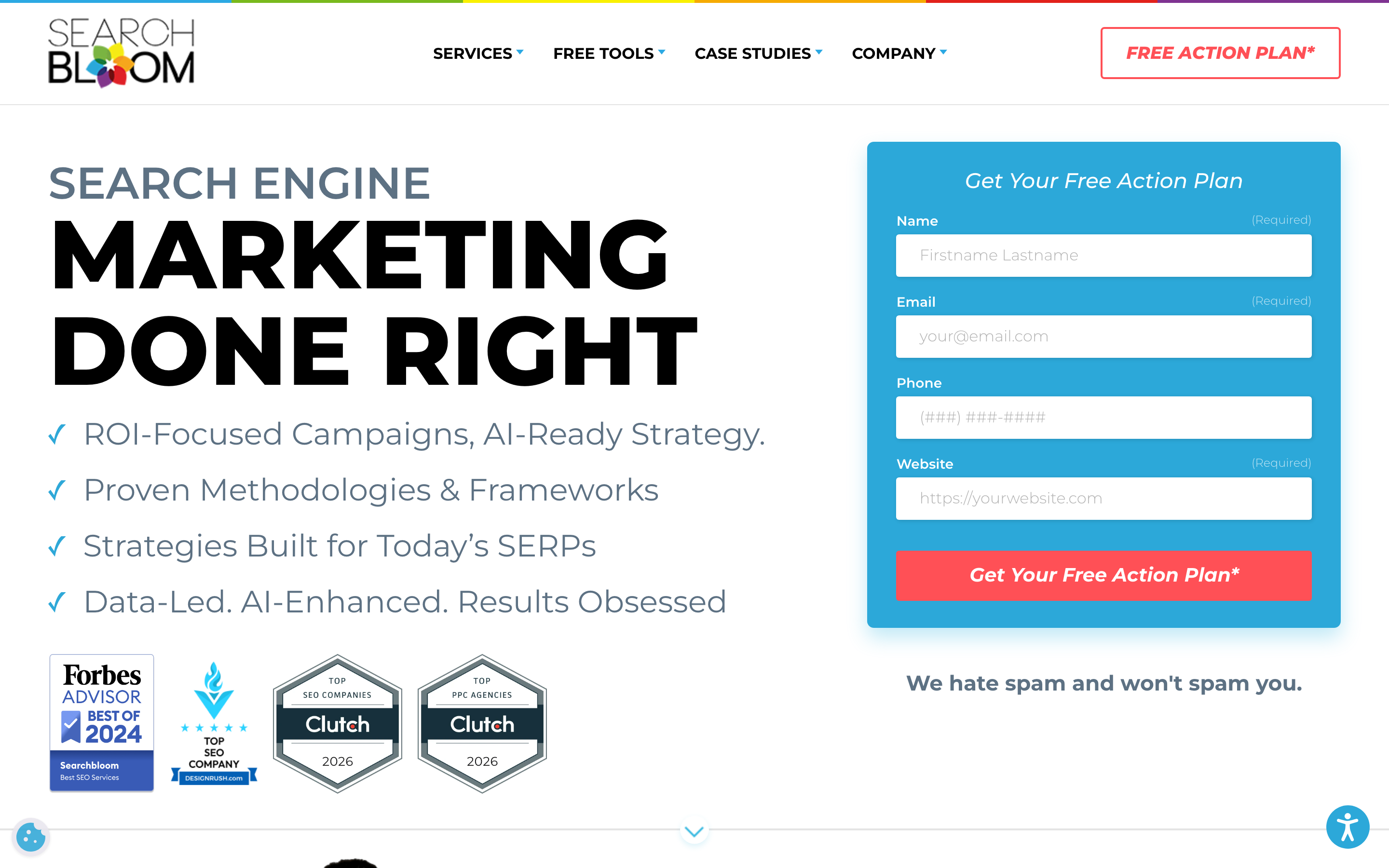
Searchbloom's homepage leads with search engine marketing and a lead form; its AEO and GEO offers sit on separate service pages.
The price is published, but you have to find it: the homepage FAQ states "Our SEO starts at $3,000 per month" and PPC management "starts at $2,000 per month", while adding "We don't use cookie-cutter pricing." There is no pricing page, and the GEO and AEO pages carry no figures. One floor, published, scores two.
Credentials are the strongest part of the file: Search Engine Land Awards winner in 2021 and finalist in 2024 and 2025, Forbes Advisor best SEO agency for mid-market, Google Premier Partner in the stated top 3%, Inc. Best Workplaces. Where it loses points: the GEO and AEO pages publish no client results at all, substituting third-party research statistics, and the free Action Plan is gated behind a qualification meeting, so there is nothing to inspect without a call. No founding year appears anywhere on the site.
8. Coalition Technologies, 3.5 out of 5
Coalition Technologies names nine engines, one of the longest lists here: ChatGPT, Google AI Overviews, Gemini, Perplexity, Claude, Grok, Microsoft Copilot, Meta AI and DeepSeek, with a separate page per engine and a six-pillar framework that includes citation tracking. Los Angeles address published, 2009 given as the founding year on their Who We Are page. Terms are published and explicit: month-to-month, no long-term commitment, contrasted on their own site with competitors' three to twelve month minimums.
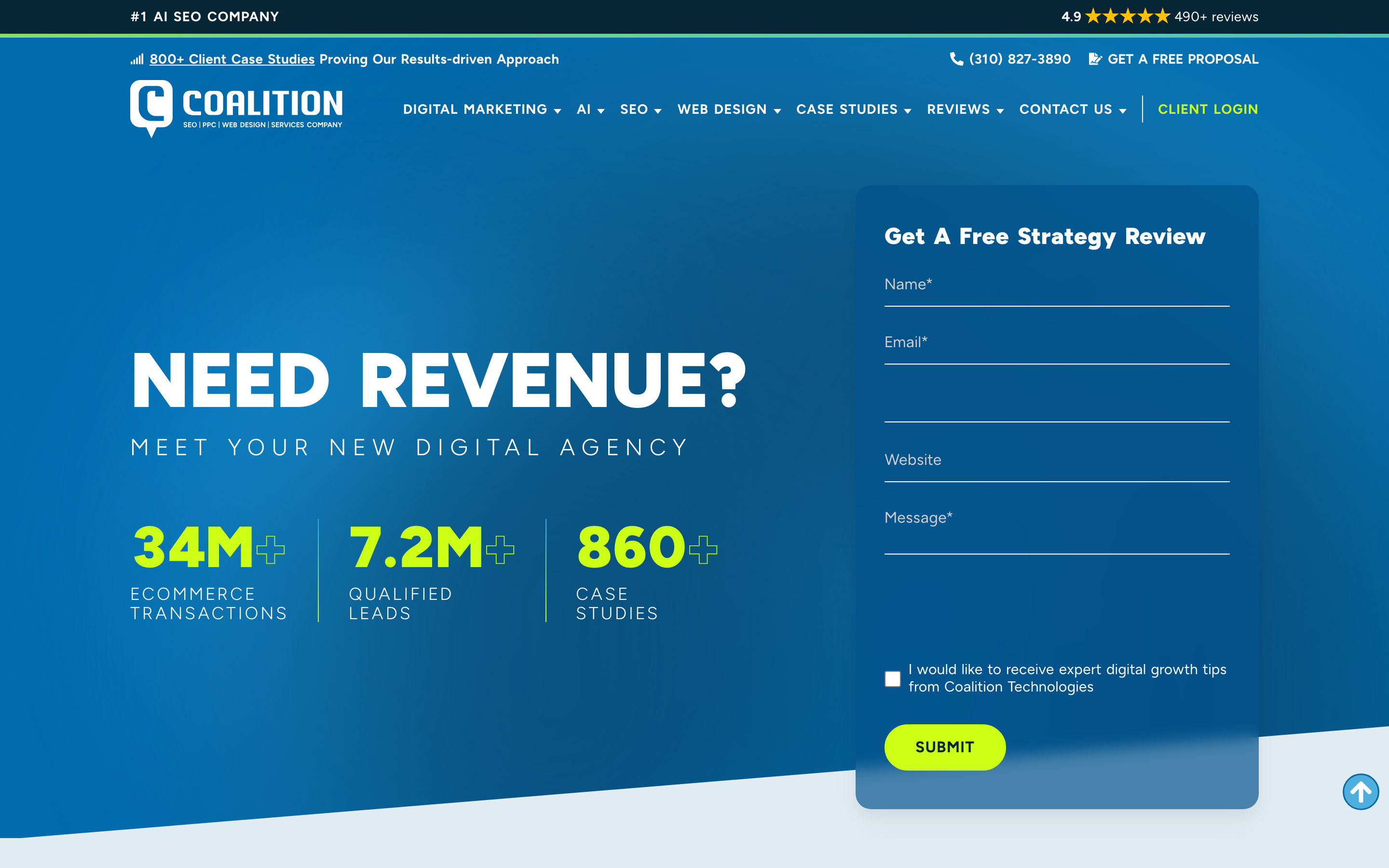
Coalition Technologies calls itself the #1 AI SEO company in its top banner and puts a strategy review form next to the headline.
Proof is AI-attributed and named: Sugatsune, traffic grown 261%, and P3 America, sessions up 149%, both credited to AI SEO on their pages, alongside ecommerce results such as Starfire Direct's organic revenue up 239% in the first year. Clutch named them a top generative engine optimization company in 2026.
No price is published: the pricing page holds a budget estimator that returns a suggested spend rather than a rate. Be careful with the figures circulating about them, because the monthly and project ranges widely quoted online come from third-party directories, not from Coalition. Their client counts are also inconsistent between pages, appearing as 500+, 800+ and 1,200+.
One finding belongs in an article about AI visibility specifically, and it is not a judgement, just a measurement: coalitiontechnologies.com returned HTTP 403 to our requests on 17 September 2026, including with an ordinary desktop browser user agent. A site that refuses automated requests is a site that is harder for retrieval-based engines to read. We could only reach their copy through a text proxy.
9. Thrive Internet Marketing Agency, 3.5 out of 5
Thrive, headquartered in Arlington, Texas, founded 2005 and renamed from MLB Web Design in 2012, publishes the most AI-specific client numbers of any agency here, and publishes them on the AI SEO page itself rather than buried in a case-study archive: Primary Care Medical Group, "+2,658% Google AI Overview Citations" and more than 1,000 total AI citations; an unnamed footwear company, "+876% Engaged Sessions From ChatGPT" and "+749% Microsoft Copilot citations". Seven engines named, including Google AI Mode and Claude. Terms published: "No Long-Term Commitment", with scope scaling on outcomes.
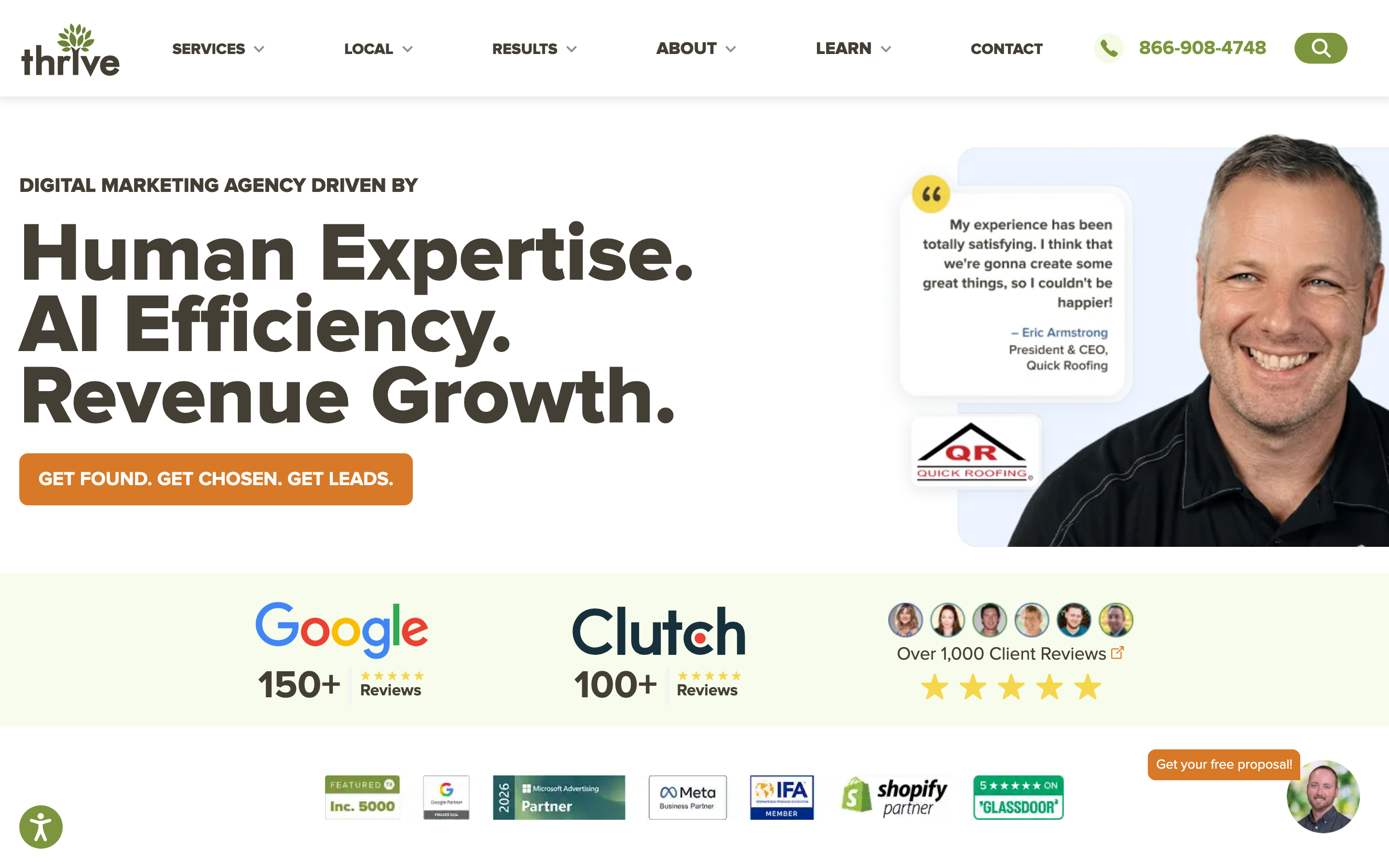
Thrive's homepage pairs an AI efficiency headline with Google and Clutch review counts; the AI client figures quoted above are on its AI SEO page.
The gap is money. Nothing on the homepage, the About page or the AI SEO page carries a figure; the wording is "affordable and flexible pricing options", which tells a buyer nothing and costs four points. Their ThriveAI tool and Thrive Score are marketed but not inspectable without contact.
10. Single Grain, 3.5 out of 5
Single Grain, Miami, founded 2014 when Eric Siu bought the then-failing agency for two dollars, a detail they publish themselves. The engine list is the widest of the pure agencies here, naming Google AI Overviews, ChatGPT, Perplexity, Copilot, Gemini, Claude and Grok alongside Bing and the voice assistants Alexa and Siri, under a top-level service named AEO and GEO with five named sub-services.
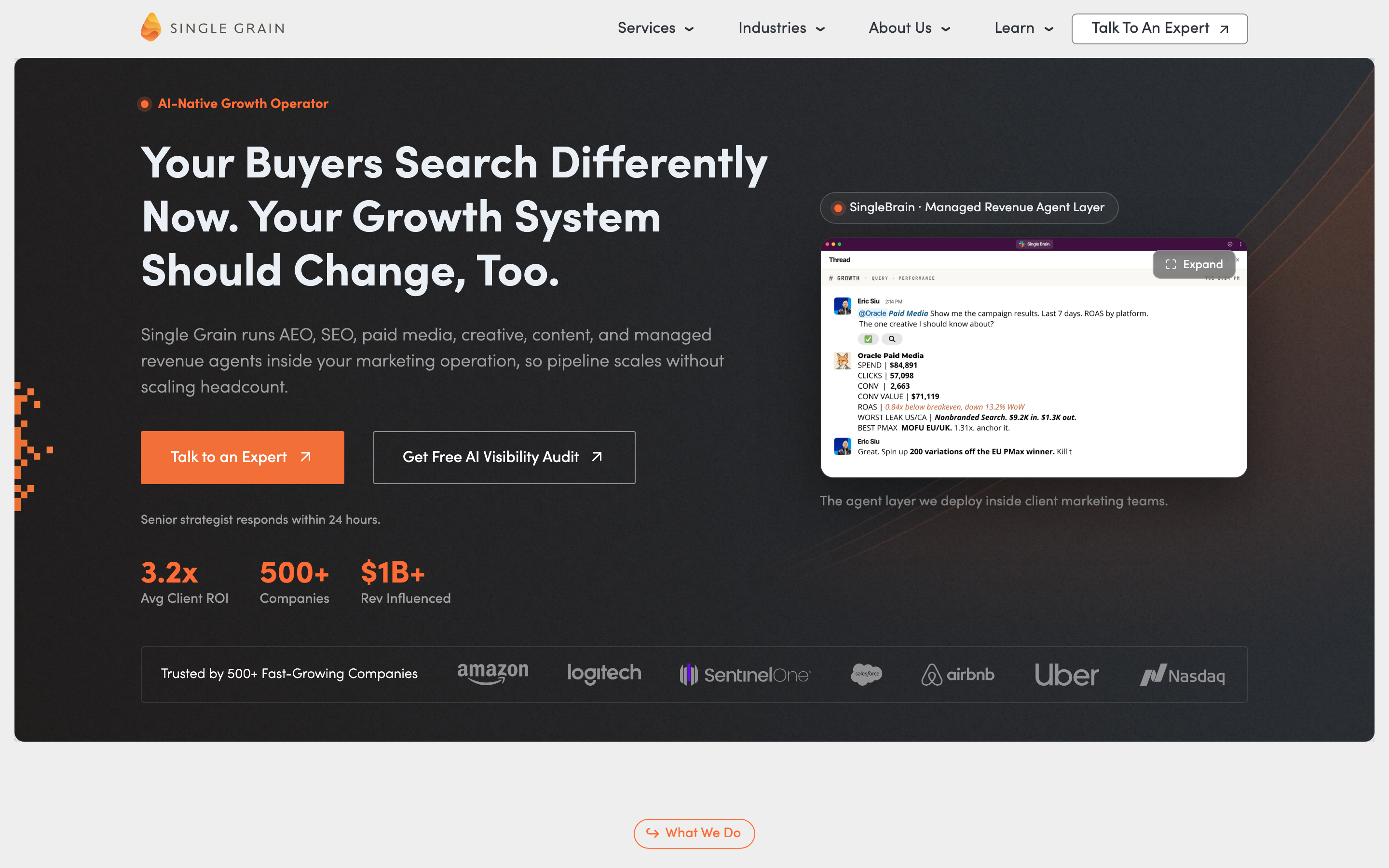
Single Grain's homepage names AEO first in its list of services and shows its own figures: 3.2x average client ROI and 500+ companies.
The proof is AI-specific and monetised, which is rare: their case-study block headlines "136 Total AI Visibility", "$126,000 worth" and "10 SQLs per month", and elsewhere they publish AI citation counts with an estimated dollar value attached. They also publish a timeline expectation on the page itself, improvements in AI citations "within 2-3 months" and significant visibility gains in four to six, and they describe the reporting as AI citations, SGE appearances and zero-click impressions on custom dashboards.
No price is published. The contact form offers budget bands from "Less than $3,000" up to "$100,000+", which is a qualification filter, not a disclosure, and scores zero. No minimum contract length is published either.
11. OuterBox, 3.0 out of 5
OuterBox, Akron, Ohio, founded 2004, with offices in Houston, Texas and Tuscaloosa, Alabama. Six engines named on a dedicated GEO services page: Google AI Overviews, ChatGPT, Perplexity, Gemini, Bing Copilot and SearchGPT. Credentials are real: Inc. 5000, Google Premier Partner 2026, Microsoft Advertising Select Partner, a US Search Award.
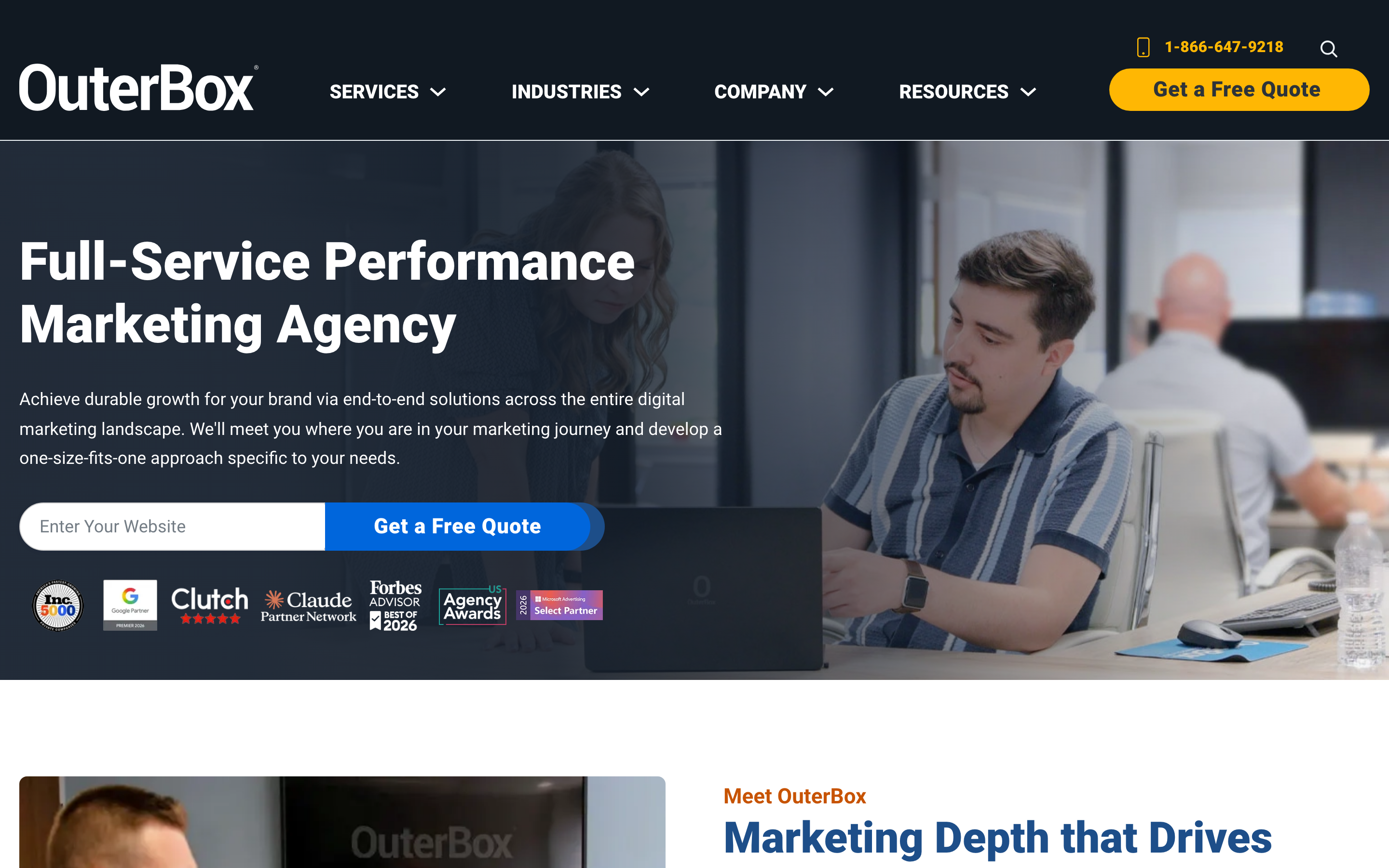
OuterBox's homepage shows the partner badges listed above, including Inc. 5000 and Google Partner, under a performance marketing headline.
They do something unusual with price, and it should be read carefully. They publish the market's rates while declining to publish their own: SEO in 2026 running "$100-$250 per hour, $3,000-$7,500 a month for most US agencies, or $5,000-$50,000 for project-based work", followed by a statement that they quote each engagement rather than work from a rate card. Useful for a buyer building a budget, but those are not OuterBox's fees, and it scores zero on own-price transparency.
The heavier deduction is proof: the GEO page publishes no client metrics at all. What exists is aggregate ("2M+ Page #1 Google Rankings", "1000+ Successful Client Partnerships") and a large logo wall including Lowe's and Sur La Table. No contract terms published.
12. Siege Media, 2.5 out of 5
Siege Media presents the sharpest internal contradiction in this list, and it is instructive. Their homepage publishes the best client citation figures anywhere here, named and specific: for Instacart, "46.5k Citations in LLMs" alongside a "356% Increase in Traffic Value", and a case-study teaser crediting Mentimeter with 250,000 ChatGPT visits. They also publish the only firm minimum engagement in the list, asking clients to commit to a six-month-plus horizon on the stated reasoning that citations compound rather than spike. Proprietary tooling is named, BlueprintIQ and DataFlywheel, and the GEO page describes the reporting: LLM share of voice tracked monthly, citations earned per asset, and AI-referral traffic.
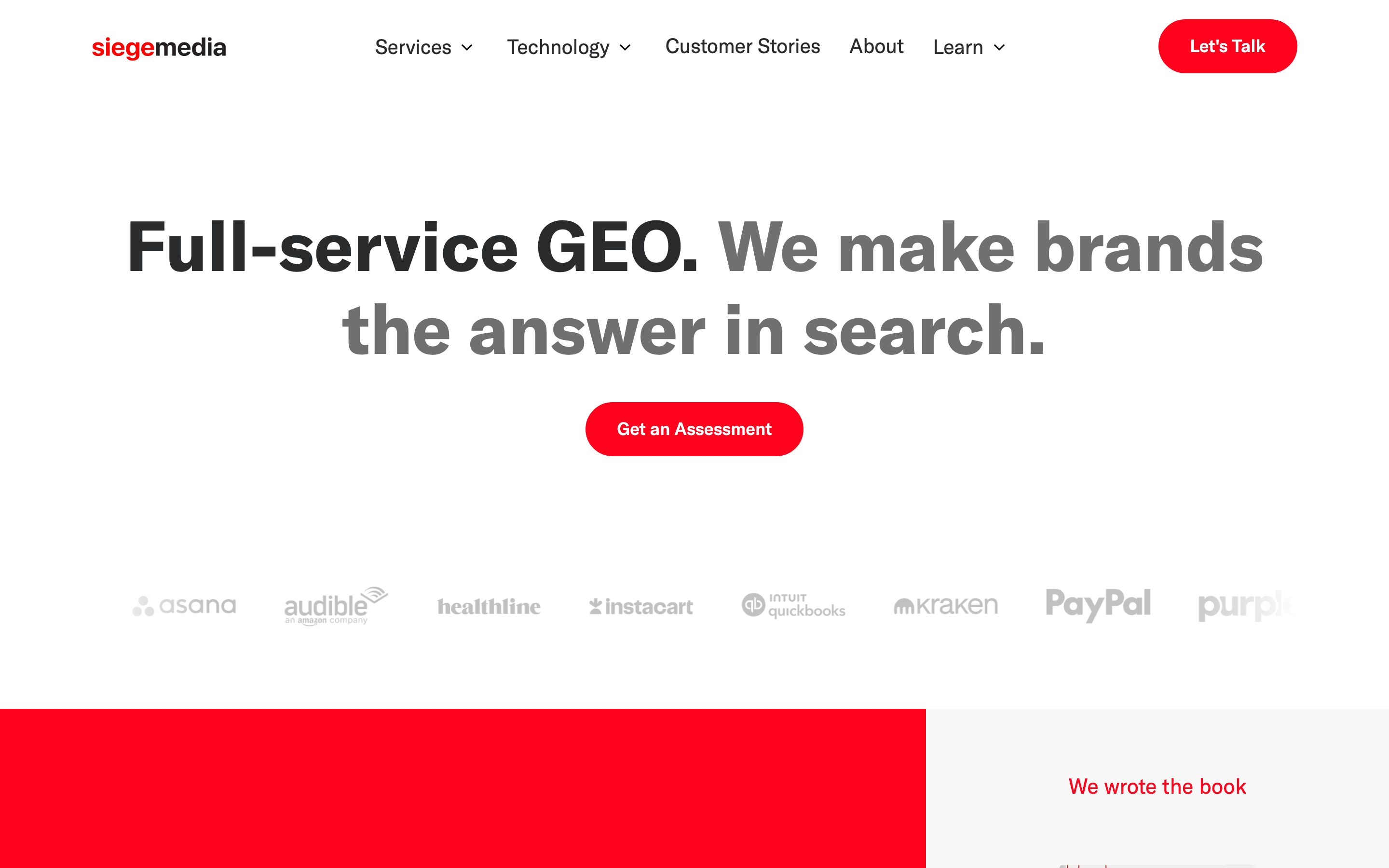
Siege Media's homepage now opens on full-service GEO and a request for an assessment, above a row of client logos.
And yet the GEO service page names no engine as a surface it covers. It says "LLMs" more than twenty times and no product name: no Perplexity, no Gemini, no Claude, no Copilot. ChatGPT appears on the page only inside a site-wide case-study teaser, and Google AI Overviews appears once, as something their interactive content is built to survive rather than a surface they track. That scores zero on coverage despite the firm plainly doing the work. No price is published anywhere. Their own materials also disagree on headquarters, with the About page captioning "Siege HQ in San Diego, CA" while the homepage presents Austin, Texas. Founder Ross Hudgens is published; a founding year is not.
A low score here means thin public disclosure, not thin capability. That distinction is the honest limit of this method, and Siege is the clearest case of it in the list.
13. Stackmatix, 1.5 out of 5
Stackmatix ranks last because there is very little published to score. The AI SEO page labels the service "SEO + AI SEO" and names no AI engine in that context; ChatGPT appears only as a paid-ads product. An About page now exists, naming co-founder and CEO Matt Pru, but it publishes no headquarters beyond "a fully remote team with Silicon Valley roots", and no founding year appears on the site. Proof consists of one named testimonial with numbers (RapidFort, CAC down 37%, conversion up 40%) and nine unnamed logos.
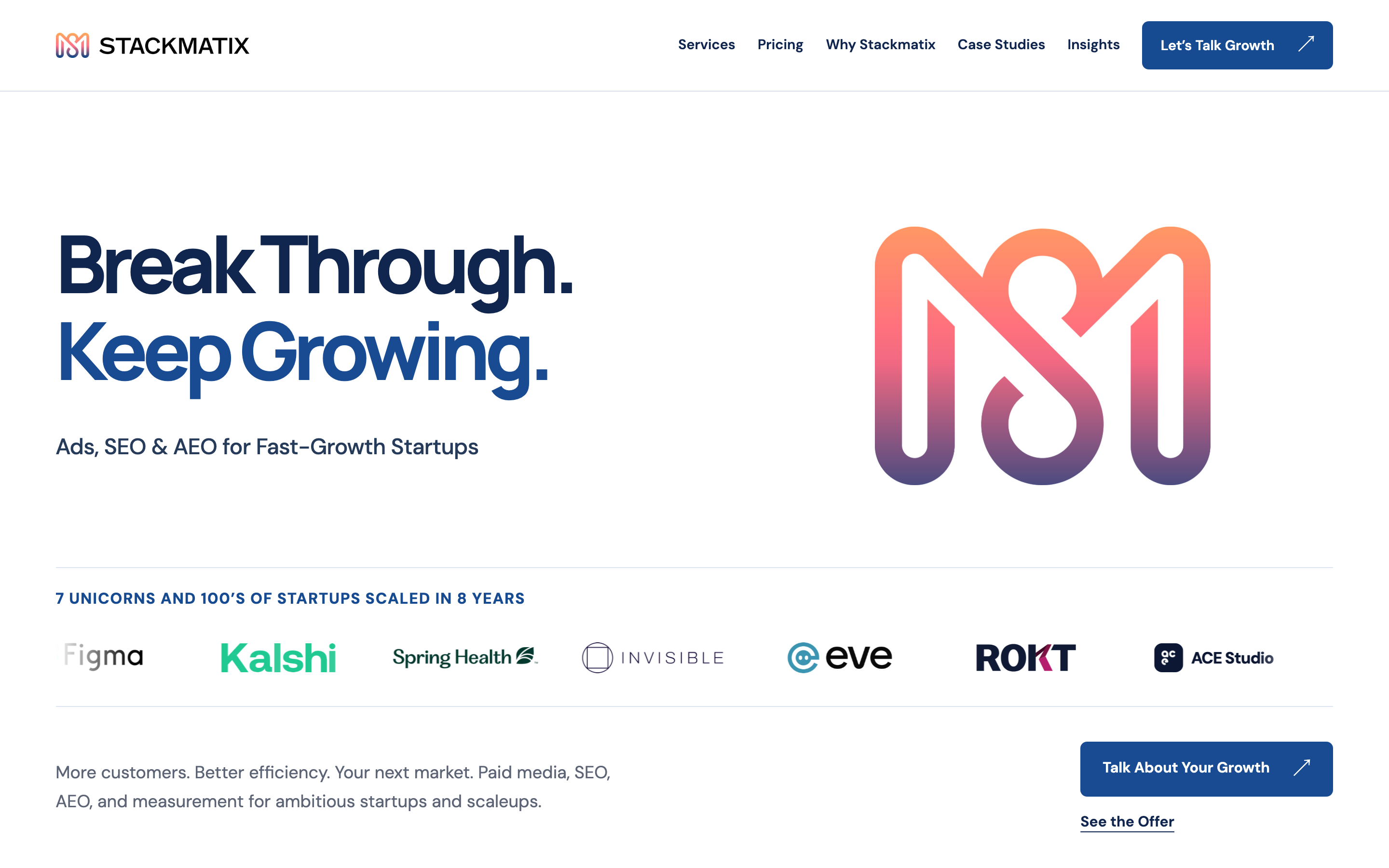
Stackmatix's homepage names AEO in its subtitle, next to ads and SEO, above a row of startup client logos.
A specific warning, because this is the easiest error to make in this category and search summaries already make it. Stackmatix publishes a post titled as an AI SEO pricing and cost guide whose tiers look like a rate card. Those figures are industry benchmarks for agencies in general, not Stackmatix's fees. Its own price sits on a separate pricing page: an SEO and AEO plan at $3,000 per month with five backlinks included, rising in steps of $1,000 to $6,000 for twenty, while the wider audit, strategy and content scope is confirmed in a proposal. That page, not the cost guide, is the one to budget from, and it scores two on the first criterion as a single floor.
In short : Citeme leads on measurement you can open and own, and Fame on a single published price. Of the eleven scored on the grid, only three publish enough of their own numbers to let you budget from the page, Grow and Convert, Optimist and Percepture. Five publish no own figure at all. The engine lists range from ten named surfaces to none.
What an AI SEO agency actually costs in 2026
Most answers to this question come from a single source repeating a single range. Here is a wider one, built only from figures agencies publish about their own services, each traceable to the page it sits on. Only three of the eleven scored agencies publish enough to budget from and three more publish a single figure, so this table is assembled from those disclosures.
| What you are buying | Published price | Who publishes it |
|---|---|---|
| A recorded advisory call | $199 per session | Grow and Convert, 60 to 90 minutes |
| A one-time strategy and roadmap | From $7,500 | Optimist |
| Advisory retainer, you execute | From $3,000 per month | Optimist |
| One-plan B2B AI search service | $2,000 per month | Fame, Fame Search |
| Entry AI search retainer | From $3,500 per month | Percepture, Launch tier |
| Full-service retainer | From $4,000 per month | Optimist |
| Mid AI search retainer | $6,000 to $8,500 per month | Percepture, Growth and Authority |
| Content-led SEO and GEO base | $10,000 per month | Grow and Convert |
| Enterprise AI search retainer | $10,000+ per month | Percepture, Enterprise tier |
| Premium growth partner | Average above $20,000 per month | NoGood, stated as an average |
| Tracking software, no agency | From $69 per month (Starter, 50 prompts), $59 billed annually | Citeme, three published plans |
The floor for a dedicated AI search retainer, among agencies that publish anything, is $3,000 to $3,500 per month, with Fame the exception at $2,000 for a single fixed plan. The working band is $3,500 to $10,000, and past that you are in custom territory where the only published signal is NoGood's above-$20,000 average. Two agencies here also publish their view of the wider market, which is worth reading as a second opinion rather than as their fees: OuterBox puts US SEO at "$100-$250 per hour, $3,000-$7,500 a month" or "$5,000-$50,000" per project, and Optimist puts serious full-service retainers at "$3,000-$15,000+ per month". Those two independent estimates and the published rate cards agree on roughly the same floor, which is the most useful thing about them.
Two cost traps, both avoidable. The first is the add-on: Percepture is the only firm that prices its extras in public, and they are not small, with link and mention building at $1,000 to $1,600 per month on top of the retainer and digital PR from $4,500. Assume similar extras exist unpriced elsewhere and ask for them in writing. The second is the measurement subscription. If the agency tracks your AI visibility inside its own seat of a third-party tool, you are paying for software you will not keep, and the history leaves when the contract does. Tracking your own citations costs tens of euros a month, not thousands, which makes it the cheapest line in any of these engagements and the one most worth owning yourself.
In short : published entry retainers start at $3,000 to $3,500 per month, the working band runs to about $10,000, and one firm discloses an average above $20,000. Add-ons are real and almost never priced in public.
The thirteen compared on what they disclose
The same information as above, in one view. "Own price" means a figure for their own services, so contact-form budget bands and third-party industry ranges both count as none.
| Agency | Score | Own price published | Engines named | Terms published |
|---|---|---|---|---|
| Citeme | 5.0 | Platform from $69/mo, agency scoped in a call | 10 | Cancel in one click, platform |
| Fame | 4.5 | $2,000/mo, one plan | 5 | Monthly, 30-day notice |
| Grow and Convert | 4.5 | $10k/mo base, $199 sessions | 6 | No 6 or 12 month contract |
| Optimist | 4.0 | $3,000 to $7,500, three products | 5 | Month to month, 30-day notice |
| Percepture | 4.0 | Full rate card, $3,500 to $10k+ | 6 | None |
| NoGood | 4.0 | Average above $20k/mo | 8 | None |
| Searchbloom | 3.5 | SEO from $3,000/mo, in an FAQ | 7 | None |
| Coalition Technologies | 3.5 | None, estimator only | 9 | Month to month |
| Thrive | 3.5 | None | 7 | No long-term commitment |
| Single Grain | 3.5 | None, budget bands only | 10 | None |
| OuterBox | 3.0 | None, market range only | 6 | None |
| Siege Media | 2.5 | None | None on the GEO page | 6+ month horizon |
| Stackmatix | 1.5 | SEO/AEO from $3,000/mo | None on the AI SEO page | Month to month |
In short : the two columns rarely line up. The firms with the best published AI results, Siege Media and Thrive, publish no price; the firms with the clearest prices publish weaker AI-specific proof. Among the eleven scored on the grid, only Grow and Convert and Optimist score well on both.
Five questions that separate an AI SEO agency from an SEO agency with a new banner
The pitch decks in this category have converged. The answers to these five questions have not, which makes them the fastest way to sort a shortlist. Ask them by email, so the answers are in writing.
1. Which engines do you measure, and how often? Ten engines exist that a brand can plausibly care about when it shortlists a GEO agency, and they behave differently: ChatGPT and Claude lean on training data with some live retrieval, Perplexity fetches and cites live pages in every answer, Google AI Overviews sits above the classic results and reaches the largest audience of any of them. An agency that measures ChatGPT only is measuring one surface and charging for the category.
2. Can you tell me the exact prompt that won or lost a citation? This is the question that separates dashboards from diagnosis. "Your visibility rose four points" is not actionable. "You gained the citation on this specific question, and lost it on that one, in this engine, this week" is a work order. Very few agencies and very few tools resolve to the prompt.
3. How will you attribute revenue, not traffic? AI assistants strip or omit referrers, so analytics often shows these visits as direct, with no idea which question produced them. Ask how the agency separates a human arriving from an AI answer from the three kinds of bot traffic around it, and whether the chain ends at a deal your CRM marked as won. If the answer stops at impressions, the budget conversation will stop there too.
4. What happens to the measurement when the contract ends? If the tracking lives in the agency's seat of a third-party tool, your history leaves with them. Ask who owns the account and whether the data is exportable, before signing, not after.
5. Show me one dated case study with an AI-specific metric. Not traffic, not rankings: citations won, share of AI answers, AI-sourced pipeline. The agencies that have done this work have such a number. The agencies that relabelled a service page do not, and will offer classic SEO results instead. That substitution is the tell.
In short : engine coverage, prompt-level diagnosis, revenue attribution, data ownership and one dated AI-specific result. An agency that answers all five in writing is doing the work. An agency that deflects on three of them is selling SEO with a new banner.
FAQ
How much does an AI SEO agency cost in 2026?
Among the agencies reviewed here, the published floor for a dedicated AI search retainer is $3,000 to $3,500 per month, with one exception: Fame sells a single plan, Fame Search, at $2,000 per month. Percepture publishes a full rate card running from $3,500 for its Launch tier through $6,000 and $8,500 to $10,000 and above for enterprise. Optimist publishes advisory retainers from $3,000 per month, full-service from $4,000, and a one-time strategy roadmap from $7,500. Grow and Convert publishes a $10,000 per month base package and $199 advisory sessions. At the premium end, NoGood discloses that its average retainer is above $20,000 per month, which is an average rather than a minimum. Six of the thirteen publish no figure of their own for agency work, offering budget bands, an estimator or a quote instead, which are qualification filters rather than prices. Add-ons are rarely priced in public: the one firm that does price them charges $1,000 to $1,600 monthly for link and mention building on top of the retainer.
What is the difference between an AI SEO agency and a regular SEO agency?
A conventional SEO agency works on your position in a list of results. An AI SEO agency works on the probability that an engine cites your brand while writing an answer, which is a different objective measured on different surfaces. The disciplines are complementary rather than competing, and the dependency runs one way: generative engines rely on conventional search indexes to discover sources, so a badly indexed site stays invisible inside AI answers regardless of how well its passages are written. In practice the honest test is not the label on the service page but the deliverables underneath it. Ask whether the engagement includes recurring measurement across named engines, entity and schema work, and citation tracking, or whether it is a keyword-research and link-building retainer with a new banner. Two of the thirteen agencies here name no AI engine at all on the page selling AI visibility, which is the clearest version of that tell.
Which AI SEO agencies publish their prices?
Four of the thirteen publish enough to budget from the page. Fame publishes a single fixed plan at $2,000 per month with its terms. Percepture publishes a tier-by-tier AI search rate card with deliverables attached and priced add-ons. Optimist publishes three separately priced products, a roadmap, an advisory retainer and a full-service retainer, plus what a $4,000 monthly engagement contains. Grow and Convert publishes a base monthly package and individually priced advisory sessions. Three publish a single figure: Searchbloom states in its homepage FAQ that SEO starts at $3,000 per month, Stackmatix lists an SEO and AEO plan from $3,000 per month on its pricing page, and NoGood discloses an average retainer above $20,000. The remaining six publish nothing about their own agency fees. Two firms also publish market ranges, which is genuinely useful context but is not their price: OuterBox puts US SEO at $100 to $250 hourly or $3,000 to $7,500 monthly, and Stackmatix publishes a cost guide whose tiers are industry benchmarks, separate from its own pricing page. Treating either as a quote would be a mistake.
Do I need an AI SEO agency or just an AI visibility tool?
They solve different problems and the price difference is roughly two orders of magnitude, so the question deserves a direct answer. An AI visibility tool tells you where you stand: which engines cite you, on which questions, against which competitors, and it costs tens of euros a month. An agency produces the work that changes those numbers, which is content, entity and schema fixes, technical corrections and authority building, and costs thousands. If you have people who can execute and you only lack visibility into what is happening, buy the tool first and skip the retainer. If you have budget but no execution capacity, the agency is the version that ships. One thing worth doing in either case is owning the measurement yourself rather than renting a seat in the agency's account, because when the engagement ends the history leaves with it. Ask who owns the tracking account before signing, not afterwards.
How long before an AI SEO agency produces measurable results?
Take the timelines these agencies publish themselves rather than a general rule, because several commit to one in writing. Single Grain publishes improvements in AI citations within two to three months and significant visibility gains within four to six. NoGood publishes ninety days for meaningful improvement. Optimist publishes early signals at one to two months with compounding over six to twelve. Siege Media makes the same point as a condition of working together, asking clients to commit to a six-month-plus horizon on the reasoning that citations compound rather than spike. Those figures cluster around the same shape: a first movement inside a quarter, a real position after two. Treat a promise of results in weeks as a warning sign, and treat the absence of any published timeline as a question to ask on the first call. The answer, in writing, is also the benchmark you will hold them to later.
How can I verify an AI SEO agency's claims myself?
Four checks, none of which need an account or a call. First, open the service page and count the engines named: no engine named means no coverage commitment, and two of the thirteen here name none. Second, look for a client name attached to an AI-specific number, not a traffic number, because the substitution of organic metrics for citation metrics is the most common tell that the practice is new. Third, search for the agency's own price and note whether what you find is a rate card, a market benchmark it published about other agencies, or a budget band on a form. Only the first is a price. Fourth, check whether the agency is itself visible in AI answers about its category, since a firm selling AI visibility should be able to demonstrate its own. Ask an engine directly which AI SEO agency to hire, and see who comes back.
Sources (6)

Written by
Alexandre Teillet · CEO, CitemeCEO of Citeme, leading the brand's content and AI visibility strategy across answer engines.