Can AI browsers actually find you?
4 questions across the three layers that decide whether you appear. Honest diagnosis included.
Layer one: does the model already know your brand?
An AI browser answers your question instead of handing you ten blue links. Ask it for the best project management tool and it names three, with reasons. Those three names are a commercial decision made without you in the room. This guide explains what actually determines whether your brand is one of them, why the answer changes from one browser to the next, and what you can control.
The short answer
- There is no single AI browser algorithm. Each product routes your query to a different language model, so the same question returns different brands depending on which browser the user opened.
- Three layers decide whether you appear: what the underlying model already learned about you, what its live retrieval step finds today, and what the agent can actually parse on your page.
- You cannot optimise for a ranking position, because there is no position. You can only influence how consistently and how clearly your brand is described across the sources these systems read.
- Blocking AI search crawlers such as OAI-SearchBot, Claude-SearchBot and PerplexityBot removes you from the live retrieval layer, which means the model falls back on whatever it remembers from training, including outdated pricing and discontinued products. Blocking only the training crawlers, GPTBot and ClaudeBot, does not.
What an AI browser actually is
An AI browser is a web browser with a language model sitting between you and the page. It can read the tabs you have open, summarise them, answer follow-up questions, and in the more advanced products, carry out multi step tasks such as filling a form or comparing options across several sites.
The important architectural detail is that the major products are all built on Chromium or a Chromium derivative. The rendering engine is not where they compete. The competition sits in the agent layer: which model answers, how it retrieves, and how it decides what to tell you. That is precisely the layer that determines brand visibility.

Not every AI browser is a new application. Brave Leo is an assistant inside a browser people already use, which is the lowest-friction way this technology reaches an audience.
The five browsers and what powers them
The category moves fast enough that any snapshot dates quickly. Here are the five products as of May 2026, with monthly active user estimates published by Presenc AI's agentic browser research, updated where vendors have since published their own figures.
| Browser | Vendor | Model behind the answers | Estimated MAU |
|---|---|---|---|
| ChatGPT Atlas | OpenAI | GPT-5.5 | 10 to 15 million (May 2026), retired on 9 August 2026 |
| Comet | Perplexity | Multi-model routing | 3 to 5 million |
| Dia | The Browser Company | Vendor-selectable, Claude by default | 2 to 3 million |
| Arc | The Browser Company | Legacy, deprioritised | 1 to 2 million, declining |
| Leo | Brave | Selectable plus Brave self-hosted | Embedded in Brave, about 126 million Brave users (August 2026) |
Treat these numbers as directional. No independent research firm publishes audited market share for AI browsers yet, and most figures in circulation originate with the vendors themselves. The ranking of the players is more reliable than the precision of any single count.
That table already needs a correction, and the correction makes the point better than the table does. On 9 July 2026 OpenAI announced it was retiring Atlas on 9 August 2026, less than a year after its October 2025 launch, and folding its browser into the ChatGPT desktop app. Atlas closed on that date. The category leader by user count was withdrawn mid-flight.
This is why optimising for a named browser is the wrong unit of work. Atlas is gone, but the model that answered inside it is not. The same GPT family keeps answering the same questions in the desktop app, carrying the same memory of your brand. Surfaces churn on a timescale of months. The model layer underneath them is what persists, and that is what you are really optimising for.
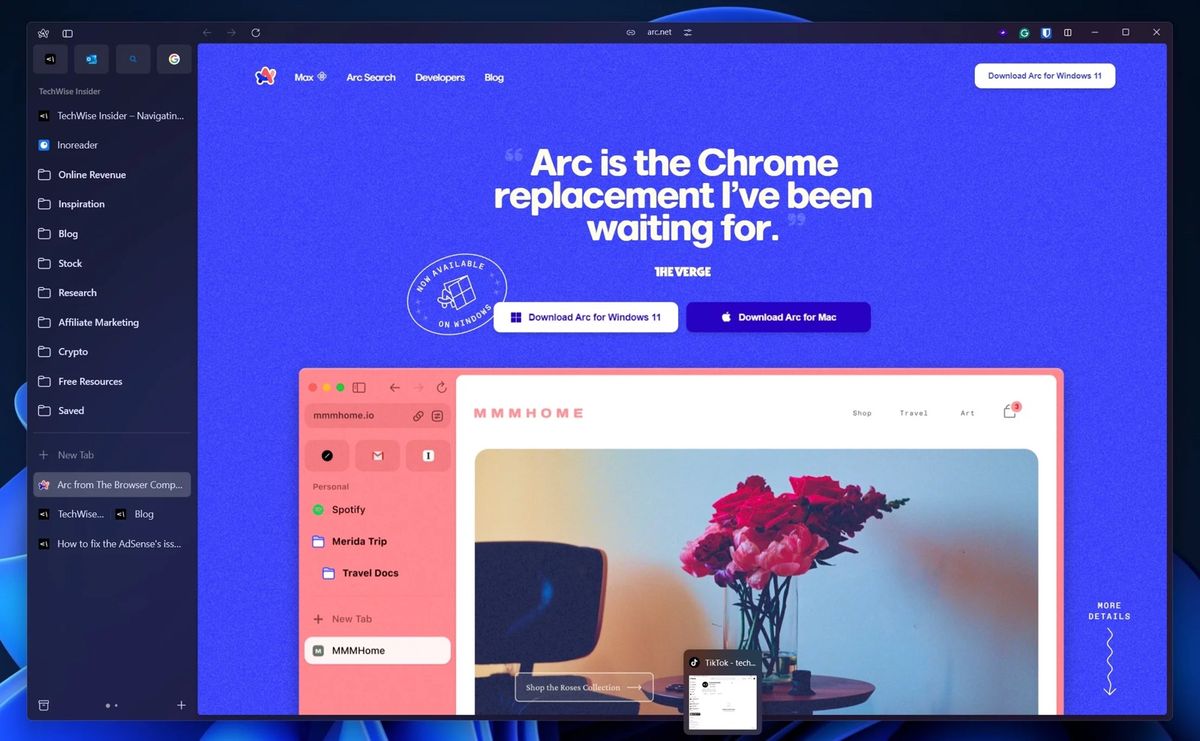
Arc is the same pattern one generation earlier. It built a devoted following, then its team moved on to Dia and development effectively stopped. Two of the five browsers in the table above have already been shut down or wound down.
One line in that table explains most of what follows: the model column is different on every row. Atlas asked GPT-5.5. Dia asks Claude by default. Comet routes across several models depending on the task. These models were trained on different data and have different recall about your company.
The three layers that decide whether you appear
Layer one: what the model already knows
Before any browsing happens, the model carries an internal representation of your brand from training. If your company is described consistently across the web, that representation is sharp: the model knows what you sell, who you serve, and which category you belong to. If your positioning shifted last year and half the web still describes the old one, the model holds a blurred or outdated picture.
This layer is slow to change and impossible to edit directly. It is also the reason two browsers disagree about you. A model trained with a heavier weighting of forum and community data will recall brands that are discussed in those places. A model trained more heavily on curated editorial sources will recall the brands that publications write about.
Layer two: what live retrieval finds today
Most AI browsers do not answer from memory alone. They run a retrieval step, fetch a handful of pages, and ground the answer in what they just read. This is the layer you can move fastest.
Retrieval usually begins by expanding your question into several narrower ones, a behaviour known as fan-out queries. Ask for the best CRM for a small agency and the system may separately look for CRM pricing, CRM for agencies, and CRM reviews, then merge what it finds. Your brand needs to be retrievable on the sub-questions, not only on the headline term.
Whether your pages can be fetched at all depends on your crawl configuration. AI crawlers are distinct from Googlebot and are governed separately in robots.txt, and the main vendors run different bots for model training (GPTBot, ClaudeBot) and for search (OAI-SearchBot, Claude-SearchBot, PerplexityBot). Blocking the search crawlers is a legitimate choice, and it has a specific consequence covered further down.
Layer three: what the agent can parse on the page
Retrieval delivers a page. The model then has to extract a usable claim from it. A pricing table in clean HTML is extractable. The same pricing rendered inside an image is not. A specification buried in a tab that only opens on click may never be seen.
This is where a lot of otherwise strong sites lose. The information exists, a human can find it, and the agent cannot lift it cleanly enough to quote. Self-contained passages work best: a paragraph that states a fact completely, without depending on the three paragraphs above it for context.
Why the same query returns different brands
Put the identical question into ChatGPT, Comet and Dia and you will often get three different shortlists. This surprises marketers who expect AI answers to converge the way search results roughly do.
They diverge because each browser is a different stack. The model differs, so the training recall differs. The retrieval source differs, so the fresh evidence differs. The synthesis prompt differs, so the number of brands named and the criteria applied differ. Comet, from Perplexity, leans on a design that surfaces citations prominently, which rewards pages that are easy to attribute. A browser optimised for speed may name fewer brands and rely more on memory.
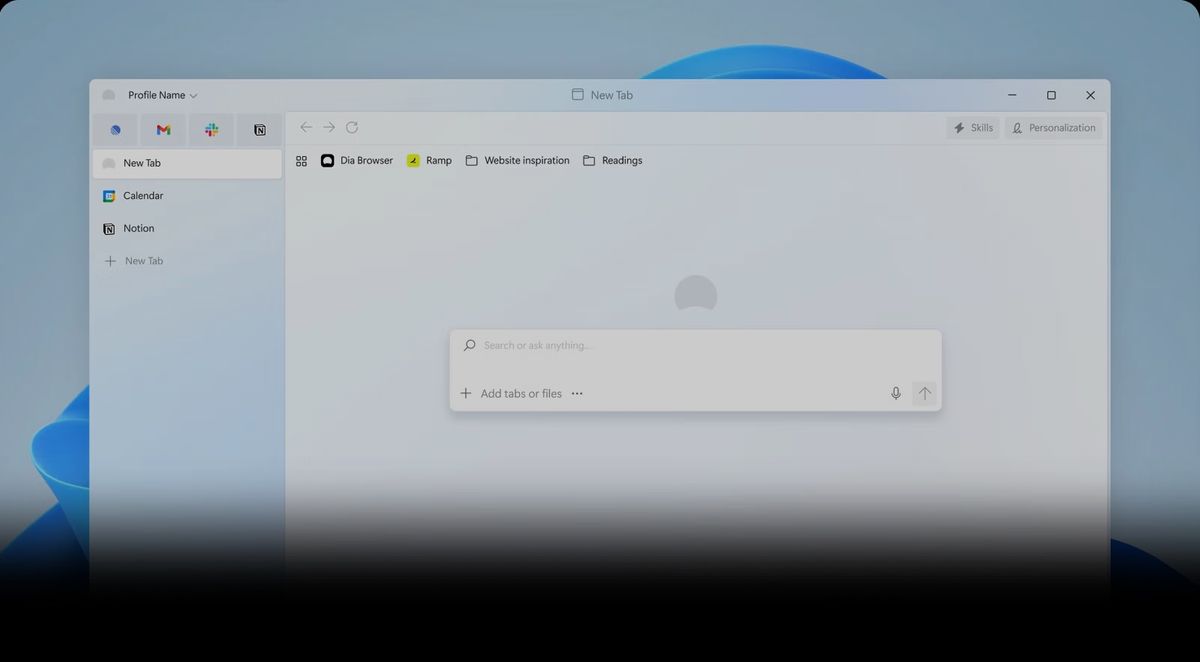
Dia reduces the whole interface to one field. Behind it, Claude answers by default, which is exactly why the brands Dia names differ from the ones Comet names for the same question.
The practical consequence is that a single spot check tells you very little. Checking one browser once is like checking one keyword on one day. You need coverage across products and repetition over time before a pattern is real. Our guide on winning visibility in AI search covers how to structure that measurement.
What actually moves the needle
Given three layers and no ranking position, the work concentrates on a short list.
Start by making yourself describable in one sentence, everywhere. Models reward consistency. If your homepage, your directory listings, your review profiles and your press coverage all describe you the same way, every model converges on the same representation. Contradictory positioning across sources produces a model that hedges, and a hedging model names a competitor instead.
Then write passages that survive extraction. Aim for paragraphs that answer one question completely and could be quoted without surrounding context. This is the highest-leverage editing habit for GEO (Generative Engine Optimization), and it costs nothing but discipline.
Keep your facts in text rather than in images: pricing, integrations, supported languages, service areas. If a fact matters commercially, it needs to exist as parseable text on a page an AI crawler is allowed to read.
The harder work is earning mentions on the pages that actually get retrieved. Retrieval frequently lands on comparison articles, listicles and community threads rather than vendor sites. Being absent from those sources is a bigger problem than anything on your own domain, and it is usually the real cause when a technically clean site stays invisible.
Publishing an llms.txt file is worth the twenty minutes it takes. It points AI systems at your canonical pages, though support is not universal and the specification is still young, so treat it as a cheap addition rather than a fix. Our complete llms.txt guide covers the implementation.
How to check where you stand
Start manually. Write down the ten questions a buyer would realistically ask before choosing a vendor in your category. Run each one in at least three AI browsers. Record which brands get named, in what order, and which sources the answer cites when citations are shown.
Two things usually become obvious within an hour. First, you will find questions where you are absent and a smaller competitor is named, which tells you where the retrievable evidence favours them. Second, you will find factual errors about your own product, which are typically the fastest thing to fix because they trace back to a specific outdated page.
Manual checks do not scale past a few dozen prompts, which is where AI visibility tools take over. The metric that matters is not a position number. It is the share of relevant questions where your brand is named at all.
Conclusion
AI browsers are not a new ranking game with a new algorithm to reverse engineer. They are several different systems that each answer from a mix of memory and fresh retrieval, and they agree with each other less often than people assume.
That makes the work less mysterious than it sounds. Describe your company the same way everywhere, put your commercially important facts in extractable text, let the AI crawlers read them, and get mentioned in the places these systems go looking. None of that is exotic. It is simply aimed at a reader that never scrolls.
FAQ
What is an AI browser?
An AI browser is a web browser with a language model built into the interface, so it can answer questions, summarise the pages you have open, and complete multi step tasks rather than only displaying websites. The main products in 2026 are Comet from Perplexity, Dia from The Browser Company (owned by Atlassian since October 2025), and Leo inside Brave, alongside the browser built into the ChatGPT desktop app, which replaced the standalone Atlas browser OpenAI closed on 9 August 2026. Nearly all of them are built on Chromium, so the underlying rendering is familiar. What differs is the agent layer sitting on top: which model answers your question, whether it fetches live pages before responding, and how it decides which sources to trust. For a business, the practical shift is that the browser now gives an answer naming a few brands, instead of a list of links the user chooses from. A page of options gets compressed into a shortlist of two or three, and everything outside that shortlist is invisible.
Do AI browsers use Google's index?
Not uniformly, and this is a common misconception. Each product makes its own retrieval choices. Some lean on a partner search index, some operate their own crawling infrastructure, and some answer largely from what the model already learned during training without fetching anything fresh. Perplexity, for example, has built its own retrieval stack rather than depending on a third party. The practical implication is that ranking well in Google does not guarantee you appear in AI browser answers, and the reverse is also true. Some brands are named consistently by AI systems while sitting on page two of Google, usually because they are well described in the community threads and comparison articles that retrieval tends to fetch. Treat AI visibility as a separate measurement, not as a byproduct of your existing search rankings.
Why does my brand appear in one AI browser but not another?
Because they are genuinely different systems rather than variations on one algorithm. OpenAI's surfaces answer with the GPT family, Dia defaults to Claude, and Comet routes across several models depending on the task. Those models were trained on different corpora, so each one recalls your brand with different confidence. On top of that, each product retrieves differently, so the fresh evidence supporting an answer is not the same. A model trained with heavier weighting toward community discussion will name brands that people talk about in forums. A model weighted toward editorial sources will name brands that publications cover. Divergence between browsers is the normal state, not a bug to diagnose. It also means you should measure across several products before concluding anything about your visibility. Being absent from one browser while appearing in two others usually says something about that model's training mix, rather than proving your site has a technical fault.
Should I block AI browsers from crawling my site?
It is a legitimate choice with a specific cost worth understanding first. Blocking the search crawlers OAI-SearchBot, Claude-SearchBot or PerplexityBot in robots.txt removes you from the live retrieval layer, so these systems can no longer index your current pages. Blocking the training crawlers GPTBot or ClaudeBot only keeps your future content out of model training. It does not remove you from the models themselves. They still hold whatever they learned during training, which means they can continue describing your company using pricing you have since changed or products you have discontinued, with no mechanism for you to correct it. Publishers who monetise page views sometimes accept that trade deliberately. For most businesses selling a product or service, blocking means competitors supply the evidence that shapes how your category is described, and you lose the ability to keep your own facts current. A middle path exists: allow the search crawlers and block only the training crawlers, or allow them on your product and pricing pages and restrict them elsewhere.
How do I check whether AI browsers mention my brand?
Begin manually, because it costs nothing and the findings are immediate. List the ten questions a buyer would genuinely ask before choosing a vendor in your category, then run each one in at least three different AI browsers. Record which brands are named, in what order, and which sources the answer cites where citations appear. Repeat monthly, since answers drift as models update. Within an hour you will typically surface two useful things: questions where a smaller competitor is named and you are not, and factual errors about your own product that trace back to an outdated page. Manual testing stops scaling past a few dozen prompts, which is when dedicated tracking tools become worthwhile. The metric to watch is the share of relevant questions where your brand appears at all, not a position number.
Sources (7)
The public documents behind the facts in this article.
- Overview of OpenAI Crawlers · OpenAI
- Does Anthropic crawl data from the web, and how can site owners block the crawler? · Anthropic
- OpenAI's ChatGPT Atlas browser shutting down · MacRumors
- OpenAI is killing its ChatGPT Atlas browser less than a year after launch · The Next Web
- Brave browser hits 126 million active users as its search engine surges past 2.5 billion monthly queries · PiunikaWeb
- The Agentic Browser Wars 2026 · Presenc AI
- Atlassian Completes Acquisition of The Browser Company of New York · Business Wire
Useful resources
Keep digging
- GEOThe 10 best AI browsers in 2026, comparedComet, the ChatGPT desktop browser, Dia, Edge Copilot and six more, ranked on answer quality, agentic reliability and privacy.Read
- GEOCiteme vs Profound: which AI visibility tool to choose in 2026?Profound is the enterprise leader in AI search visibility; Citeme is our self-serve alternative at 59 € excl. VAT a month. An honest comparison of pricing, engines, data and action layers as of October 2026.Read
- GEOPeec AI vs Profound: pricing, engines and verdict after Profound went enterprise-only (2026)Profound dropped its self-serve brand plans in September 2026, so Peec AI and Profound now serve different buyers. Here is how their pricing, engine coverage and data compare today, and which one fits your team.Read
- GEO17 AI visibility tools compared: pricing and engines (2026)Seventeen AI visibility tools ranked on what they cost and which AI engines each plan actually queries, with every price checked at the vendor's own pricing page on 7 October 2026.Read