For twenty years, being visible online meant one thing: ranking in the top results of a search engine. That era is not over, but it is no longer the only one that matters. A growing share of searches now ends without a single click, inside an answer generated by AI. If your content is not built for answer engines, it simply becomes invisible in this new search experience. AEO is the discipline that answers that shift.
What is Answer Engine Optimization (AEO)?
Answer engine optimization is the practice of optimizing content so it can be understood, selected, and cited by AI-powered answer engines. These platforms do not return a list of pages. They analyze, synthesize, and produce a direct answer to the user's query. The goal of AEO is therefore no longer to be clicked, but to be the source of the answer.
In practice, effective AEO produces situations like these: a voice assistant reading a definition pulled from your article, a Google AI Overview synthesizing a response from several sources including yours, or Perplexity attributing a factual claim to your page by name. In each case your brand gains AI visibility and authority even when nobody visits your site.
Remember this sentence, because it explains everything: LLMs do not rank, they select. A traditional search engine orders links from most to least relevant. An answer engine instead hunts for the clearest, most trustworthy passages to build a single response. AEO is the work of becoming one of those passages.
Why does AEO matter in 2026?
The reason is simple: search behavior changed faster than content strategy did. Google rolled out AI Overviews at scale, which mechanically lowers the click-through rate on organic search results. In parallel, tools like Perplexity and ChatGPT now handle tens of millions of queries every month. People ask full questions and expect a direct answer.
This creates a paradox for many brands: their SEO traffic can look fine while their presence in AI answers is zero. They rank on Google but are absent from the conversation happening inside ChatGPT or Gemini. That blind spot is exactly what AEO fills. Being cited by an answer engine is becoming an authority signal at least as important as a position in the blue links.
There is also a leveling effect worth noting. A lesser-known but precise, reliable, well-structured brand can get cited by Perplexity ahead of a large but poorly structured site. The barrier to entry is not raw fame, it is the quality of your structure and information. For small teams and independents, that is a genuine window of opportunity.
AEO vs SEO vs GEO: what is the difference?
All three disciplines share one goal, making content visible, but they aim at different targets. SEO (search engine optimization) aims for a position in traditional organic search results, shown as clickable links. It relies on technical signals, backlinks, and the match between content and a keyword's search intent.
AEO shifts the target: the point is no longer to be listed but to be the answer produced by a conversational assistant or an AI Overview. GEO (generative engine optimization) is the newest and most specific term. It focuses only on generative engines and on how content is chunked, analyzed semantically, and weighted to build a generated answer. In everyday use, many practitioners treat AEO as the umbrella term that covers GEO.
| Criterion | SEO | AEO | GEO |
|---|---|---|---|
| Target | Traditional search engines | AI answer engines (voice and text) | Generative engines (LLMs) |
| Desired result | Position in a list of links | Citation in a direct answer | Inclusion in generated text |
| Priority signals | Backlinks, keywords, technical | Clarity, structure, authority, trust | Semantic coherence, segmentation |
| Maturity | Very established | Growing fast | Emerging |
The key point: these approaches do not compete, they compound. Content that is technically clean for SEO is a strong base for AEO, and the rigor GEO demands lifts overall quality. The line blurs at the production level. What really changes is the definition of success.
How do answer engines actually work?
The best way to understand AEO is to put yourself in the AI's shoes. Imagine you are ChatGPT or Perplexity. You get a query, you have a few seconds to pull the most useful fragments from the web and assemble a reliable answer. What do you reach for? A clear paragraph that directly answers the question, or a block mixing three ideas buried under a marketing intro? The answer is obvious, and it drives the entire AEO strategy.
An answer engine does not read your page like a human. It retrieves the page through a crawl or an API, then splits it into semantic fragments called chunks, usually a paragraph, a list, or a question-answer block. Each chunk is converted into a vector and compared to the query. The closer and more self-contained a fragment is, the likelier it gets selected. This is the logic of RAG, retrieval augmented generation.
This has a direct consequence for writing: the rule of one idea per paragraph is not a style tip, it is a technical signal. A paragraph that develops a single idea clearly can be extracted and cited as is. A catch-all paragraph gets ignored, even when the information inside it is excellent.
How do answer engines choose what to cite?
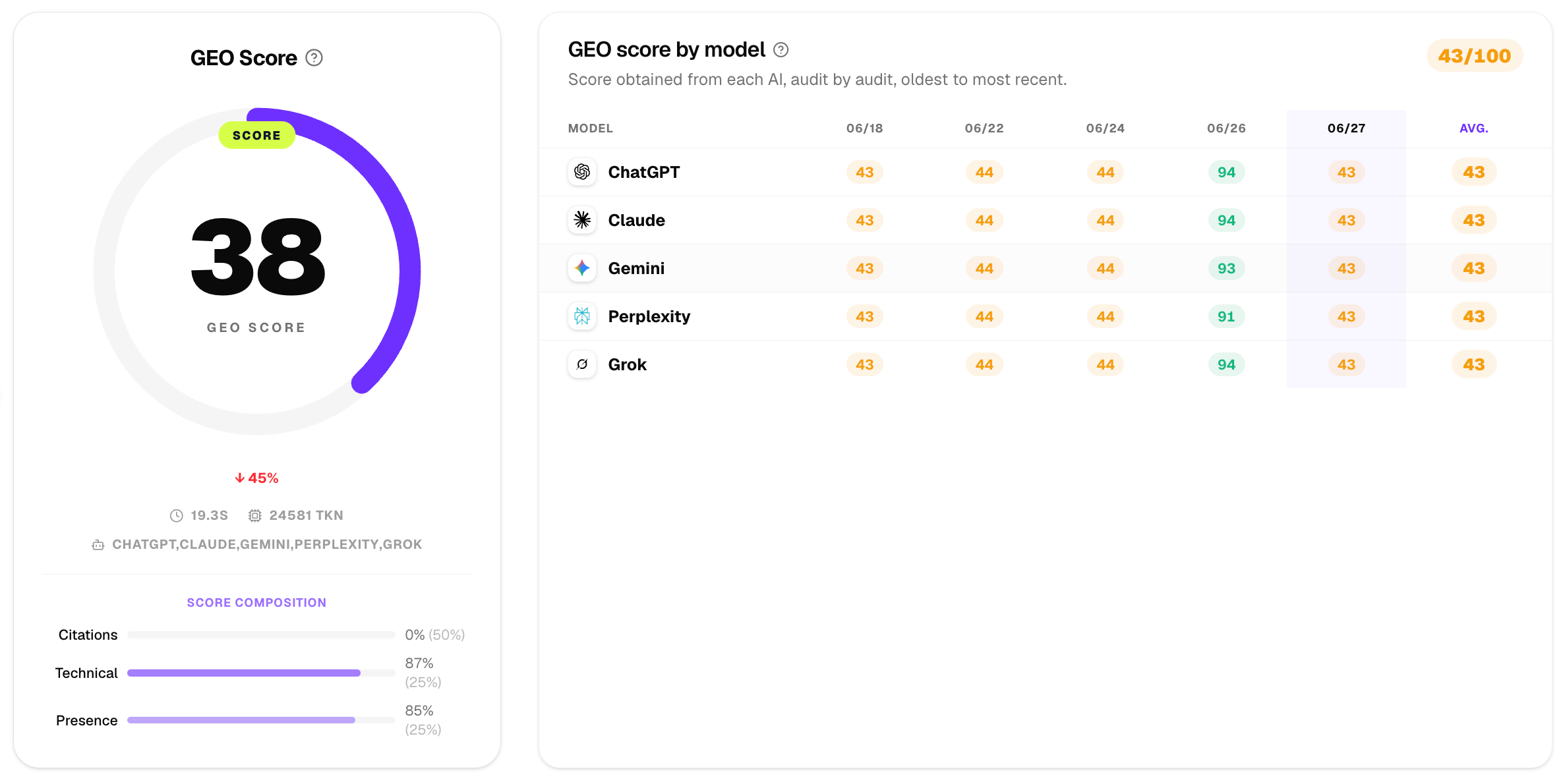
Once your content is chunked, each fragment is scored on several signals before it can make it into an answer. The main ones are semantic proximity to the query intent, factual precision (numbers, dates, verifiable definitions), the fragment's autonomy, syntactic simplicity, and the presence of structured data.
One criterion is rising across every platform: source credibility. Google formalizes it as E-E-A-T (Experience, Expertise, Authoritativeness, Trustworthiness), and that framework extends well beyond Google. For an AI system, E-E-A-T translates into detectable signals: an identified author page, cited sources, update dates, legal pages, and how often your content is itself cited elsewhere on the web.
Each platform then applies its own logic. Google AI Overviews leans on the existing index and rewards content that already ranks well. Perplexity crawls in real time and cites its sources explicitly, which rewards freshness and clean HTML structure. ChatGPT combines web browsing with training data, weighting source notoriety heavily. The common core stays the same: clarity, structure, and trust.
What are the pillars of an effective AEO strategy?
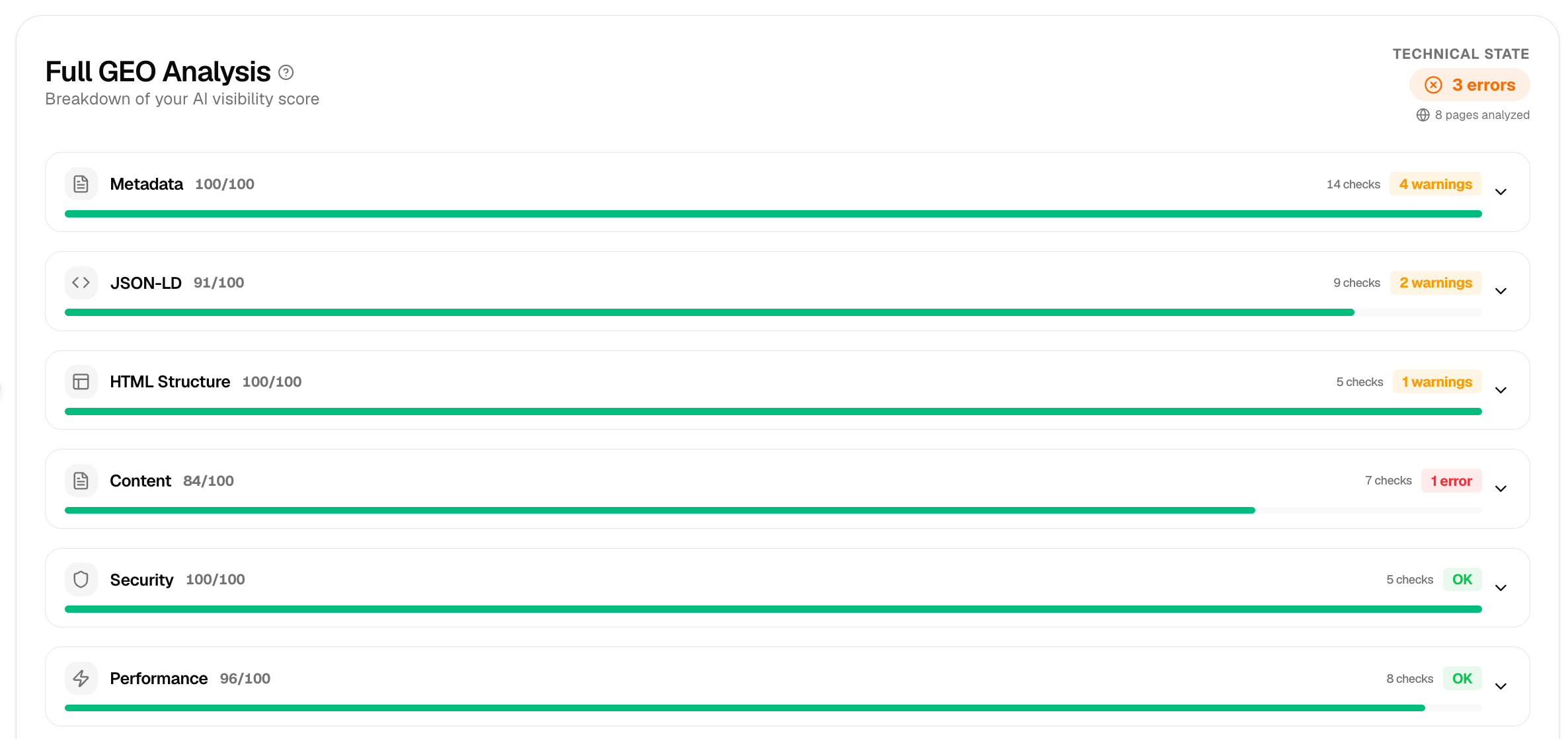
A strong AEO strategy is not one clever trick, it is the coherence of several levers. Here are the pillars to focus on, from the most accessible to the most structural.
- Content structure. One clear H1, H2s and H3s that restate real questions, short paragraphs, lists and tables for comparisons. This is the fastest and highest-return lever to activate.
- Chunk-friendly writing. Answer in the first sentence after each heading, one idea per paragraph, and avoid implicit references to earlier context. Every block should stand on its own.
- Topical authority. A site with one lonely article on AEO rarely gets cited. A site that covers the whole AI search ecosystem in depth, with identified authors and coherent internal linking, is seen as a reference.
- E-E-A-T signals. An author page with verifiable expertise, update dates, reliable sources, complete legal pages. These are proof points that answer engines can read.
- Crawlability and structured data. Content that is not accessible cannot be cited. Mark up your FAQs in JSON-LD, apply Article schema, make sure the main content is readable without JavaScript, and check your llms.txt file and how AI bots are handled in robots.txt.
These pillars do not work in isolation. It is their combination, clear structure, demonstrated authority, signaled credibility, and flawless technical access, that decides whether your content gets cited or ignored.
How to optimize your content for answer engines
Let us get practical. The first step is not writing, it is mapping the real questions your audience asks. Answer engines respond to natural-language queries that are usually longer and more specific than the keywords typed into Google. Collect the actual phrasings from People Also Ask boxes, forums, and your support team's verbatims, then sort them by intent.
Next, structure each piece for extraction. Restate the question in the text before answering it, deliver the answer in the first sentence, then expand. Use crisp definitions in the form "AEO is...", numbered lists, and comparison tables. These are the formats answer engines reuse most readily because they are directly usable.
Finally, build presence beyond your own site. AI systems heavily weight sources they encounter elsewhere in their corpus: a mention on Wikipedia, a citation in a recognized publication, a consistent listing in your industry's directories. Our guide on winning visibility in AI search breaks this mechanism down, and if Perplexity is a priority for you, our Perplexity ranking guide goes deeper.
How do you measure AEO success?
This is the question that stalls most teams, and for good reason: there is no direct equivalent of Search Console for AI answers. You cannot improve what you do not measure, so solving this is what separates a serious AEO strategy from a blind bet.
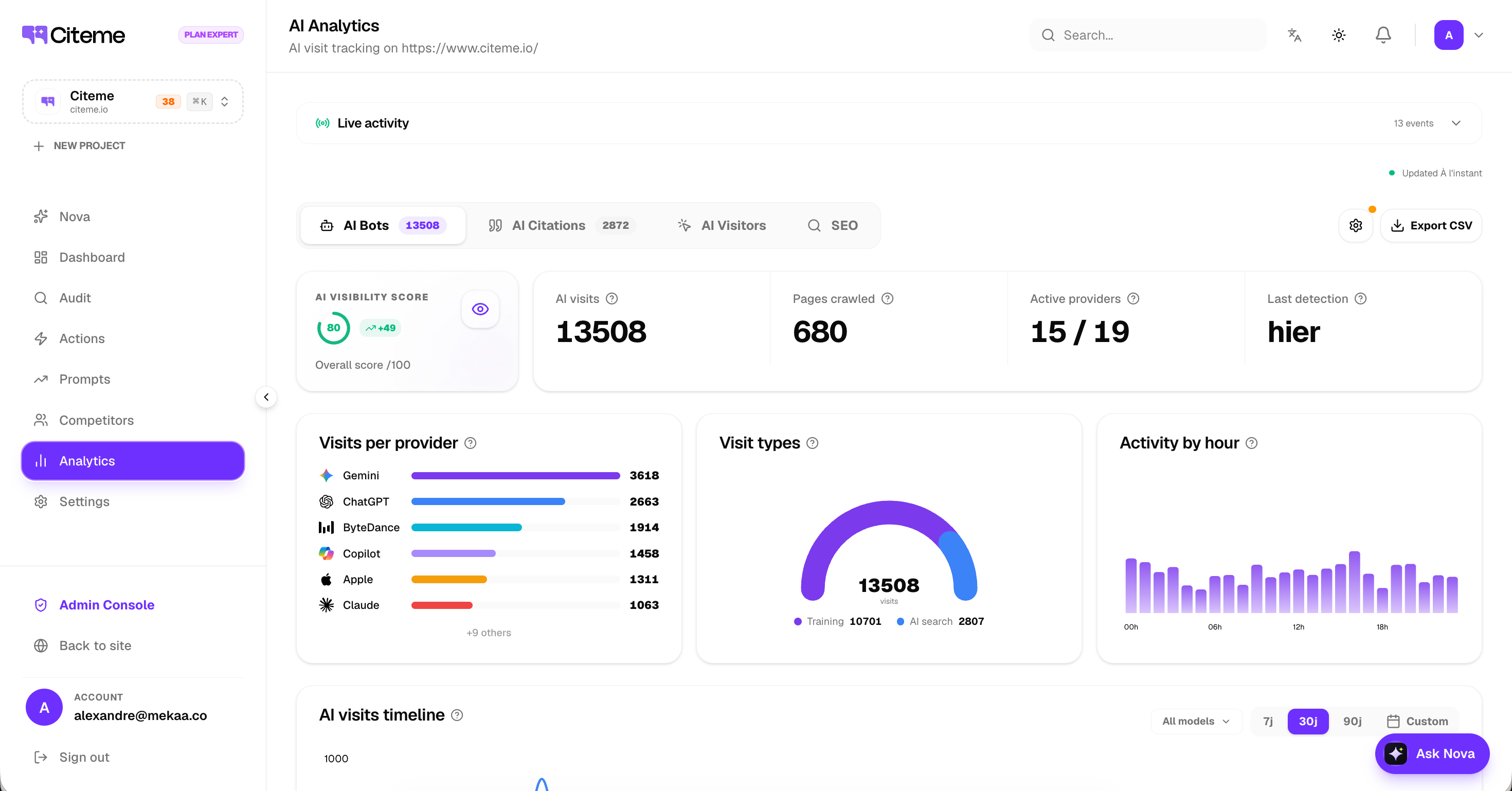
Several indicators let you track your AI visibility: how often your brand or domain is cited in the answers of the main answer engines, referral traffic from Perplexity or ChatGPT, citation frequency across a panel of target queries tested regularly, and the trend in your branded searches. Worth noting, a new metric is quietly replacing classic search volume: prompt volume, the number of prompts that trigger an answer in your topic area.
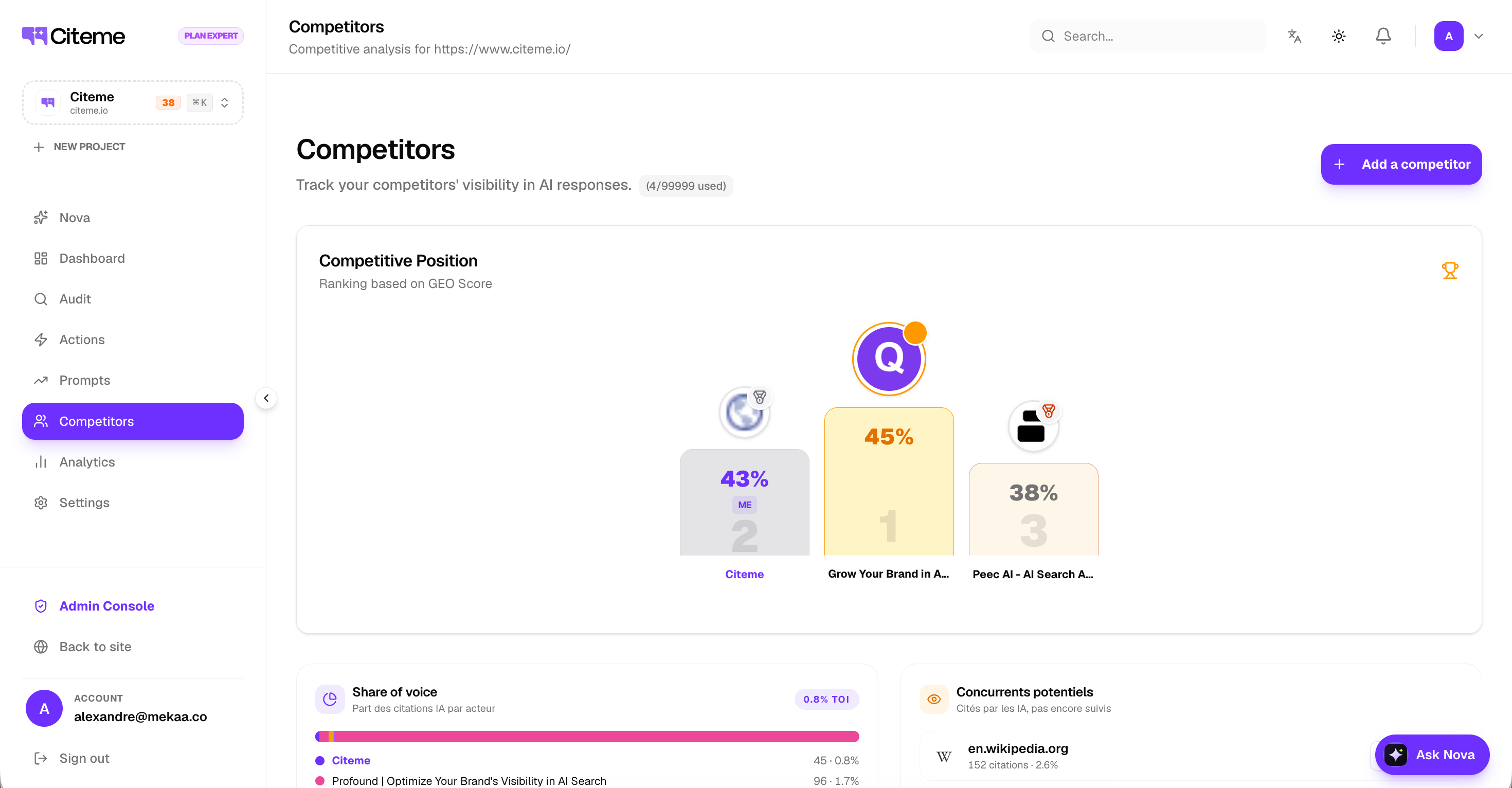
Manual tracking hits its limits fast, because AI answers vary by user and by day. That is exactly the problem CiteMe solves: automatically tracking your brand citations across ChatGPT, Perplexity, Gemini, and other answer engines, benchmarking your position against competitors, and surfacing the queries where you are missing. This kind of GEO audit turns AEO into a data-driven discipline instead of guesswork.
Should you invest in AEO or stick with SEO?
Neither, and the framing is a trap. AEO does not replace SEO, it extends it. Both share the same foundations: content quality, domain authority, technical structure. What changes is the final criterion, a position in the links for SEO, a citation in an answer for AEO.
The most advanced teams no longer separate the two in their workflows. They produce content that satisfies classic crawlers and LLMs at once: an immediate answer to the main question, structured markup, a coherent heading hierarchy, explicit definitions, and short sentences. A single writing effort serves both goals.
In short, AEO is not one more channel to fund separately. It is an additional layer of the same visibility strategy, one that diversifies your traffic sources and reduces your dependence on Google algorithm updates.
Key takeaways
- AEO means optimizing content to be cited by answer engines like ChatGPT, Perplexity, Gemini, and AI Overviews, rather than merely clicked.
- LLMs do not rank, they select: put yourself in the AI's shoes and produce fragments that are clear, self-contained, and factual.
- SEO, AEO, and GEO do not compete, they compound. The success criterion changes, not the foundations.
- The pillars of effective AEO are structure, chunk-friendly writing, topical authority, E-E-A-T, and technical crawlability.
- You cannot pilot what you do not measure: track your brand citations across answer engines to make AEO a data-driven discipline.
Frequently asked questions about AEO
Will AEO replace SEO?
No. AEO extends SEO rather than replacing it. SEO aims for a ranking in a list of links, AEO aims to become the answer itself. The two reinforce each other: content optimized well for one usually improves on the other, because they share the same foundations of quality and structure.
What is the difference between AEO and GEO?
AEO covers optimization for all answer engines, including AI Overviews and voice assistants. GEO is more specific and focuses on generative engines built on LLMs and how they chunk and weight content. In common usage, AEO often serves as the umbrella term that includes GEO.
How does answer engine optimization work technically?
An answer engine retrieves your page, splits it into semantic fragments, converts each fragment into a vector, then selects the ones closest to the query and most trustworthy to build its answer. Optimizing for AEO means producing fragments that are clear, self-contained, factual, and well marked up.
Does AEO apply to every industry?
No industry is fully exempt, but the stakes are highest where informational search dominates: education, health, law, finance, marketing, and tech. Transactional sectors are also affected for the comparison and advice queries that precede a purchase.
How long before you see AEO results?
It depends on your starting authority and the freshness of the target engines. Perplexity, which crawls in real time, can pick up fresh content within days. Engines backed by an index or training data take more patience. Either way, regular measurement is what tells you whether your strategy works.

