7 best profound ai alternatives for ai visibility in 2026
Looking for profound alternatives in 2026? Compare 7 best profound ai alternatives for ai visibility tracking, prompt monitoring and ai search optimization.

If you only remember a few things from this guide:
- Profound is excellent but priced for enterprise. Most teams need a cheaper alternative.
- A pure tracker is half the tool. Look for platforms that connect ai visibility to optimization.
- Cross-engine coverage matters more than total prompt count: 100 prompts across 5 engines beats 500 prompts on ChatGPT only.
- Real interface tracking beats api-only tracking. Api answers often differ from what real users see.
- Free trials are non-negotiable. Never buy a profound alternative without testing it on your own brand for at least 14 days.
- Pair visibility tracking with optimization workflows from the start. The improvement loop only closes when ai visibility data ships into content changes.
Profound is the loudest name in ai visibility. It is also the most expensive, with a $499 per month entry plan and an enterprise sales motion that prices out every team that does not have a six-figure marketing budget. If you are looking for profound alternatives that actually let you track ai visibility without flying to a discovery call, this guide breaks down the 7 best profound ai alternatives for 2026, what each one does well, and the trade-offs nobody mentions in the marketing pages.
This is not a regurgitated comparison list. It is the kind of breakdown you want when you have already burned a free trial on the wrong tool and need to pick the right profound alternative on the second try. If you run a brand that wants to know what ai says about your brand, when ai positions you ahead of competitors, and how to actually improve ai citation rates, read on.
In summary: The best profound alternatives in 2026 are Citeme for full ai visibility insights and optimization, Peec AI for affordable cross-engine tracking, AthenaHQ for narrative positioning, Otterly AI for entry-level monitoring, Scrunch AI for hallucination detection, Ahrefs Brand Radar for teams already on Ahrefs, and Semrush AI Toolkit for unified seo and ai search workflows.
why look for profound alternatives in 2026
Profound pioneered enterprise-grade ai visibility tracking. Its Conversation Explorer, citation analytics, and ai crawler dashboards genuinely set the standard for the category. The problem is not the product. The problem is the math.
Profound's Lite tier costs $499 per month for 100 prompts across 3 platforms. Comparable tier on Gauge: $99 per month, also 100 prompts. Comparable tier on Peec AI: €89 per month, with 4 to 5 platforms included. Even Profound's basic ai monitoring is priced like an enterprise tool, while the actual feature set has been replicated (and in some cases, improved upon) by tools that charge a fraction of the price.
There is also a structural issue. Profound is a monitoring platform, not an optimization one. It tells you where you stand inside ai search engines, but it does not help you fix the gaps. Compared to more affordable alternatives that bundle visibility tracking with content recommendations, Profound forces you to buy a second tool the moment you want to act on the data. For most teams, that double subscription is the moment they start looking for the right profound ai alternative.
what makes a real ai visibility platform, not just a tracker
Before we get into the list, here is the filter we used. Most articles on this topic confuse "ai visibility tools" with "ai search visibility tracking." They are not the same thing. A real ai visibility platform should do at least four of the following:
- Comprehensive ai search monitoring across ChatGPT, Claude, Gemini, Perplexity, and Google ai overviews
- Prompt-level analytics showing exactly which queries trigger your brand
- Citation and source attribution indicating which pages ai engines pull from
- Sentiment and narrative positioning indicating how ai describes your brand
- Optimization guidance that turns ai visibility insights into specific actions
- Ai traffic analytics measuring real referral traffic from ai engines to your site
- Visibility tracking across major ai platforms with consistent prompts on a daily or weekly cadence
If a tool only counts mentions, it is a basic ai dashboard with nice charts. The 7 tools below earned their spot because they do at least four of these well, and most of them do more.
Citeme: the most complete profound alternative for full ai visibility
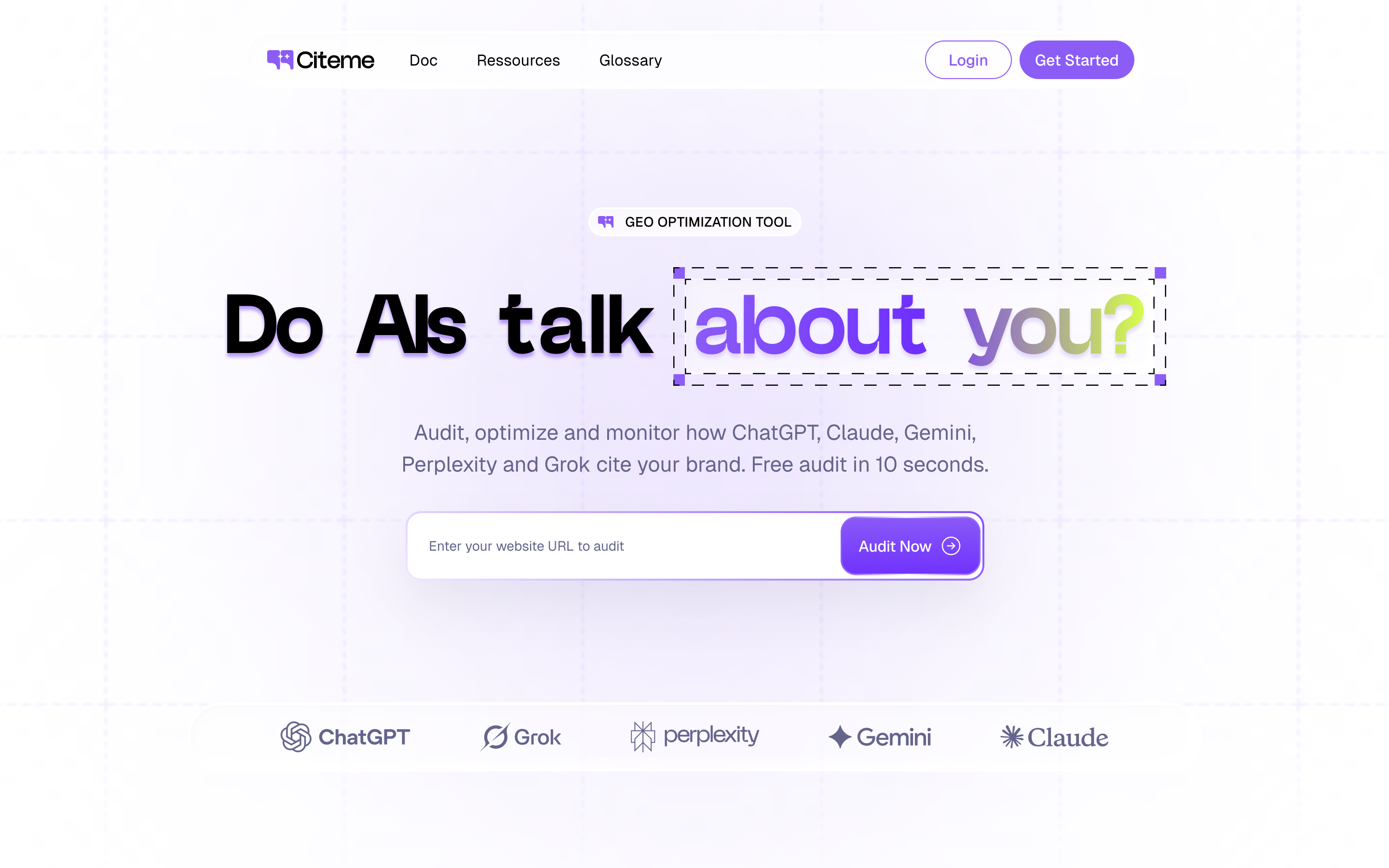
Citeme is the platform we use ourselves and the one we recommend most often as a profound alternative for teams that want full ai visibility plus optimization in a single product. It runs daily audits across 5 major ai engines (GPT-4, Claude, Gemini, Perplexity, Grok), generates a weighted GEO Score from 0 to 100, and ships a Copilot of suggestions that turns ai visibility data into concrete fixes.
What makes Citeme different from Profound is the closed loop. Profound shows you the gap. Citeme shows you the gap, ranks the suggestions by impact, and supports more than 17 cms platforms (Webflow, Shopify, WordPress, HubSpot, and others) for direct content deployment. The platform connects ai visibility tracking with executable content optimization, which is the gap most pure trackers leave open. You can read more about the methodology in the GEO resources hub or the 4-step audit process guide.
Pricing on Citeme is positioned for growing teams, not Fortune 500. There is a free trial that includes a full audit so you can see the GEO Score before committing. The opinionated take here: if you are picking your first ai visibility platform in 2026 and you do not need 200 prompts on day one, Citeme is the right profound alternative for 90 percent of teams. If you need a deeper comparison of geo tools in the same category, the best geo tool guide breaks down Citeme against Profound, Semrush, and others.
Peec ai: the leanest cross-engine alternative to profound
Peec ai is the profound alternative people pick when they want serious cross-engine coverage at a price they can defend in a finance review. It tracks brand mentions and source citations daily across ChatGPT, Perplexity, Gemini, and Google ai overviews, with a clear distinction between "your brand was named" and "your content was used but you were not credited." That second metric is something most pure ai monitoring tools miss.
Pricing starts at €89 per month for the Lite plan. That alone is a decision point: it is one fifth of the cost of Profound's Lite tier for comparable coverage. Peec also supports more than 115 languages, which matters more than people expect once you go beyond English-speaking markets.
The trade-off: Peec is a tracker, not an optimizer. There is no content workflow, no schema generator, no "fix this" recommendations. If you only need ai visibility data and you already have a content team that knows what to do with it, Peec is excellent. If you want the system to also tell you what to fix, you will outgrow it quickly.
In summary: Peec AI offers comprehensive ai search monitoring across major ai platforms at a fraction of Profound's price. It is the right profound alternative for teams that need data, not optimization, and its 115-language support makes it especially strong for global brands.
Athenahq: best for narrative positioning and ai answer framing
AthenaHQ is one of the more strategic profound ai competitors. Instead of counting citations, it analyzes how ai engines describe your brand: are you positioned as the leader, as a niche player, as an alternative, as a secondary option. That qualitative framing is increasingly important because ai systems shape buying perception before users ever click through to a website.
The platform offers prompt-level analytics, share of voice in ai responses, and source-level attribution. AthenaHQ pricing starts at $295 per month for Self-Serve (3,500 credits across 8 LLMs) and $545 per month for Growth (10,000 credits), with enterprise plans starting around $2,000. Cheaper than Profound at the entry level, but still firmly in the mid-market price band.
The honest take: AthenaHQ is overkill for solo founders and undersized for global enterprises. It is a good fit for B2B saas teams that have already validated they have an ai visibility problem and need to understand the narrative angle, not just the citation count.
Otterly ai: best entry-level profound alternative
Otterly ai is the cheapest credible profound alternative on this list. At $29 per month for the Lite plan, it is what you give your intern when you want to start tracking ai visibility next week without going through procurement. It treats ai responses like traditional rank tracking, monitoring whether your brand appears first, second, third, or not at all in answers from ChatGPT, Claude, Perplexity, and Gemini.
The visual ranking reports are designed to be readable by stakeholders who do not know what a citation is, which sounds trivial until you have spent two hours explaining ai search optimization to a CMO who just wants a chart. Otterly leans on consistent prompt testing, refreshed daily, with sentiment and citation tracking layered on top.
Where Otterly falls short is depth. Prompt limits are tight on the entry plan, content optimization is non-existent, and tracking happens at the api level rather than through actual ai interfaces. That last point matters more than people realize: api responses often differ from what real users see in the consumer ChatGPT or Perplexity ui. For surface-level ai visibility monitoring, Otterly is fine. For decisions that move budgets, you want something more rigorous.
Scrunch ai: best for hallucination and accuracy detection
Scrunch ai is the only major profound alternative that takes hallucination detection seriously as a first-class feature. It alerts you when ai engines describe your product, your pricing, or your features incorrectly. That is not a vanity metric: hallucinations actively cost deals when prospects show up to demos with the wrong understanding of what you sell.
The platform raised $19 million in funding and currently serves more than 500 brands, with clean ui and ga4 integration for ai traffic attribution. It tracks visibility across ai search and isolates replacement patterns: when your visibility shifts down, Scrunch shows you which competitor took your slot. That comparative angle is where it pulls ahead of pure monitoring tools.
Scrunch is also more focused than the other profound alternatives. There is no content generation, no schema toolkit, no ai content workflow. It does one thing (accurate ai visibility monitoring with anomaly detection) and it does it well. Pricing is per quote, which is the usual signal that you are entering enterprise sales territory.
Ahrefs brand radar: best profound alternative for existing ahrefs customers
Ahrefs Brand Radar is the most pragmatic profound alternative if your team already pays for Ahrefs. Instead of building yet another standalone ai visibility tool, Ahrefs layered ai citation tracking on top of its existing backlink and authority infrastructure. The result is a brand visibility view that connects ai overviews coverage with the underlying domain authority signals that influence which sources ai engines trust.
The reporting integrates with Ahrefs Site Explorer, so you can see not just where your brand appears in google ai overviews but also why: which pages are getting cited, what their backlink profile looks like, and how that compares to competitors. For teams that think of ai visibility as an extension of seo and ai search, this connects ai visibility back to a familiar dataset.
The catch: Brand Radar is not a complete ai visibility monitoring solution. Coverage of ai engines is narrower than dedicated tools, and you cannot run prompt-level analytics with the same depth as Citeme or Profound. If you are already an Ahrefs customer, this is a reasonable add-on. If you are not, it is not a strong enough reason to switch your seo stack.
In summary: Ahrefs Brand Radar is the right profound alternative for teams already invested in Ahrefs who want ai citation tracking layered on top of existing backlink and authority data. It is not a replacement for a dedicated ai visibility platform if you need full ai search performance analytics.
Semrush ai toolkit: best for unified seo and ai search workflows
Semrush AI Toolkit is the second consolidation play, this time for teams that already use Semrush as their seo backbone. The Brand Radar feature inside Semrush tracks brand appearances across ChatGPT, google ai overviews, Gemini, and Perplexity, alongside Semrush's existing keyword and competitor data. Ai keyword suggestions and the AI Content Helper round out the optimization side.
The pitch is consolidation. Semrush One at $199 per month includes seo plus ai visibility for 5 sites, while Profound's Growth plan at $399 per month gives you ai monitoring for one brand on 3 engines. The math heavily favors Semrush for teams that already use it for traditional seo and want ai search visibility tracking added on top.
Two cautions worth flagging. First, multiple Capterra and Trustpilot reviewers reported unexpected charges after the free trial in early 2026, so test billing carefully. Second, Semrush's ai layer is broader but shallower than dedicated tools: prompt-level depth is limited, and there is no real ai catalyst layer that turns ai visibility insights into specific content optimization actions the way Citeme or Writesonic do.
Comparison table of the 7 best profound alternatives in 2026
How to choose the right profound ai alternative for your team
The right profound alternative depends on three things: how mature your ai visibility program is, how much budget you can defend, and whether you also need optimization workflows or only data.
For teams just starting out and exploring ai visibility, Otterly AI at $29 per month or a Citeme free trial are the right entry points. You want something that gets you running visibility tracking inside a week, not a 6-week procurement cycle. For mid-market b2b saas brands that need cross-engine tracking and a real ai answer view, Citeme and Peec AI are the obvious picks, with Citeme winning on optimization and Peec winning on price-per-prompt at scale. For enterprise teams that need narrative analysis or hallucination detection, AthenaHQ and Scrunch sit in different but adjacent niches. According to a 2026 GEO report from NoGood, more than 60 percent of consumers now use ai assistants for product research and discovery, which is what makes ai visibility a board-level priority for the brands taking this seriously.
If you already have a stack, the integrated plays (Ahrefs Brand Radar, Semrush AI Toolkit, SE Ranking's ai search visibility features) save you a second login and consolidate billing. They are rarely the deepest ai visibility platforms, but they are the most pragmatic option for teams that do not want to manage another vendor. To understand the broader category logic, the seo vs geo guide explains why these tools are now strategic, not optional.
Conclusion
The 7 best profound ai alternatives in 2026 are Citeme, Peec AI, AthenaHQ, Otterly AI, Scrunch AI, Ahrefs Brand Radar, and Semrush AI Toolkit. Each one solves a different version of the profound problem: too expensive, too monitoring-only, too deep when you wanted simple, too shallow when you wanted complete. The right profound alternative for your team is rarely the most popular one. It is the one that matches your visibility stage, your stack, and your willingness to act on the data.
If you want to see what an ai audit looks like on your own site, the Citeme free audit runs the same kind of multi-engine analysis on any url, no signup, no sales call.
Your competitors are already in AI answers, Why aren’t you?

Maël Bourdin
Co-founder, Citeme
